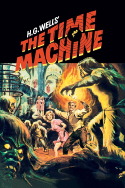
Review of The Time Machine (1960) by Mel V — 01 Feb 2009
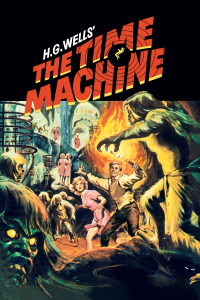
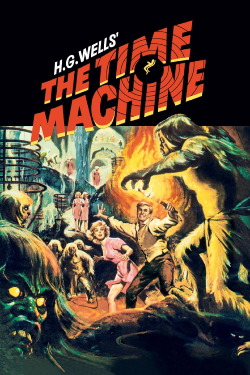
Over a career spanning five decades, George Pal produced fourteen feature-length films. Of those fourteen films, only two didn?t include science fiction or fantasy elements ([i]The Naked Jungle[/i], [i]Houdini[/i]). The rare producer (and occasional director) with auteur-level credentials, Pal?s feature-film output reached its peak in the 1950s, beginning with [i]Destination Moon[/i] in 1950, and continuing through [i]When Worlds Collide[/i] in 1951, an adaptation of H.G. Wells? 1898 novel, [i]The War of the Worlds[/i] in 1953, [i]Conquest of Space[/i] two years later, and ending with an adaptation of H.G. Wells 1895 novel, [i]The Time Machine[/i] in 1960 (Pal also directed). Despite dated visual effects and even dated racial and gender politics, [i]The Time Machine[/i] remains one of the better adaptations of H.G. Wells? novels.
H.G. Wells never gave the main character in [i]The Time Machine[/i] a first or last name. He?s introduced only as the Time Traveler remains nameless throughout the novel. For the film adaptation, Pal and his screenwriter, David Duncan, gave the Time Traveler his creator?s name, H. George Wells (Rod Taylor). His friends, David Filby (Alan Young), Anthony Bridewell (Tom Helmore), Walter Kemp (Whit Bissell), and Dr. Philip Hillyer (Sebastian Cabot), call him ?George? and not ?Herbert? (Wells? first name). In the first scene set on December 31st, 1899, a bedraggled George returns home abruptly after a five-day absence with a fantastical story: he?s traveled to the distant future in his homemade, sled-like time machine.
[i]The Time Machine[/i] subsequently unfolds through flashbacks as George narrates his voyage through time aboard his time machine. As he travels through time, he sees the days, months, and years pass quickly, with a mannequin in a store window across the road hinting at cultural and social changes through fashion. He first stops in 1917 during the first World War, where he learns about the premature death of a friend in the war, then on to World War II and 1940, as the skies are filled with bomber planes, followed by a stop in 1966, as nuclear bombs fall on London, triggering volcanic eruptions. With each stop, George becomes increasingly discouraged by the seemingly endless war he sees.
His last jump takes him to a lush, overgrown London in the year 802,701. With the exception of a pyramid and a semi-dilapidated dome, man-made structures have disappeared. Exploring, he finally discovers the blonde and blue-eyed Eloi. As the Eloi look on dispassionately, George rescues a young Eloi, Weena (Yvette Mimieux), from drowning. The Eloi have become incurious and passionless through centuries of comfort and security. George, however, soon discovers the Morlocks, an underground dwelling species and the real masters of the Eloi, have stolen his time machine. Before he can recover his time machine, the Eloi, including Weena, are called into the pyramid by an air raid siren. The Eloi who enter the pyramid never return to the aboveground world.
Before he begins time traveling, George recoils in horror when one of his friends suggests turning the time machine into a weapon against Britain?s enemies. His three major jumps in time lead him to three separate, but related wars (thus the anti-war theme). His last jump takes him into a post-apocalyptic future. The Eloi and the Morlocks duplicate Victorian class structure, a structure echoed in Fritz Lang?s 1924 science-fiction classic, [i]Metropolis[/i], and that foreshadowed [i]Planet of the Apes[/i] eight years later, but where Lang optimistically envisioned good-faith cooperation between the ruling and working classes, Wells and Pal saw endless class conflict between the aboveground and belowground species, with one species literarily using the other as food, foreshadowing 1984?s C.H.U.D. (Cannibalistic Humanoid Underground Dwellers). Wells and Pal also see too much leisure and too much comfort leading to incuriosity and the loss of creative pursuits, including art and science.
Surprisingly (for contemporary viewers at least), [i]The Time Machine[/i] won the Academy Award for Best Visual Effects in 1961. Due, in part, to his background in animation and his involvement with Puppetoons in the 1940s, Pal pushed visual effects technology with every feature film he produced. For [i]The Time Machine[/i], Pal relied on a combination of time-lapse photography, stop-motion animation, miniature work, matte paintings, makeup, and costumes to create Victorian England and the various futures the Time Traveler encounters. While the visual effects are more than passable, they often fall short of then contemporary standards (e.g., sloppy, seams-showing matte work). The Morlocks were created through a combination of white, loose-fitting white wigs, red light bulbs, facial appliances, and green greasepaint, making them, at best, laughable.
Dated effects can (and should) be forgiven, but [i]The Time Machine?s[/i] gender and racial politics are harder to overlook, even if viewed within the context of the pre-Civil Rights, pre-Vietnam, pre-feminist era. The lone female character barely rises out of her passivity, even when her life is in danger near the end of the film. As ?our? future descendents, the blonde, blue-eyed Eloi show Pal and Duncan at their worst. In Wells? novel, the Eloi are identifiably human, but diminutive in stature. They also don?t speak English as they do in Pal?s film. They also seem to understand concepts like ?government? and ?law? with little prompting from George (they have none). What they learned, they?ve picked up from talking ?rings? found in a dusty, disused library (they can?t read either), making Pal?s choice all the more egregious, one of the few things the 2002 adaptation/remake altered for the better.
This review of The Time Machine (1960) was written by Mel V on 01 Feb 2009.
The Time Machine has generally received positive reviews.
Was this review helpful?