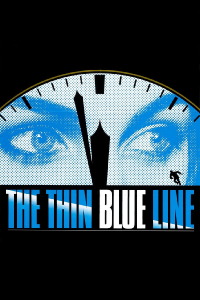
Review of The Thin Blue Line (1988) by Jerry R — 10 Aug 2012
It is odd the things that captivate me. Late at night sometimes I indulge in those forensic shows like "American Justice" or "Forensic Files", those shows about horrific true crimes that are put together like a murder mystery from beginning to end. They are great if you can forget the fact that you are watching a show that is basically put together for entertainment purposes, but is focused on human suffering. I try not to think about that part.
Those shows are all the same. We see family photographs, file photos of the crime scene and some of the evidence. We hear from officals, family members, friends, co-workers, all talking about the deceased. Sometimes while watching those shows, I wonder how they would play out if they were directed by Erroll Morris.
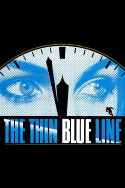
Morris is one of my very favorite filmmakers. His documentaries always have an odd visual palette to make his point. He is interested in the obsessions of the human heart, of odd people, with odd priorities and obsessions. His films may resemble others you've seen in subject matter but they march just a little different. Take, for example, The Thin Blue Line, a movie that recalls the 1975 shooting of a Texas police officer named Robert Wood. Wood was shot and killed during a routine stop in which he intended to inform the driver that they were driving without their lights on. Wood's ticket book was still in his prowler, so he only intended to issue a friendly reminder to the driver. Instead he was shot three times with a small caliber pistol.
The man arrested for the crime was a drifter name Randall Adams who is interviewed in this documentary, was serving a life sentence for murder. His name was given to police by a 16 year-old trouble maker named David Ray Harris, who confessed to the crime to his friends when he saw it reported on television. He led police to the car, which contained the .22 caliber murder weapon and fingered Adams as the killer.
Adams came from Ohio and had been living in a motel with this brother. He was arrested for the crime and then, during interrogation was handed a form with a confession and told to sign it. He refused and the officer threatened to shoot him if he didn't. "I don't know how long I was in there", he says in an interview, "but it was long enough that I smoked two packs of cigarettes.".
We see Adams all through the film, a nice enough fellow, literate and intelligent. Still sitting in prison on a life sentence, he has a keen insight into explicit details that fit more accurately than anyone else in the film. He takes us back and forth through his ordeal as do others who were involved, officials, friends, eye witnesses, family members. What is interesting is that Morris presents the interviewees, not in the standard head-and-shoulders shots but with odd lighting that makes us pay attention to their faces. That's always been his specialty, he wants us to look a little deeper into the faces of his subjects.
The most memorable moments of The Thin Blue Line are Morris' trademark visuals. He reenacts the crime and the events before and after with an odd visual style. He has close ups of the 1973 Mercury Comet that the killer was driving, always focusing on the headlights and on the number on the license plate that Wood's partner couldn't remember. Over and over he returns to the scene of the crime with Wood approaching the car, his long shadow seen moving forward. He even features the Burger King milkshake that the killer had, tumbling through the air as it splatters to the ground after the shooting. He's even interested in the moments when Adams and Harris went to the late show at the drive-in, focusing on a clip from the movie, "The Swinging Cheerleader".
What Morris does is to reconstruct the crime moment by moment. He returns to the minutes of the crime to give us, the viewer a mental timeline of the events as the testimony comes down from his witnesses. What comes to us at the end of the film is a clear idea of exactly what happened, how it happened, who told the truth and who lied.
What is even more fascinating is that The Thin Blue Line might never have come to light if Morris had stuck to his original plan. He had gone to Dallas to interview Dr. James Grigson, a psychiatrist who had identified, in half a dozen cases, which murder suspects were sociopaths who would kill again if released. Morris had interviewed Randall Adams while gathering information about Grigson and then interviewed David Harris and found that the story didn't add up. Therefore he shifted focus and The Thin Blue Line is the result.
Here we have another example of Morris' style. In his other films, he focused solely on his subjects. Gates of Heaven, was about the owners of a pet cemetery in Southern California; Vernon, Florida was about various weirdos in the title town including a man who lives, breaths, eats and sleeps and dreams turkey hunting; A Brief History of Time was about the life and theories of Stephen Hawking who discusses his understanding of the vastness of the universe while suffering from a condition that renders him almost completely unable to move. Here he takes his fascination for details and odd human behavior and turns it into a in-depth look at a senseless crime that was mishandled and led to a man being railroaded to prison.
Note: As a result of the publicity surrounding this film, Adams was granted a re-trial. He was released from prison as a result of a haebius corpus in 1989.
This review of The Thin Blue Line (1988) was written by Jerry R on 10 Aug 2012.
The Thin Blue Line has generally received very positive reviews.
Was this review helpful?