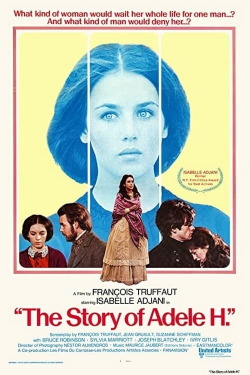
Review of The Story of Adèle H. (1975) by Andrew L — 15 Nov 2009
Entering Halifax, Nova Scotia, Canada by dull-lighted small rowboat transporting but a few passengers is a rather determined and beautiful young lady. Opting to stay at a boarding house and not a nearby hotel, she gives her name to the coachman and the owner of the house as Miss Lewry. Any individual can thus discern that this is a pseudonym, an alias, a cover, and we are afterwards informed by her half-hearted attempts at secrecy that she is the second daughter of the famous French author Victor Hugo, younger sister of Leopoldine Hugo?Leopoldine who, at the age of 19, drowned.
Her name, though, has not brought her here to Halifax, no, it was love: a passionate and all-consuming love that tortured her frail person to a truly cinematic degree. Adèle Hugo (Isabelle Adjani) has followed Lieutenant Albert Pinson (Bruce Robinson) here to marry and keep him, but upon first meeting it is evident that there are obstacles: one, Albert?s conviction that her parents will not consent; and two, that Albert himself may not share her prominent feelings, and her endeavor to elicit his emotions will only exacerbate their respective lives. This, though, will not stop Adèle from trying to retreive him and change his mind, even when she finds him with another woman: she will, with help from her late sister, continue to impress, to adapt, to propose endearing sentiments of faithful, tearful love. ?Since I can?t have the smile of love,? she says, ?I condemn myself to its grimace:? unlike her sister, she will not drown.
One of director François Truffaut?s most impressive films, it takes its roots from the diaries of Adèle Hugo, whom Roger Ebert thinks ?must have seemed the ideal Truffaut heroine.? The film is filled with intense, engrossing scenes: for example, the first meeting between Adèle and Albert in Halifax: hesitant Adèle unable to choose a dress (white, red, blue, representing her struggle with her differing emotions) before deciding on a fragile-looking light-blue gown in which to appear; their conversation, especially heated and heartfelt by Adèle; a firm, set jaw and simple exit by Albert leaving a distraught, disconcerted Adèle in tears. That ardent quality, that obsessive behavior, beautifully and tragically shown by actress Isabelle Adjani is what earned her an Oscar nomination and considerable success for her and for Truffaut thereafter. A fascinating film, a powerful performance and a stimulating study of the harsh and hard effects of unrequited love on a sensitive soul.
This review of The Story of Adèle H. (1975) was written by Andrew L on 15 Nov 2009.
The Story of Adèle H. has generally received positive reviews.
Was this review helpful?