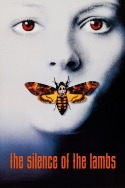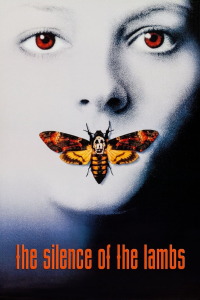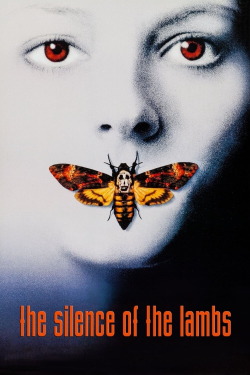
Review of The Silence of the Lambs (1991) by Mike S — 19 Apr 2015
"Amputate a man's leg and he can still feel it tickling. Tell me mom, when your little girl is on the slab, where will it tickle you?".
Being part of pop culture can be a good thing or a negative thing. For a film like The Silence of the Lambs, it's a negative thing.
The Silence of the Lambs was a film that was probably a bigger hit than it needed to be. I don't say that because it wasn't a great film, but because films of this type, aren't generally that successful. It came at a time in movies, when proper serial killers were not as commonplace as they are now, and were poorly written and cliché. It has spawned many imitators and influenced many TV shows, such as Criminal Minds.
Silence of the Lambs follows the basic rule. Don't show us the gore, leave it to our imagination. There is little violence in Silence of the Lambs, and what violence or gore there is, is well placed and tactful: The old lady decomposing in the bath; the head in the jar; and even the most action packed moment of the film, when Hannibal strings up one of his guards, the film hides the gore, leaving you questioning what you just saw.
The film is packaged like a horror film, but it isn't a horror film. It's a psychological thriller, based on character development, most notably, that of Clarice Starling. Jodie Foster is at her best here, handling the big moments well, but underplaying everything, keeping Starling realistic, with the right amount of determination to over ride the obvious fear and insecurity she has.
It's Hopkins' Hannibal that pop culture has softened the most, causing the film to lose some of its standing in recent years. This is not Hopkins' fault. He is faultless and plays Hannibal very much as the gentleman trapped in an insane mind. The endless parodies and references to his character over the years have turned his character into something else, and the follow up movie, Hannibal (which was in no way like the very disturbing and bizarre book) further diminished the character. However, he had a much better turn in the very under-rated Red Dragon, a prequel to Silence, where Hopkins, despite clearly being much older than he was in Silence, brings back a real nastiness to Lecter. Throughout the trilogy, Hopkins gets to play his character in three stages of his life. In Red Dragon he is bitter and angry. In Hannibal he is free and more relaxed. However, in Silence, he is intrigued and entertained. He is still angry and bitter, but he see's something in Clarice that interests him, and that interest awakes something in his character. His inability to help himself though is shown, when he can't help but insult the senator who has promised him rewards for information about her daughter's abductor.
The film excels in its pacing and structure. The biggest success is the escape scene, when the films plot has to stop for ten minutes whilst we focus on Hannibal, but the film turns this scene into a mini movie within the movie. This scene has no bearing on the plot of the film, and yet is so vital its overall effect. And the reveal at its conclusion is a twist worthy of a full two hour movie.
But what was mostly overlooked, and under appreciated at the time that the film was getting every award under the sun, was the stunning performance by Ted Levine as Jame Gumb. Gumb is seriously disturbed, but he isn't flashy in the way he is portrayed. He is almost child like in many scenes, and he casts a depressing shadow on every scene he is in. Like Hannibal, he has been parodied endlessly ('it rubs the lotion on its skin or else it gets the hose again') and some have misinterpreted his character as being the typical 'homosexual killer' that was badly used in so many movies throughout the 1980s. But Gumb is not a homosexual. As Lecter says "he tries to be. He's tried to be a lot of things I'd imagine". His character is well layered and complex, and in some ways appears harmless. Levine's best moment is when he is face to face with Starling and he realises she has worked out who he is. He gives a subtle smile, indicating his great enjoyment at being caught, before he sneaks away and gets the upper hand.
The film has an amazing tone. The film feels cold and damp, much like the weather we see throughout. When they pull bodies out of the water, they feel dirty and cold. You feel you're part of it and not watching through a screen. The autopsy scene is a great example. There is no use of gore to over play the horror. It's enough that this young woman was killed and dumped in the river. You don't need a bloody image to go with that. The music is also great, with an old fashioned score that has a strong feeling of sadness, yet enough tension to create a feeling of dread within the viewer.
It won all the major categories at the Oscars and deserved every one of them. Watch the film without thinking of the parodies, and without comparing it to other more recent films where you might feel this film has little going on. It's not glossy and it's not stylised. It is a slow, dark, menacing film that should be remembered as one of the best of its genre.
This review of The Silence of the Lambs (1991) was written by Mike S on 19 Apr 2015.
The Silence of the Lambs has generally received very positive reviews.
Was this review helpful?