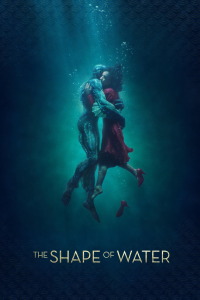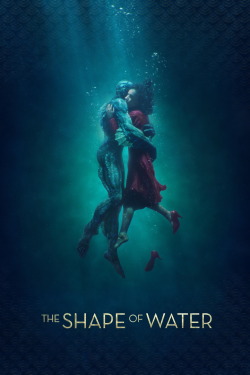
Review of The Shape of Water (2017) by Hasseina S — 16 Dec 2017
Gather together the essentials that embody a fairy tale. Add a generous coat of rustic and dreary colored paint. Draw a bath, and gently lower the needle onto your favorite french album on vinyl. The Shape of Water is a myriad of emotions, and flows as whimsically as the aged foreign cinema that it endears oh so much.
The backdrop is set in the Cold War era, a time of civil and racial unrest. Murmurings of Soviet espionage echo throughout-while, on the surface, the top powers of the world race to put their strengths and achievements on display for all to see. Eliza (Sally Hawkins) works janitorial services in an underground US lab that houses some of the countries most twisted and inhumane experiments. Upon discovering a peculiar specimen residing in the water, the movie then sets sail for an uncanny romance unlike any other.
Like most fairy tales, we have a princess and a prince. Our heroine is without words, and communicates via sign and body language. Our prince is of the mythos of the sea; a curious and elegant amphibian-like humanoid, and one that is also without words. Director Guillermo del Toro takes the trials and tribulations of an impossible romance to its furthest bounds, and meticulously interweaves the supernatural into the film's core.
The Shape of Water provides almost an overwhelming amount of qualities that noteworthy filmmaking consists of. To start, the film is nearly perfectly divided into individual acts; ones that transition to the next seamlessly. Each segment not only draws immediately from its preceding partner, but continuously increase the return value on all prior events. The pacing and balance were like that of a spiral staircase; each step provided equal footing. No storyline or character was without purpose, and each played a pivotal role in leading up to the final conclusion.
Music also presents itself in atmospheric and thematic fashions. As a device that can provide common ground between two otherwise incommunicable parties, it's no surprise that it makes several key appearances. Artists like Frank Sinatra, Ella Fitzgerald and Jo Stafford can all be heard, and pair pleasantly with each of their corresponding scenes. The original score also does a tremendous job of creating serenading melodies that link most of the vocal tracks together.
Visually, the film touches on quite a few memorable points of imagery. At the forefront, water is present in nearly every scene-ranging from droplets on a bus window, to a torrential downpour, or a loving embrace in the midst of it all. The main scenery consists of a rotation between the dreadful and lifeless laboratory, to the mundane, autonomy of everyday life. The distinct separation between the two, and then eventual overlap is about as aesthetically pleasing as it gets. Odes to old cinema and music are also present, and add a sort of novel feel to the already well-developed atmosphere.
Sally Hawkins and Michael Shannon highlight the fairly small cast of characters. Their shared scenes include both moments of intensity, and surprising candor. Hawkins's performance should be in prime contention to win Best Actress by year's end, as she's a quintessential example of doing less with more. Her expressions and movements often convey far more than what speech is capable of, and feelings of heartbreak and glee become that much more amplified. Michael Shannon does well to escape the mold of a one-dimensional antagonist. His actions aren't without deliberation, and never feel impulsive. The conflicts caused by the two characters are both painful, yet necessary, and add even more worth to the film's entirety. Octavia Spencer and Richard Jenkins round out the rest of the core cast members. Their storylines, while small, did well to encapsulate a lot of social and cultural issues present during that time period.
If you're wondering where my criticisms of the film are-well-I'm afraid you won't find any. The Shape of Water is an amazing achievement of what filmmaking provides as a medium. It adheres both to that of a child-like wonder and matured pessimism. It stands firmly as an imaginative period piece, as well as unadulterated, offbeat romance.
Del Toro breathes life into lifeless scenery. He uses ageless themes of the unknown, and love, and wonder as a bridge to connect this 1960's drama to present day emotions. One of the most rewarding parts of engaging in cinema is to be whisked away by unfathomable or unrealistic tales that elude typical lives. The Shape of Water is that exact sentiment, with the added bonus of immediate, current-day relevancy.
This review of The Shape of Water (2017) was written by Hasseina S on 16 Dec 2017.
The Shape of Water has generally received very positive reviews.
Was this review helpful?