Review of The Searchers (1956) by Nick R — 22 Apr 2013
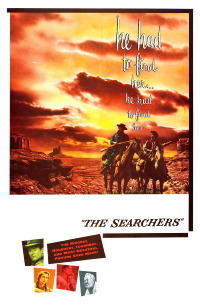
The Searchers opens on a shot of a desert landscape seen from inside a house. Someone is approaching on horseback. It is Ethan Edwards (John Wayne), returned from the Civil War to his brother's ranch in Texas. From a series of looks and gestures we realize that Ethan is in love with his brother's wife, Martha (Dorothy Jordan). Next day he departs with a party of Texas Rangers in pursuit of Indians who have stolen some cattle. While he's away Comanches attack the ranch, killing Ethan's brother and sister-in-law and capturing their two daughters. For the remainder of the film, in actions set over a period of five years, Ethan and his part-Indian companion Martin (Jeffrey Hunter) crisscross the West in search of the girls.
How did John Ford turn this simple story into one of the greatest of all Westerns? First, there's the setting. Ford shot many Westerns in Monument Valley, an isolated region on the border between Utah and Arizona. The eroded red sandstone rocks are an awesome spectacle, and Ford's unerring eye for composition invests them with a special aura. The sheer size of the landscape makes the human figures seem especially vulnerable, and the life of the Texan settlers precarious. How could anyone scratch a living in such a barren wilderness?
At the heart of the story, though, is the figure of Ethan Edwards. As played by Wayne, Ethan is a colossus, overwhelming and indomitable. But he has a tragic flaw. Ethan is eaten up with hatred of the Indians, and it becomes clear that his quest is driven by an implacable racism. His intention, as Martin discerns, is not to rescue Debbie (Natalie Wood), his surviving niece, but to murder her. In Ethan's view she has become irredeemably contaminated through contact with her Comanche captors. Slowly we realize that the Comanche chief Scar (Henry Brandon) functions as a kind of mirror image of Ethan. In raping Martha before he kills her, Scar has performed a horrific travesty of the act that Ethan secretly dreamed of committing. Ethan's urge to kill both Scar and Debbie thus arises from his need to obliterate his own illegitimate desires.
The true genius of The Searchers is in its being able to keep the audience's sympathy for Ethan, despite the evident fact that he is a murderous racist. In doing so, it elicits a far more complex and productive response than that of more obviously liberal films in this vein, such as Broken Arrow (1950). Instead of preaching a message, Ford leads us into the complexities of the American experience of racial difference.
Along the way there are many other pleasures, including marvelous score by Max Steiner and plenty of comedy from stalwarts of the John Ford Stock Company such as Harry Carey Jr., Ken Curtis, Hank Worden, and Ward Bond. Vera Miles is excellent as Marty's girlfriend Laurie, whose mother is played by Olive Carey, widow of Ford's first Western star, Harry Carey.
In 1992, The Searchers was voted the fifth greatest movie of all time in a poll of international film critics held by Sight & Sound magazine. That's quite an accolade, but Ford's picture lives up to it.
This review of The Searchers (1956) was written by Nick R on 22 Apr 2013.
The Searchers has generally received very positive reviews.
Was this review helpful?