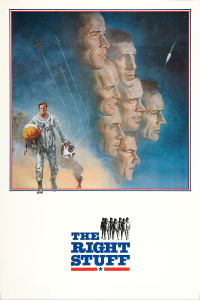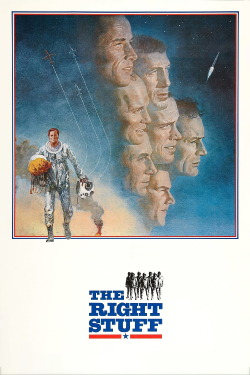
Review of The Right Stuff (1983) by Emanuel D — 17 Jul 2007
One small step for man ?
This is the story of the time just before that small step. This is when man learnt to crawl in space. It is the beginning of our peep outside the window of the very limited, insignificant space we occupy in the universe. It is the spirit that drove American science-fiction of the 60s and the idea of boldly going where no man has gone before. This is that same Buck Rogers/James T. Kirk spirit but in science-fact.
The story starts with the breaking of the sound barrier. The film opens with a narrator on a flight through the clouds reminiscent of the opening of Dr Strangelove: ?There was a demon that lived in the air. They said whoever challenged him would die. Their controls would freeze up, their planes would buffet wildly, and they would disintegrate. The demon lived at Mach 1 on the meter, seven hundred and fifty miles an hour, where the air could no longer move out of the way. He lived behind a barrier through which they said no man could ever pass. They called it the sound barrier.?
Chuck Yeager (Sam Shepard) will be the fastest man alive, confronting that demon in what to our eyes is a creaky, rickety peace of flying equipment and proving the demon does not exist. That gung-ho energy and will to defeat limits justifies the statistical likelihood of death while trying.
It seems that these test pilots throw their lives lightly and willingly in the process of research on how to push back the limits of the technology of movement. It is not that their death is absolutely necessary to the research process. This is especially true when these test pilots work on flying into space, a feat entirely controlled from the ground and that quite literally monkeys could do better.
But humans are necessary because the march to go faster and higher and eventually the race to the moon is not simply a game for German scientists working for the Americans and the Soviets. It is that. But it is also an important cold war front of propaganda and dramatic achievement. Tragic deaths are episodes of heroic failure that are as necessary as glorious victories and ticker-tape parades down New York esplanades.
Perhaps the most important process of this film is the contrast between the secretive, dusty, private life of the Air Force test pilots in the desert and the extremely public nature of the space program. Notice the transition of the shy Edwards veterans at their first press conference in the space facility. They are quick to follow the example of the more TV savvy John Glenn (Ed Harris) and quickly coin phrases and speech lines that would combine their now rather under-utilised skills as pilots with their new skills as glam stars and politicians.
It is this critical, endearing look at Americania that gives much value to this film. LB Johnson (Donald Moffat), senator and later vice-president and chief promoter of the space program as a vehicle of personal and geo-strategic propaganda is a ridiculous character with eminently transparent motivation: exposure for himself and going one up on the Ruskies.
The humour with which his character is approached places a context around the merits of the space program that defines humanity as a species dissatisfied with the physical limits of its existence and the cynical reasons that may drive decision makers to sacrifice other people?s lives.
But consider how frustrated the pilots themselves were when the sensible ?Cherman? scientists passed them by and flew a monkey on the first ?manned? American flight into space. A monkey is not likely to panic, and if it does, it will not try to mess with the controls. And if the experiment goes wrong, sad as that may be, it will be a monkey that dies, not a man (it is early for the American space program to speak of women).
All that sensibility is suppressed when the Russians put Yuri Gagarin into space. Though Yuri did very little but stare into space during his short trip in the great out-doors, it is easier to capture the world?s imagination with the idea of a technological latter-day Columbus than with a monkey obviously oblivious to what it had just been through.
It is that political imagination that the scientists cannot grasp. When they first design the man-containing capsule (the pilots prefer to call it ?space-craft? but the USS Enterprise it is not), the scientists neglect to include a window in the design for the man inside to enjoy the view. Two reasons that are not articulated in the film but emerge in the telling. First, a window is necessarily a weakness in the structure of the capsule especially during re-entry. Second, what a man sees out of the limited view of a window he is very likely to misunderstand. Consider the ?fire-flies? Glenn is sure of seeing entertaining him in outer space when a broader view of the great outdoors would have told him just how less charming those flashes of light should have been from his point of view.
Herein lies the debate that still plagues America?s space program (and now China is also joining that fray). As the now rickety space shuttles increase the likelihood of killing their passengers what are the next steps for astral science. Do we continue to consume resources in struggling to bring people back from the round trips we send them to, or do we focus instead on sending probes further, to study deeper and send more accurate data further?
But then again how far can you go if the public?s imagination is limited to toy cars crawling around the sand on Martian terrain without any real risk to anyone?s life and limb? If nobody?s dying, why do it?
There is no Apollo 11 (?one small step for man? and all that) without Apollo 1 (Gus Grissom ? Fred Ward in this film ? et alia burnt up) and Apollo 13 (?Houston, we have a problem?).
There is no space shuttle program without the burning up of the Challenger and later the Discovery.
Heroic failure is inherent to success. The tragic loss of battle gives the charge to fight the war. It is crucial to funding programs and to politicians justifying their own existence and the budgets they consume.
As American national pride is challenged again by China as it had been by Russia, we may yet see in our lifetime an American (or a Chinese) making a one small step for man (and woman) on the lurid Martian landscape.
This review of The Right Stuff (1983) was written by Emanuel D on 17 Jul 2007.
The Right Stuff has generally received very positive reviews.
Was this review helpful?