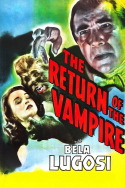
Review of The Return of the Vampire (1943) by Van R — 26 Jun 2010
This atmospheric World War II era horror chiller constitutes a rare treat. The filmmakers have skillfully intertwined serious, real-life serious events with supernatural fictional proceedings. Meaning, few monster movies appropriated the contemporary crisis of World War II and exploited it as a part of its storyline. Remember, during World War II, American and British films served as propaganda for the masses and championed democracy over fascism. Usually, these horror films skirted political ideologies, with only the most marginal references to the war. Mind you, â??The Return of the Vampireâ?? doesnâ??t weave World War II entirely into the fabric of its yarn, but the titular fangster does arise as a consequence of the German Luftwaffe. Moreover, the evil that National Socialism posed to England is comparable to the bloodlust of the vampire. Like the autocratic Nazis that manipulated millions into submission, the vampire here exerts total control over its powerless prey. During a London air raid, bombs shatter the tranquility of a cemetery where the vampire has been consigned to oblivion with a stake in his chest. Director Lew Landers and â??Mummyâ??s Handâ?? scenarist Griffin Jay have taken Kurt Neumannâ??s original story idea and done a splendid job of integrating the war with the vampireâ??s reign of terror. The cinematography of lensers L. William O'Connell and John Stumar creates a creepy feeling with its reliance on a fog machine and some graceful camera movement. Todayâ??s audiences will probably find nothing scary about this old-fashioned ghoul fest with its use of expressionist shadows to tell a story. â??The Return of the Vampireâ?? is quite unusual as it foreshadowed the combo chiller that brought together two supernatural creatures. A vampire and the werewolf work hand-in-hand for the first fifty minutes before they turn on each other in the end. â??Twilightâ?? fans may initially find this film disconcerting because the vampire wields power over the werewolf, but they will savor the ending.
Bela Lugosi doesnâ??t appear during the opening 23 minutes. Nevertheless, when Lugosi does show up, nobody can steal a scene from him. The first scene where a werewolf, Andreas Obry (one-time actor only Matt Willis), enters a gloomy cemetery and awakens the vampire at dusk is mildly spooky. Andreas serves as the equivalent of Renfield from "Dracula,â?? because Lugosiâ??s vampire possesses his soul. Admittedly, Willis appears rather ridiculous in his hirsute make-up, but this scruffy canine look may have been frightening to early twentieth century audiences. Anyway, Landers and his lensers pay tribute to German Expressionist filmmakers when they present the vampire as a shadow against a wall as he emerges from his coffin. The only flesh and blood shot is a close-up of the bloodsuckerâ??s hand as it raises the coffin lid. Similarly, they stage the action of a man driving a stake into the vampireâ??s heart in silhouette against a wall. Initially, use of silhouettes was a Hollywood method of depicting violence without nauseating the audience. The vampire, Armand Tesla (Bela Lugosi of â??Draculaâ??), differs considerably from Count Dracula. A depraved Romanian scientist who lived 200 years ago in 1744, Tesla published an authoritative text about vampires. He fell victim to his obsession with the undead and turned into one after his death. No, the filmmakers never explain what specifically turned Tesla into a vampire. Tesla is preying on young women in the year 1918 when the action unfolds and the werewolf acts as his servant. Meantime, Dr. Walter Saunders (Gilbert Emery of â??The House of Rothschildâ??) and Lady Jane Ainsley (Frieda Inescort of â??Mary of Scotlandâ??) track Tesla down to his tomb and hammer a spike through his heart. Ironically, everything that Dr. Saunders knows about vampires he has learned from Teslaâ??s writing. Landers and his scenarists use Dr. Saunders as a mouthpiece throughout these early scenes so that non-horror movie audiences would not be left in the dark about the procedure for killing a vampire.
The second act of â??The Return of the Vampireâ?? occurs in 1940 before America had entered World War II with the British. Dr. Saunders has died in a plane crash and left behind a manuscript of his fantastic exploits, principally the destruction of Armand Tesla. Scotland Yardâ??s Chief Commissioner, Sir Frederick Fleet (Miles Mander of â??South of Suezâ??), has perused the manuscript and has no alternative but to exhume Teslaâ??s body to substantiate what appears to be murder. Of course, Sir Frederick flatly refuses to believe in the existence of vampires. Later, a bomb devastates the graveyard where Saunders and Lady Jane buried Tesla's body in an unmarked grave between the Fairchild grave and the Smithley grave. Two laborers stumble upon Teslaâ??s unearthed coffin and mistakenly believe that the bomb hurled a spike into the corpse. The conversation that they have between themselves about this grisly incident serves as amusing comic relief. Dutifully, the laborers remove the spike and bury the coffin. Nevertheless, Tesla arises and Andreas reverts to his werewolf days. Since Teslaâ??s demise, Andreas has been a tireless laboratory assistant to a now older Lady Ainsley. Lady Ainsleyâ??s son John (Roland Varno of â??Zanzibarâ??) has grown up. A former Royal Air Force pilot, he has now become a concert pianist, while the late Dr. Saundersâ?? daughter Nicki (Nina Foch of â??Illegalâ??) serves in the womenâ??s corps. The two plan to marry in the future. Tesla enters Nickiâ??s bedroom and bites her. Later, Nicki bites John. Nothing that Lady Jane tells Sir Frederick about Tesla convinces him that Tesla is a supernatural being. Meanwhile, when his detectives question Andreas, Andreas turns into a werewolf and escapes from them. The detectives show Sir Frederick the wolf hairs that they collected in their brief struggle with Andreas, but Sir Frederick remains dubious.
Meanwhile, Lady Jane has been asked to help a scientist fleeing from the Nazis. Dr. Hugo Bruckner has escaped from Axis-occupied France with the help of the Resistance. He comes to London to meet our heroine. Tesla has Andreas dispose of Bruckner, and Tesla assumes the scientistâ??s identity. Eventually, Sir Frederick discovers this deception. Tesla visits Lady Jane. Since she knows his true identity, Tesla decides it is time for him to exact his revenge against her and turn Nikki into a vampire. Before Tesla can carry out his morbid plan, Andreas kills him. Eventually, Sir Frederick discovers this deception. Tesla visits Lady Jane. Since she knows his true identity, he decides it is time for him to exact his revenge against her and turn Nikki into a vampire. She exposes a cross and Tesla flees. Later, Lady Jane has another of her futile arguments with Sir Frederick about the reality of vampires. Before Tesla can carry out his morbid plan, Andreas kills him. The ending of â??Return of the Vampireâ?? is both clever and amusing. Despite everything that has transpired, Sir Frederick remains adamant in his disbelief about vampires. He queries his two plainclothes detectives. â??You two fellows donâ??t believe in vampires, do you?â?? They are just as convinced that vampires exist as Lady Jane is. Sir Frederick then breaks the fourth wall and addresses the audience. â??Do you people?â??
All vampire movies have their own unique set of rules. â??The Return of the Vampireâ?? is one of those vampire movies where the vampire can enter a residence without the permission of its owner. "The Return of the Vampire" may have been the first time in a film that a character shines a mirror on a vampire and the mirror reflects the vampire's apparel but not the vampire. Typically, in these scenes, the vampire's image is not reflected in the mirror, including his apparel.
This review of The Return of the Vampire (1943) was written by Van R on 26 Jun 2010.
The Return of the Vampire has generally received mixed reviews.
Was this review helpful?