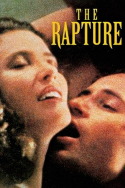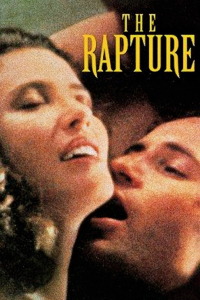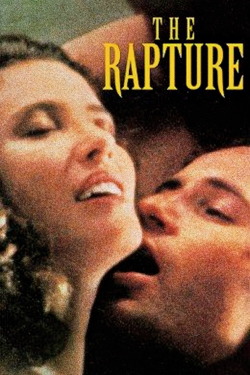
Review of The Rapture (1991) by M. K — 10 Jan 2008
'Have you heard the word of God? It's the greatest gift of all time. You have to trust completely in God. He'll forgive you of all your sins.'.
'Who forgives God?'.
These lines of dialogue can best sum up what The Rapture is best at saying: if God exists, he has some serious sins of his own to atone for.
Although its low budget shows (and during the finale, does it ever), the film manages to overcome this with its fabulous performances, eerie musical score, and most of all, its ideas.
Mimi Rogers plays Sharon, a telephone operator who hates her job, has nothing in her life, and spends her evenings cruising for couples sex with her partner Vic. Eventually, this unfulfilling existance causes her to have a breakdown, and after attempting suicide, Sharon turns to fundamentalist Christianity.
The Rapture contains one of the most profound and conceptually brilliant endings in cinema history. ***SPOILERS AHEAD*** Sharon's faith in God is put to the test constantly througout the film - not her faith in his existance, of which she is always certain after her conversion, but her faith in his goodness and promises. After recieving a message from God to wait for the title event in the desert, Sharon obeys, but the rapture does not come as they were promised, and she is forced to kill her daughter, who can not physically stand to wait around any longer with no food. After sending her daughter to Heaven, Sharon despairingly turns the gun on herself - only to angrily fire shots into the sky, as she remembers that killing herself will send her straight to Hell. It's a powerful scene, and from then on until the silent end titles roll, The Rapture transforms from an interesting study of religious fanatacism, to a profound look at whether God, should he exist, deserves the love he demands from humanity. The ending, in which Sharon, standing in a kind of limbo between Heaven and Earth, refuses to tell God she loves him. Her daughter pleads with her to accept God back into her heart. After all, he did give her the gift of life. But Sharon counters that if God gave the world the "gift" of life, he also gave it the "gift" of suffering, and after all God's rules about love and caring - rules he himself does not abide by, considering his indifference to the suffering in the world - Sharon cannot say that she loves him. After her conversion to Christianity, Sharon married her loving husband and had her daughter, but both were brutally taken from her; her husband gunned down by a mentally deranged man, and her daughter killed by her own hand due to God's disregard for their survival in the desert. The Lord giveth, and the Lord taketh away. Sharon's final line, 'forever...', is devastating in its implications, but also powerfully triumphant; one soul's defiance of eternity and an indifferent, patriarchal deity.
Thank goodness the film is so well-written, because it lends itself to multiple interpretations, including the one above. What is probably Tolkein's own intent is a significant disappointment: a devout Jew, Tolkin is essentially critiquing how fundamentalist Christianity views God. So basically what we have here, if we subscribe to his view, is a big, cinematic cry of "you worship God the wrong way!" It seems slightly ridiculous how Tolkin goes on a full-out character assasination of the fundamentalist Christian God, raising several valid points about the dubious righteousness of a creator who demands love and obedience from his creations at all cost, but it mystifies me how he fails to see that these damning characteristics apply to his Jewish interpretation of God as well. Thankfully, his script does not explicitly trumpet this message, and is actually very subjective - many people even see this as a "tragedy", in which Sharon's main flaw is that she can't fully accept God into her heart. Yeah, whatever.
While Tolkin's script is brilliant, his direction is rather lacking. This was his debut film as a director, and his inexperience shows in the dull, static way the events of the first half unfold. He improves as he goes along, though, and there are several powerful moments and haunting visuals in the film's second half, most notably the shot of bars falling away in prison cells as the rapture comes, while an inmate sharing a cell with Sharon begins to sing Amazing Grace.
As Sharon, Mimi Rogers is fantastic, delivering a performance so strong she carries the entire film. David Duchovny is fine (in all senses of the word; he looks hot even with a mullet). Thomas Newman's musical score is subtle, yet haunting, and despite the film's flaws (of which there are several), this remains one of the most inexplicably underrated films of the past twenty years.
This review of The Rapture (1991) was written by M. K on 10 Jan 2008.
The Rapture has generally received mixed reviews.
Was this review helpful?