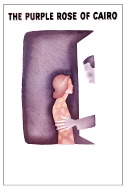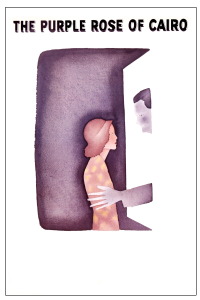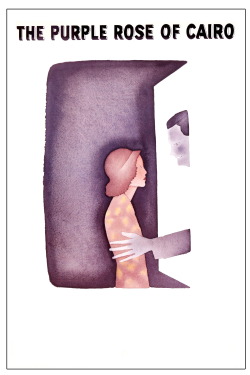
Review of The Purple Rose of Cairo (1985) by Joseph A — 04 Jun 2011
Plot:
Perhaps the least appreciated of Allen's great films, The Purple Rose of Cairo, is arguably his most playful, albeit direct, outing. Set in New Jersey during the great depression of the 1930's, Mia Farrow plays Cecilia, a film aficionado and broken housewife. Recently, her marriage has since turned into a considerable disaster and she finds herself in frequent disagreement with her out-of-work, abusive, and even womanizing husband, Monk (Danny Aiello).
Too afraid to be on her own, she naturally finds escape at the local cinema where she sits upon hours in admiration of the actors on screen and the lives in which their characters live. When the theater first features the film entitled The Purple Rose of Cario, Cecilia finds herself enamored by the film and its subsequent character, Tom Baxter (Jeff Daniels). The following day while at work as a waitress, she finds herself distracted from the mere memory of the feature and due to the nature of her reverie is there upon fired for her demeanor. She later frequents the film over and again and it is not until the happening of one her later viewings, perhaps the sixth time over, that her presence attracts the attention of Tom Baxter, causing him to come off-screen and appear before her and all others in the theater.
As he confesses his attraction toward her, together the two run off as the audience and too the characters on screen (as if suddenly viable actors taking part in play) remain caught in panic and awe. Word soon spreads that a character in a feature film has walked off screen, discovering the real-world. Expectedly the news spreads quickly to ears of the film's producer, Raoul Hirsch, and the actor who portrays Tom Baxter, Gil Shepherd (Jeff Daniels). Mr. Hirsch's objective here is to stop the mass running of his picture to cease any further occurrences that share semblance and potential lawsuits. Gil Shepherd finds himself frightened at the thought of losing his growing popularity due to what crimes he believes the character he created, his essential double for all intensive purposes, may be out committing.
Cecelia You're Breaking My Heart:
Mia Farrow's interpretation of Cecilia is simply charming. It is with such perfection that she plays the role of this lonely, naïve romantic in search of change. Her lamenting disposition and reserved attitude, together, truly make her irresistible to any viewer and impossible for one not to feel sympathetic toward her plight.
Jeff Daniels does as well a marvelous job as both Tom Baxter and Gil Shepherd. He very well may be amongst Hollywood's underrated.
Film as a World of its Own:
The Purple Rose of Cairo presents yet another interesting aspect in the sense that Allen depicts the world on the theater screen as a world entirely of its own; and it is! Cecelia mentions over and again her desire for a world similar to the depictions on screen and it is with a high degree of craft that Allen creates that so sought after world. The scene in the picture itself, when Tom Baxter leaves, can no longer move forward or backward, but must remain in place. The characters however are free to move about, discuss at will topics of interest, as well as see outwardly, beyond the screen, into the theater. These characters on screen are alive, disturbed even. Their world of routine has since been interrupted and they are left in a state of restlessness and wait for there is nothing more they desire than to continue their life of pattern. One character even mentions excitedly how he is a "dramatic character" and needs "forward motion" while another mentions the fear he has of the screen going "black". In their impatience others pass time arbitrarily by poking jokes at the audience. As a whole these sequences make for brilliant satire that only Allen could write.
Tom Baxter leaves the picture and enters the real-world where he remains no longer a victim of repetitiveness. Moviegoers, however enthusiastic, wish to enter the very world of a Hollywood picture in the hope of escaping theirs.
The two worlds do exist and perhaps are separate equals, but after all, what is a life without the movies? What is a life without wanting to or even having an escape, even if only for a little while?
Love, Actually:
What else Purple Rose so genuinely explores is the unrequited love one may share for a fictional character; be that of literature, film, or even our very own imaginative perception of those so in which living life surrounds us with to a great abundance. Cecilia found herself enthralled by the character Tom Baxter even before he took his first steps off-screen. His charm, his romanticism, looks and perfections that captivated her so, all of course translated to the real-world. However, his limited knowledge of the living-world, what is past and now, as well as being only capable of what has been written into his character, hinders Tom Baxter from certain human emotions. Also, as aforementioned, he, Tom Baxter, is in practical sense, fictional.
One has to wonder if it is the artist whom they love or his creation. It is here in Allen's piece that Cecilia falls too in deep affection toward the actor who portrays Tom Baxter. He is certainly a man of a great many faults no doubt, but an artist no less and more importantly, the man who gave life to Tom Baxter. It is such that Cecilia finds herself amidst the grand decision of choosing reality or fantasy for her ultimate happiness.
One Sentence Summary:
The Purple Rose of Cairo is a fantastic, probing piece of cinema in which, through comedic, romantic tones, great acting and of course music, leaves the viewer appreciating cinema that much more than what was once before.
This review of The Purple Rose of Cairo (1985) was written by Joseph A on 04 Jun 2011.
The Purple Rose of Cairo has generally received very positive reviews.
Was this review helpful?