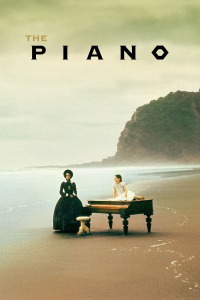
Review of The Piano (1993) by Edith N — 24 Jun 2013
Choosing Silence.
I was watching [i]Northern Exposure[/i] today, and there was an episode featuring a monk who had chosen a vow of silence. Chris says he could never do it, that in essence he is addicted to words. I don't think he phrases it quite that way, but close enough. But you know, no matter how it phrased it, it rang true to me because I'm much the same way myself. It tends to amaze people when they listen to me on the phone with someone and I'm not saying anything. My daughter can fill space with words like that, and that also amuses people; it's another data point in the nature versus nurture discussion I'm having with her adoptive parents. So I guess I'm slightly in awe, too, of people who choose not to talk, and that is the case with Our Heroine in tonight's film. I mean, it's one thing if you don't talk because you have nothing to say or because you just don't like talking. But choosing not to no matter what? That's impressive.
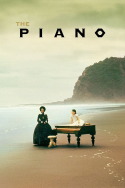
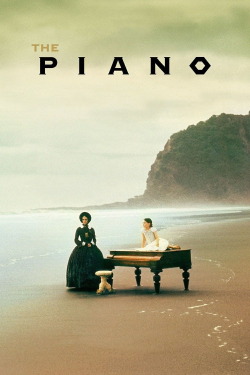
Our Heroine is Ada (Holly Hunter), a beautiful but silent woman whose father arranges a marriage for her with Alisdair Stewart (Sam Neill), who lives in far-off New Zealand. Ada brings her daughter, Flora (Anna Paquin), who knows her mother's sign language. One of the things that Ada brings with her is her piano, but Alisdair refuses to have the men haul it from the beach to his house. One of the other Europeans in the area is George Baines (Harvey Keitel), and he is fascinated with Ada. He trades eighty acres of land to Alisdair for the piano--and the promise that Ada will give him lessons. To Ada, he promises that he will give her back the piano. However, she must trade him certain liberties, one for each key of the piano. Alisdair has sent Flora along as Ada's chaperone, but Flora obeys her mother and plays outside while her mother stays inside with Baines and the piano. And her mother trades more than one key for certain things.
I don't think we ever really know how Flora came to be born. We know that Ada was not married to Flora's father, but that's the extent of what we know. Flora tells at least two stories of how her parents met, and Ada tells the outlines of what seems to be a third, and I don't think we can entirely trust any of them. However, I suspect that, when Ada was with Flora's father, she was more able to feel. She lost the man, whoever he was, and she is now lost herself. She loves her daughter. She connects to her daughter. But that's the extent of it. She does not trust Alisdair, and she fears Baines. The women, I think, mostly just bore her, and I don't blame her for that. However, that leaves her with just a child for companionship, and while I'm not completely sure that bothers Ada, I do know that it isn't good for her. Perhaps this is a result of the loss of Flora's father, but I suppose it is also possible that Flora's father left because he saw that self-isolation inside Ada.
I'm not entirely sure I consider this movie all that romantic, come to that. It gets called that a lot, but I think it's too painful and unpleasant. No one ever seems to ask what Ada wants from beginning to end. Sometimes, she is treated well, and sometimes, she is treated brutally, but she didn't even make the decision to go to New Zealand on her own. She did not choose Alisdair. She makes one request of him--that he rescue her piano from the beach where she and her belongings have been left--and he refuses. When Baines trades those eighty acres for it, there's almost no point in it, because the piano is still on the beach. Anyone might claim it simply by hauling it away, and the only reason Baines doesn't do that is that he is trying to get Ada as well. Ada refuses to teach Baines, because he is ignorant, unwashed, and unpleasant, but Alisdair won't let her refuse and sends her anyway for fear of losing the land. No one ever asks her what she wants, and no one pays attention when she tries to make her will known. All she controls is her voice.
It's still a beautiful movie, if a stark and painful one. I do not understand the choice Ada made as a child--the choice not to talk and to communicate only through the piano. I tend to assume that her connection to Flora's father came in part because he did, though of course I cannot prove that, either. Flora has always just believed that this is how life is; Anna Paquin portrayed it so believably that she remains the second-youngest person to win a competitive Oscar (after Tatum O'Neal, both for Best Supporting Actress). She was eleven at the time, and that is, I think, the age at which you start to realize that the way you grew up is not necessarily the way everyone grew up unless you are terribly sheltered. (I had friends from a wide array of ethnic and socioeconomic backgrounds, and I still kind of believed as a child that our lives were broadly the same.) She knows her mother is different, but how different can she be, right? But we as adults know what Flora cannot.
This review of The Piano (1993) was written by Edith N on 24 Jun 2013.
The Piano has generally received very positive reviews.
Was this review helpful?