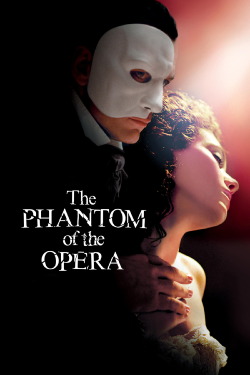
Review of The Phantom of the Opera (2004) by Filipeneto — 23 Oct 2020
I confess that I am not particularly fond of films based on musicals. It's not the kind of film that attracts me, but I loved this film. I already knew the story, written by Gaston Leroux, and I was not badly impressed by the fact that the film did not literally follow the book. The film preferred to rely closely on the American musical inspired by it, which makes perfect sense since it is also a musical film and there were already several regular feature films, mostly horror, inspired by Leroux's book. About the story, there is much to tell and some believe that some parts of the story was based on people and facts that really happened. I will not enter into conjectures, but it is still a seductive idea.
The film begins in 1919, with the auction of objects from the decadent "Opera Populaire" in Paris. One of the objects is acquired by the elderly Viscount de Chagny and, together with the pieces of the old theater chandelier, its the starting point for a flashback until 1870, when the theater was at its peak and the events of the film are taking place: the arrival of new managers to the theater leads to a manifestation of the Phantom. Its an evil and perverse entity that no one knows about, but that manifests itself punctually and sometimes causes accidents if it is contradicted. And this time the Phantom decides to demand that the lyric singer Christine Daaé be the new star of the show. His obsession will lead him to a series of dramatic and fatal events, where his madness will be highlighted and will lead the still young Viscount de Chagny, in love with Christine, to take a drastic attitude and to defend the woman he loves.
Living in Europe, far from the American musical circuit, I can't say that I saw, or think one day I could see Andrew Lloyd Webber's original musical. Anyway, if the critics and experts are right and the film was quite true to it, it would be something I would pay to see in person. Joel Schumacher was an excellent director, the ideal man for the film, with an attention to detail and very attentive to how it all came together. The result is a wonderful film, like a fairy tale, with an excellent pace where there are no dead moments. The scenes where the Phantom takes Christine to his lair, on an island under the theater, are truly unforgettable, more than the famous fall of the chandelier, which is quite unimpressive, to be honest. I was also not impressed by the ending, which seemed predictable and somewhat anticlimactic.
The cast has big names, most of them already proven in singing: for example, the film's protagonist, Emmy Rossum, began her artistic career as a lyrical singer at the Metropolitan Opera in New York. She has an excellent voice and charms with every melody. Also Patrick Wilson, who gave life to the young Viscount Raoul, was notable in his work and knows how to interpret as well as sing, with a very soft voice that makes an excellent counterpoint to the deep profound voice of Gerard Butler, who gave life to the Phantom who, in this film, never sees his name revealed. In addition to this remarkable trio, the film features excellent participation's by Miranda Richardson, Minnie Driver (the only actress who doesn't sing), Ciarán Hinds, Simon Callow and Jennifer Ellison.
Technically, the film bets all the chips on the music and does it right, taking into account that it is the cement that holds everything else together in a cohesive and solid work. From what I was reading at the time of writing this review, all the songs were taken from the American stage musical, with the exception of "Learn To Be Lonely", sung by Minnie Driver, used in the final credits and composed specifically for the film by Andrew Lloyd Webber. From the wide range of songs its difficult to choose the best ones but I especially liked "All I Ask Of You", "Music of The Night", "Masquerade", "The Point of No Return" and, of course, the famous "Overture" that has become almost a cultural icon. In addition to this set of great melodies, the film presents excellent choreographies. The sets and costumes are also very good and there is a certain notion of visual and aesthetic grandeur that looks good and is welcome. On the other hand, I did not particularly like the makeup of Gerard Butler, who is too handsome without a mask, far from being hideous and similar to the living death, as described by Leroux. A kind of visual skillfully used by horror movies.
This review of The Phantom of the Opera (2004) was written by Filipeneto on 23 Oct 2020.
The Phantom of the Opera has generally received positive reviews.
Was this review helpful?