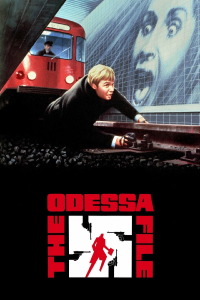
Review of The Odessa File (1974) by Luc L — 06 Oct 2012
Couldn't They Have Just Gotten an Older Guy?
Germany has a complicated relationship with the Holocaust. For obvious reasons, of course. But it is true that a whole generation of Germans pretty much wanted to sweep the whole thing under the rug and pretend it had never happened. This is in part because that generation is not sure how culpable it is, all things considered. Did they see? Did they know? If they didn't, should they have? How much responsibility do they bear for what happened? And, in the end, it's why Germany did not do all it could to go after those responsible, because more people were responsible than could ever have been punished. Of course, Germany also had its own troubles at the time. By the time the occupation was really over after World War II, most of those who had been responsible for what happened during the war were dead. Those few who were left were now so old that not everyone was comfortable with prosecuting them.
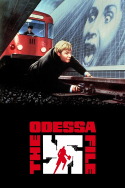
An old man, Salomon Tauber (Towje Kleiner), has gassed himself, leaving behind only a diary. It is brought to the attention of Peter Miller (Jon Voight), a young German reporter. The diary tells of the atrocities committed by Eduard Roschmann (Maximilian Schell), the SS officer who ran the Riga concentration camp. Peter then meets the old man's friend, Marx (Martin Brandt), who tells him that Tauber believed he had seen Roschmann only weeks before, in Munich. Peter tries to go through legal methods to track down Roschmann, but he is rebuffed. He then goes to Austria to meet famous Nazi-hunter Simon Wiesenthal (Shmuel Rodensky), who tells Peter about ODESSA--[i]Organisation der ehemaligen SS-Angehörigen[/i], or the Organization of former SS Members--an organization intended to keep SS members from prosecution, generally with forged identities and smuggling them to countries where they won't be extradited. With that discovery, Peter gets in far deeper than he expected would ever happen.
There is no little debate as to whether or not ODESSA really existed. Wiesenthal insisted it did, various historians have said that it was never a single organization, and the US War Crimes Commission never denied that it existed. I lean toward the belief that a lot of men were making a lot of connections and a lot of plans. There were some who really wanted to raise a Fourth Reich, one of the declared goals of the supposed ODESSA, but I think a lot of them just wanted to disappear and evade prosecution. I doubt most of them thought they'd done anything wrong, but they knew that their view was a minority after the war. Some of the people, I'm sure, had just drifted into positions where their ordinary morality was subsumed under what was going on around them and what their orders were, but I think most of the ones who disappeared were sociopaths. I think you have to be in order to do that level of thing to other people and not see that there's something wrong with it.
I had a hard time getting into the story here. Okay, I get that the probably-Mossad guys need an Aryan to infiltrate ODESSA with, but was Jon Voight really the best choice for that? You kind of have to do a bit of math for this, but bear with me. When the movie was made, Voight was thirty-six. The movie was set in 1963 and 1964; it starts the day Kennedy was shot in Dallas. So if you assume that, at the beginning of the movie, the character and the actor were the same age, that means the character was born in 1927, meaning that he was twelve at the start of the war and eighteen when it ended. The SS member he disguises himself as is explicitly said to be ten years older than he, and that's a problem. However, it also means that Peter Miller would have definitely served in the tail end of the war himself, yet he's also implied to be too young to remember what the war was really like. This means they've cast someone pretty much exactly the wrong age.
Probably the weirdest part is the score, composed by Andrew Lloyd Webber. And that's truthfully the only weird part, that it was composed by him, but once you know that, you can't stop comparing it to other works of his. At least, not if you know music. It's understated, by Andrew Lloyd Webber standards, but you can still hear certain musical tricks of which he is fond, and they just don't work here. Someone also decided that what the movie really needed was a Christmas song sung by Perry Como. So Andrew Lloyd Webber teamed up with Tim Rice and André Heller and provided us with one. Now, I am generally torn when it comes to his music; I like some of it and really dislike others. This isn't the worst of his music by a long shot. He wasn't quite as huge then as he has since become; this is after [i]Joseph and the Amazing Technicolor Dreamcoat[/i] and [i]Jesus Christ Superstar[/i]--and a failed version of Jeeves and Wooster--but before [i]Evita[/i] and so forth. However, it's practically the only movie score he ever wrote, and I'm not sure why they hired him.
This review of The Odessa File (1974) was written by Luc L on 06 Oct 2012.
The Odessa File has generally received positive reviews.
Was this review helpful?