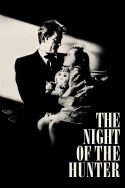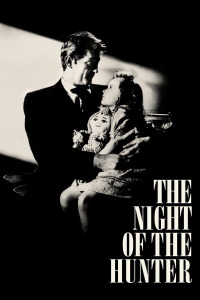
Review of The Night of the Hunter (1955) by Jake R — 03 Jan 2009
'The Night of the Hunter' is one of those rare films that catches everyone off guard. A commercial failure, British director and acting legend Charles Laughton never found the courage to direct again, which is a shame as his talent here more than makes up for a possible later career in making films.
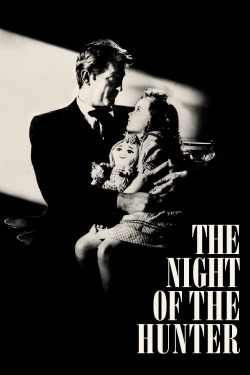
Appearing to begin as tepid Southern melodrama, the film slowly, menacingly curls into something more evil. Robert Mitchum's 'Harry Powell' is a classic cinema villain, and one of a kind. He's the antithesis of the Southern gentleman: mysogynistic to the core, mentally unstable, socipathic and homicidal, finding the murky edge to religion for profit, he carves up the screen whenever he's on it, turning his broad, towering frame into a flesh and blood shadow. It's a terrific, terrifying performance, one of the simplest and most effective evocations of evil in cinema history.
Yet the film isn't about Powell. He's the main catalyst for the events, but it's really a journey for the children themselves, namely Billy Chapin's 'John Harper'. In a way it's a coming of age story, the pair finding themselves orphaned and forced into acting like adults for their own survivial, but it's also about discovering what it means to be an individual person. John feels he's been shouted down and chased like an animal by Powell, so much so he finds talking and acting like a kid pointless afterwards. But when he lets his natural curiosity through he finds comfort and an allowance to be himself again, though he's also given the freedom to become his own personality again. Chapin does a brilliant job, giving one of the very few intelligent and emotional child performances in the movies. His is a development of subtlety, letting his eyes speak and dwell on things, speaking only when necessary, yet finding himself unable to manner through every emotional trauma he's forced through, as confusing as ever for a child.
Chapin's silent movie-style performance is one of many allusions to the era before sound. The shady Expressionistic lighting draws striking comparisons to German cinema of the 1920s, perfectly suited for the eerie Southern Gothic tone. But the biggest symbol of the silent era is 'Mrs Cooper' herself, played by living legend Lilian Gish. The woman who practically single handedly brought the element of glamour to movie stars and who defined women's roles in the age of Griffith, as well as starring in some of the most important films of all time, it's only fitting her lovably grumpy Mrs Cooper pioneers another major step in cinema's relationship with women.
This is a very feministic film, showing a rainbow of female personalities. In a way it's scarily realistic, Shelley Winter's 'Willa' blundering through most of the film in a dizzy, drunken emotional wreckage after the execution of her husband, totally subsurvient and submissive to Powell's cynical demands. Gloria Castillo's 'Ruby' is another victim, the beauty lacking in self-esteem and hungry for attention to convince herself she's worth something. Out of all of these damaged people emerges Gish's Mrs Cooper, as towering as Powell in her solid conviction and world-weariness that keeping your wits about you all the time is the only way you can survive. Freudian symbolism abounds with weapons of choice: Powell's enormous stature yields death at the tip of a flick knife, whilst Mrs Cooper's diminuitive frame supports a giant shotgun. She is not only in control but is the victor before the fight's over. Singing along to Powell's abridged hymn, she transfers her silhouette onto him, so much so he disappears from the frame, becoming a mere ghost of himself, though its the ghosts that continually haunt us.
Laughton's film is ghostly in its dreaminess. The famous drift down the river brings nature to life all around. Frogs, foxes, rabbits, even tortoises, all creep and crawl around, reminding us that nature lives and breathes just as much as those that walk and talk. Laughton's ability to observe the annoying nuances of Southern life, such as endlessly interfering neighbours and a blind-to-the-point-of-absurdity faith, also gives way to his own lyrical construction. Iconic images of a submerged Willa, glistening like a mermaid of legend, to a looming Powell cloaked in shadow, render the most inexplicable of elements the most enchanting, and coldly bewitching. This isn't a dystopian film but it's certainly downbeat, emphasising hardship and the responsibility of trust in others, rather than any old escapist hogwash Hollywood wanted in the 1950s.
Finally, 'The Night of the Hunter' is timeless in its themes and texts. The entire story is endemic of American culture: poverty and a sense of injustice gives away to crime and merciless punishment, and the subject that causes such chaos is money, nothing more. What starts as a twinge of guilt blows up into a fully-fledged riot, and after the end of it all nothing's ever resolved or put back to normal, as the simmering bars of Powell's theme play over the otherwise harmonic last shot.
It's a strange, beautiful and indecipherable film, simultaneously warm and cold, horrifying yet gentle, and always poetic, in many different shades. It's cerebral in the sense that it comments on people themselves, and how foolish and stubborn they are, and yet intensely spiritual, constantly referring to nature and the world outside our front doors. It's also the weirdest Christmas movie ever.
This review of The Night of the Hunter (1955) was written by Jake R on 03 Jan 2009.
The Night of the Hunter has generally received very positive reviews.
Was this review helpful?