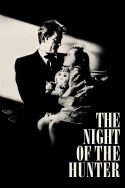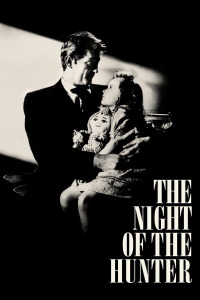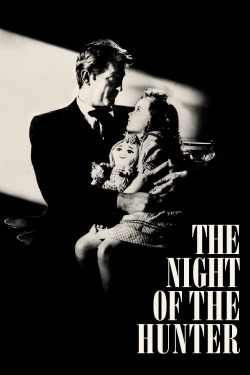
Review of The Night of the Hunter (1955) by Avery B — 10 Nov 2009
I get a charge out of old films that twist the mid-20th century American Judeo-Christian religious ethic into something disturbing and subversive. My dad's a religious man who loves a good western. I wonder what he made of Robert Mitchum in his role as a psychotic, murdering preacher hellbent on stealing from widows. He probably didn't see it. Not many did, after all, but it serves to reaffirm my own belief that Mitchum is one of the great actors of any era, former or current.
There weren't a lot of films quite like "Night of the Hunter", at least until long after its 1955 release. I wasn't aware of it until earlier this year, when I saw it starting to pop up as a forgotten classic on a few best-of lists. There is a bit of the disturbed Reverend Powell in Michael Myers, Freddy Krueger and the Ghost Face Killer. The film's main characters, a young brother and sister, are relentlessly chased downstream by Powell on a river that snakes through the midwest. They make their way across farmlands that clearly appear to have influenced Tim Burton's darkly imaginative set designs and hide in a barn as Powell's silhouette is seen riding eerily against the horizon, singing a hymn that would bring a congregation to a hesitating silence.
It is during the time of the Great Depression, when orphaned children were forced to knock on doors for handouts of food and clothing. There doesn't seem to be much of God in the suffering. Out of desperation, Ben Harper (Peter Graves) commits murder and makes off with $10,000 in cash. He is arrested in front of his son John (Billy Chapin), who promises his dad to keep the money's hiding place a secret. It is stuffed into the plaything of Pearl (Sally Jane Bruce), who is too young to see its value and cuts the bills up into paper dolls.
The father is executed, but not before putting the idea of the money's whereabouts in the head of his cellmate. Powell has a racket of courting widows until he is able to rob them of their funds and has left a trail of bodies in his wake. He is under the delusion that he is performing the Lord's work and talks to God as he navigates country roads in a stolen car. Dressed in an ominous black getup and sporting tattoos on his fingers that spell out "LOVE" and "HATE", Powell is nevertheless able to charm townspeople all over Ohio with his charisma and unique philosophies on God's will.
Powell introduces himself to the widow Willa Harper (Shelley Winters) and is soon able to work his way into their marriage bed, which he soundly condemns shortly after she gazes fondly at her body in the mirror. In one of the film's best scenes, Powell stands in the foreground with his back to the camera as Willa seems trapped in the space between his accusing gaze and the foreboding black jacket hanging on the bathroom door. She moves across the room to look into a mirror and the shot switches to show the look of overbearing scorn on Powell's face as he preaches that her body is a temple.
The film is operatic in its treatment of Powell's madness. The sets look obviously constructed and recede deeply into the frame, making the characters appear grotesque and isolated. I was struck by the way its framing worked in perfect conjunction with the performances to create a tense yet comedic atmosphere. Upon a first consideration, Winters' character seems almost laughably awful as she spouts trite and weak-willed dialogue. We can't imagine that she could possibly marry this man, who seemed to enter her life with such ease. Yet she readily suits her purpose, which is to heighten the sickness of Powell's murderous, misogynistic persona behind the cloth. She cannot last under the tight hold he has on her.
There is a longstanding feeling of horror in the idea that man can turn to God and find the Devil. It is in the works of Flannery O'Connor and other writers in the Southern Gothic tradition, along with the Davis Grubb source material. Director Charles Laughton, screenwriter James Agee and cinematographer Stanley Cortez, who shot Orson Welles' "The Magnificent Ambersons", greet the gothic themes with a feverish Expressionist energy, creating distorted yet hyperreal environments for their characters to run in. Balancing Mitchum's creepy preacher is Lillian Gish as a saintly orphanage matron, whose readings of the Bible and loaded shotgun attempt to restore a sliver of sanity to the narrative.
Robert Golden's editing work intercuts phallic metaphors of speeding trains and sprung jackknives to indicate the threat of rape. Hardly any of the violence is shown, but his dramatic use of shadows and light make the darkness a palpable threat, especially once John and Pearl are on their own, running scared. The film is peppered with unsettling musical numbers about death sung by children in innocent, angelic voices. There is a mania to how things transpire and it is consistently driven by Mitchum's insane and often hilarious performance. As the children hide in a cellar, he pokes his head in from the top of the stairs, announcing, "I can feel myself getting awful mad" in the voice of a bedtime storyteller raising the curtain on a nightmare.
This was the only major film directed by Laughton, who had a slate of successful acting work in films such as "Spartacus" and "The Hunchback of Notre Dame". In "Hunter", he offered the kind of wildly inventive suspense picture that infuriated critics and studios wishing to brand the film as one thing or another. It recalls to mind the craziness of Robert Aldrich's "Kiss Me Deadly", released the same year, also overlooked and just as influential by virtue of its desire to be a nail in the coffin of film genre. Sometimes the benefits of hindsight are tenfold.
This review of The Night of the Hunter (1955) was written by Avery B on 10 Nov 2009.
The Night of the Hunter has generally received very positive reviews.
Was this review helpful?