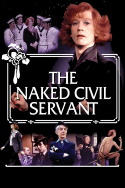
Review of The Naked Civil Servant (1975) by Edith N — 21 May 2012
Not That He Could Have Hidden Anyway.
To be perfectly honest, I'm not entirely clear what Quentin Crisp was famous for. For being fabulous, I suppose. I first encountered the name in the liner notes of the Sting album [i]. . . Nothing Like the Sun[/i]. The album came out in 1987, so if my sister (whose copy I borrowed and played constantly) got it new for Christmas, as I remember, I would have been eleven. The song "Englishman in New York," which is the title of the sequel (which, yes, I will get around to; it's available streaming on Netflix and I've been waiting until I did this before I get to it), is about Quentin Crisp, and the liner notes include an amusing [i]bon mot[/i] of his as delivered to Sting. I since read about him, then saw him interviewed, in book and movie of [i]The Celluloid Closet[/i]. He played Queen Elizabeth I in [i]Orlando[/i] and had a cameo in [i]To Wong Foo, Thanks For Everything, Julie Newmar[/i]. And to this day, I cannot tell you why anyone cares.
Still, here he is, played by John Hurt. The movie begins in the 1920s, when young Quentin was trying to figure out who he was and why he simply wasn't interested in sex with girls. He knew he was different, but he didn't have the context to figure out what was different about him. And then one day, he happened to meet a flamboyant and effeminate homosexual man on the streets of London, and suddenly, everything clicked for him. He has a bit of difficulty at first, because he still leads something approaching a normal, respectable British life. But he stops living with his parents (Lloyd Lamble and Joan Ryan) and gets fired from his job--because of the economy, not his sexuality--and moves into a bohemian subculture full of interesting characters. And that's all he really sees them as--characters in his story. And so young Quentin moves from the Roaring Twenties through the grim thirties and into the forties and war, on his way to becoming what he calls "one of the stately homos of England.".
Yes, it's true that he expressly states that he is fighting for a cause, though he never quite defines what that cause is. Quentin Crisp was an early proponent of gay rights before the idea that gays should have rights had occurred to much of anyone. In his youth, he came to terms with the fact that he was never going to fool anyone; he admits as much when he goes to enlist in the army during World War II. So if he was going to be visible, he was going to be [i]very[/i] visible; the first thing he did upon the declaration of war was to buy two pounds of henna to keep his hair that gaudy red for the duration. Because you never know. And in fact, the most touching scene in the movie is the one wherein his friends give the judge character references after he has been arrested for solicitation. Over and over, they repeat that they know he's a homosexual, and they still think he's a good person. And mostly, Quentin chose to fight the charges because Lord, someone had to.
Despite being vain and self-centered, Quentin as portrayed by Hurt really is still a good person. For one thing, he is completely honest about things when it's important. He isn't one of those terrible people who tells you exactly what they think at all times because to do otherwise would be to lie to you. Quentin knows that telling you the truth at all times isn't necessary and appreciates the importance of tact. But he also knows that, say, the girl who claims to love him and believes that they can have a platonic relationship which will satisfy them both above romance and sex needs to have that little illusion burst in the gentlest way possible, and that actually involves telling her his own romantic fantasy, making it quite clear that there are no women involved. He doesn't tell "Mr. Pole" (Stanley Lebor) that he's schizophrenic, because there's no point, but he does attempt in a quiet way to make sure everyone else realizes what's going on.
Probably if we hadn't skipped thirty years or so from the end of the war to the year the movie was made, I might know why anyone should know who Quentin Crisp is. Or maybe it's because there's this movie about him. I could look it up, but I almost like it better not knowing. After all, there are some people who just rise into the public consciousness like shapes out of some cultural fog. Quentin Crisp is distinctly more interesting than most of the ones who appear to be showing up these days. Even knowing as little about him as I do, I can say this. After all, Quentin Crisp at least was intelligent, witty, and artistic. He had a legitimate cause to speak out for, and he did so long before it was fashionable to do so. He was exactly the kind of person he wanted to be, not letting public disapproval prevent him from being true to himself. Though at the same time, I think he was generally respectful of people of people who were respectful of him. Gay or straight, there are worse ways to be.
This review of The Naked Civil Servant (1975) was written by Edith N on 21 May 2012.
The Naked Civil Servant has generally received very positive reviews.
Was this review helpful?