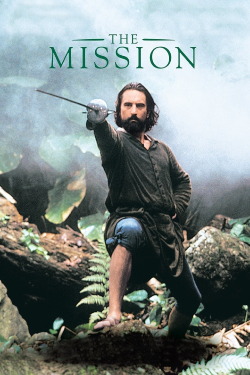
Review of The Mission (1986) by Daniel K — 05 Oct 2010
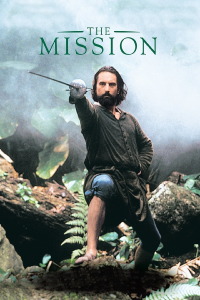
The Mission takes us into the jungles of Brazil in the 1750s where we follow the lives of a group of indigenous people and a small group of Jesuits who create a mission for them. The mission becomes a safe haven for the Indians as they live in fear of mercenaries and slave traders. The story develops into a battle between good and evil as the Pope?s envoy has to decide whether or not to allow the mission to remain or to dispose of it. This comes after a treaty is signed between Portugal and Spain. While slavery was technically illegal in Spanish territory, it was fully legal on Portuguese territory. After the signing of the treaty, the Brazilian land that this mission was located on became Portuguese territory. After the Pope?s envoy informs the Jesuits of his decision to close the mission, the Jesuits are forced to choose whether or not to take up arms with the Indians. A bloody battle ensues between the Portuguese army and the Indians.
The plot is simple enough and it is historically accurate for the most part, but the director never fully fleshes out any of the characters enough to make the film dramatic. The Indians are caricatures with no individuality among them. Jeremy Irons gives the best performance as a Jesuit who fully believes that God is love. He sees the world in black-and-white terms and is very admirable, but very bland. Robert DeNiro plays a mercenary turned Jesuit after killing his brother over a woman. He seeks penance in the brotherhood. Unfortunately, the great DeNiro is awful in this film. He uses his New York accent throughout, and it is very distracting. Considering all of his great performances, (Raging Bull, Taxi Driver, The Deer Hunter) he is very disappointing in this film. Maybe he did not have enough time to find the soul of his character, or maybe the script simply did not give him enough to work with. Regardless, the only scenes in The Mission where DeNiro does not embarrass himself are the ones where he keeps his mouth shut.
The most interesting, and seemingly complex character in the film is the Pope?s envoy. He has a difficult decision to make which is based not only on his faith, but on very important political factors as well. However, the director avoids delving too deep into this man and even tries to stereotype him as a stuffy religious figure by showing us all of his fancy jewelry and belongings. In one scene, we see trunk after trunk of the man?s belongings being carried into a palace by slaves. Whenever the envoy travels out into the sun, an Indian holds an umbrella over his head. The director wants us to see him, not as a man who has a difficult decision to make, but as a puppet of the Pope who is only looking out for his political interests.
This film could have been great if placed in the hands of a more capable director. The film suffers from a lack of dramatic tension. It is a foregone conclusion that the mission will be closed, and the ?climactic? battle that ensues during the film?s conclusion is actually laughable at times due to the poor choreography. The director crosscuts the battle scenes with scenes of Jeremy Irons holding the cross among indigenous women and children as a kind of juxtaposition between love and hate / good and evil. It is supposed to be ironic, but it feels hollow. Here, the director is asking us to care about the plight of these indigenous people when he has done nothing throughout the duration of his picture to allow us do so. The film started promisingly enough, with shocking imagery of a priest attached to a cross being washed down a waterfall. Unfortunately, it was a powerful opening that the rest of the film failed to live up to.
This review of The Mission (1986) was written by Daniel K on 05 Oct 2010.
The Mission has generally received positive reviews.
Was this review helpful?