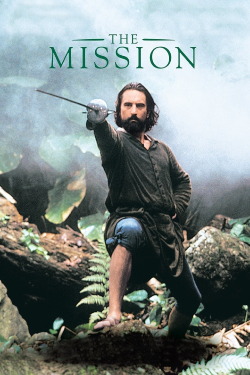
Review of The Mission (1986) by Gracie C — 08 Dec 2015
Captain Mendoza (De Niro) is originally a slave trader. He, however, kills his brother in a duel over a woman, and he experiences acute remorse and guilt over what he does although the law cannot touch him because his brother is killed in a duel. Father Gabriel (Irons) visits him at the prison Mendoza puts himself in voluntarily. Father Gabriel gives him a way to forgive himself. Mendoza, as his punishment, goes to Guarani "Indians"- the very people he kidnaped and sold - to help them live better lives. Conflicts arise, however, when the Portuguese and the Spanish want the Guaranis to leave their missions. Firstly, the missions are the Portuguese and Spanish's trading rivals. By forcing the Guaranis to leave, they get rid of their trading competitors. Secondly, the Portuguese and Spanish want to enslave the Guaranis.
I'd like to start off by saying that many people, especially on this website, watch this movie and think that this movie glorifies the "White Man's Burden." They go on to explain that this is glorified because Jesuits are sent to convert people, and the movie portrays this as them doing a favor to the "Indians." However, I completely disagree. First of all, the "White Man's Burden" is not the message of the movie. It's not even the essence - these people are completely missing the point. The "White Man's Burden" is simply a concept used to convey the message of the film. Secondly, this movie is loosely based on a true story - it is true that Jesuit priests died with Natives to fight the Portuguese and Spanish. Of course, many elements are certainly dramatized in order to increase the effect of the film. Yet, by completely ignoring the true message of the film, these people are missing out on a lot. Thirdly, the arrival of the Portuguese and the Spanish actually marks the opposite of the "White Man's Burden" because they are the main antagonists of the film. Finally, many people have been saying that they dislike the subtle glorification of the conversion of the Natives. I don't see how this is a problem if it's a movie. This is not a documentary, and because it is not one, the audience should not expect a 100% factual and unbiased product.
Now, to the message of the film. I really loved the way the director defined love. As I was watching this, there were many themes I was able to spot. For one, in the beginning, even after a priest is killed by the Guarani Natives, Father Gabriel goes to them and still tries to convert them. This shouldn't be interpreted by the audience as something that glorifies the conversion to Christianity. Rather, I think it should be looked as something less literal. Father Gabriel, for one, thinks that conversion to Christianity will save these Natives, and he will do anything in his power to help them convert. This, analyzed in a less literal perspective, shows love. Father Gabriel does this out of love. Whether or not the conversion to Christianity is too glorified in this film is secondary. He truly believes this will save the Guaranis, and because he loves them, he goes back to do anything he can to save them.
The second definition of love that is shown during the movie is when the Jesuit priests die with the Guarani when the Portuguese invade. This shows the true definition of love and friendship. A true friend will go to hell and back to save you. If you're in a pit, he won't stand above the pit and say "go on, you can do it." If you're in a pit, he will climb down the pit and help you to reach the top. You are both in it together. This reminded me of "The Deer Hunter," also starring Robert De Niro. Michael (De Niro) goes all the way back to Vietnam to save his friend Nick (Christopher Walken) from playing Russian Roulette and gambling his life. As I was watching the movie, I was struck with the thought that this is what true love for a friend looks like. Michael goes to hell and back to save his best friend.
Another theme that I loved (more of a Christian concept) was conflicting identities. Mendoza (De Niro) eventually becomes a Jesuit priest. However, when it comes to fighting the Portuguese, he chooses to renounce his vows of obedience as a Jesuit and to fight with the Guaranis. Father Gabriel refuses to do fight with him because he is a priest. The audience is left to decide whether Mendoza or Father Gabriel is right. In the end, we realize that there is no right and wrong as long as you do something out of love for someone other than yourself - your neighbors. This appears in the Bible verse Mark 12:31, "The second is this: you shall love your neighbor as yourself. There is no other commandment greater than these.".
Finally, "The Mission" clearly portrays one core concept in Christianity. In the Bible verse Romans 8:28, "And we know that God causes all things to work together for good to those who love God, to those who are called according to His purpose." This part of the movie is extremely Christian, and I think the part is when Mendoza decides to fight, and Father Gabriel decides to maintain his peace. Mendoza decides to fight because he thinks that is how he can help those around him, and as a result, serve God the best. Father Gabriel, on the other hand, refuses to fight because he believes that is what will please God the most.
The two things, although complete opposites, produce the same results. It doesn't matter, in the Christian point of view, as long as what you do is in accordance with what God wants you to do (and really, that can be so many different things). God says multiple times to obey Him. The specific phrase he uses in Exodus 19:5 and Jeremiah 7:23 is "Obey My voice." God, in the Bible, gave humans free will. And I personally think that it is really up to us to decide how to obey Him the best. There is a verse in 1 Kings 8:17-18, "My father David had it in his heart to build a temple for the Name of the Lord, the God of Israel. But the Lord said to my father David, 'You did well to have it in your heart to build a temple for my Name.'" This shows that God commends David for having or wishing to do good in his heart. Although the result isn't what David wanted, God still rewards David (written in 2 Samuel 7:8-16). This is similar to the situation in "The Mission" because these two people have completely opposite things in mind. Yet, they both wish to do good and their hearts are in the right place. In the end, the result is the same.
This review of The Mission (1986) was written by Gracie C on 08 Dec 2015.
The Mission has generally received positive reviews.
Was this review helpful?