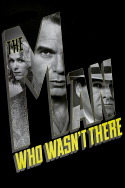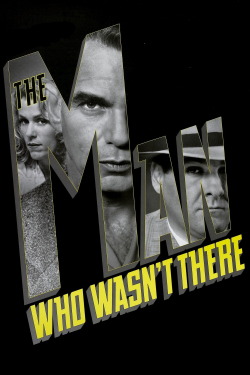
Review of The Man Who Wasn't There (2001) by Parker M — 25 May 2010
2.5 Stars out of 4.
Yesterday, upon the stair,.
I met a man who wasn't there.
He wasn't there again today.
I wish, I wish he'd go away...
When I came home last night at three.
The man was waiting there for me.
But when I looked around the hall.
I couldn't see him there at all!
Go away, go away, don't you come back any more!
Go away, go away, and please don't slam the door... (slam!).
Last night I saw upon the stair.
A little man who wasn't there.
He wasn't there again today.
Oh, how I wish he'd go away.
-- Antigonish by Hughes Mearns.
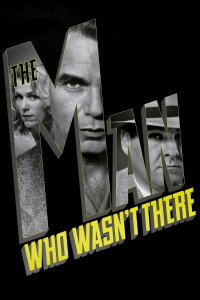
The Coen brothers' The Man Who Wasn't There has this irrefutable pessimism to it. This is the realm the Coen Brothers are so good at conquering (see Blood Simple and Fargo). To benefit its temperament, the film carries a neo-noir style -- the black and whites dialling in this perturb macabre. Being based, loosely, upon a poem called Antigonish from 1899, The Man Who Wasn't There acts like a monochromatic Sophocles au cinema. It tackles a society, centres the characters within it, and then discombobulates the two by giving them a shake. The two elements create a cynical mix. The Man Who Wasn't There is fascinating for its style, but the Coen's overrun the film with recyclable themes, contrived payoffs, and impassive characters. Even if the man was never there, you still have to feel for him. For that dreaded invisibility.
If you look at the poem, it acts as a paradox. A disgruntled omniscient narrator asks eagerly that a non-existent presence elude him or her. The better question is this invisible entity actually them? Is it the lack of individual substance that drives their angst? When you look at life as a paradox, it's eye-openingly dour. How pathetic are we really? The Coen Brothers' find the perfect actor to instil that sensation of loss and negativism. It's Billie Bob Thornton, playing the laconic Edward Crane, a barber. He reassures us: "don't worry, I'm just a barber." He's totally innocent, yet totally weak. He's a pessimistic misanthrope, and according to how society treats him, rightly so.
His drunkard wife, Doris (the underused Frances McDormand, a regular for the Coens'), is just as sad and loathing as Ed. She hides her shadiness with high-class attire and thick make up. The booze bring out her bigger problems. How pathetic is that? There's a moment in the film, when Ed questions if they should get married. "Shouldn't we get to learn more about each other?" He asks. Doris stares blankly: "why? Does it get any better?" Nice. The Coens' are excellent at proclaiming very counter-intuitive faux pas about society. It's like they love coming from another planet. But when Ed suspects that his wife is having an affair with the paunchy Big Dave (James Gandolfini), he blackmails Dave. Dave doesn't know it is Ed because Ed is working through an embezzler with a toupee. He assures Ed, with an obnoxious grunt: "I am not some fly by night schmuck." Why does Ed strive for such unscrupulous measures? It's his attack back against his world. He begins to think sometimes to make it in this world, you got to be dirty (how did Brad Pitt say it in Fight Club? "To make an omelet, you gotta break some eggs."). As per usual, things go horribly wrong, which allows the Coens to propel their glacial plot and enhance to their primary point: life is a bitch.
It seems The Man Who Wasn't There just begs for empathy. And rightly so. The film is layered with such dejected themes that you need to give it a cloak of sentiment. Ed is apathetic but we still need to feel for him. As if his degenerated behaviour is totally human and unfortunately real.
I admire the shots in The Man Who Wasn't There -- the low-key lighting, the shadowed figures, the lingering smoke of a crusty cigarette. These characters are quintessential film noir folk -- suave, low-brow, and zany. When a murder occurs, Doris is charged for it, when it is actually Ed who committed it. His laconic temperament becomes deflowered. He is no longer that innocent barber. But really, when was he ever innocent?
Ed and Doris's lawyer Freddy (Tony Shalhoub) is a true optimist. He thinks they got a crack at breaking this trial but Ed sits with a shaken head. He's remorseful and considers that life is no longer the way it will ever be anymore. No more garrulous fellow barbers to chat next to Ed, day-by-day, just adding to the overflowing meter of internal angst Ed has. His brother-in-law Frank (Michael Badalucco) talks away while Ed contemplates hair. It just keeps growing and growing -- it's a part of us, but we just throw it away. The Coens' again perforate their nifty perspective on nihilistic society.
The Coens' even throw in an attractive, young student named Birdy Abundas (Scarlett Johansson) who has a knack for piano. There is this meticulous energy between Ed and Birdy. It's not quite of Lolita standards, but they do have a liking for each other. Ed wants her to succeed in life. Forget the academics, pursue the tapping of ebony keys. If she has hope, he has hope. But there is a terrific scene involving a prestigious piano player named Jacques who submits to Ed that Birdy can play fine but she stinks. She just doesn't have that soul. It's viscerally vague, but we know exactly what this cocky frenchman is talking about. Life doesn't make sense which is why it makes sense.
Okay, so I have revered much about this movie. But it negates itself by not tapping us into these characters. It is emotionally distant, leaving you only to relish in its Wellesian style. Welles' most acclaimed film Citizen Kane had those piercing deep focus shots, darkly lit settings, but it also had magnetic characters. Their flaws became our flaws. It was as if we had said Rosebud too. In The Man Who Wasn't There, the Coens' fall in love with their themes, but forget to include us. Their pessimism is precise but the willingness to make us care is astray. When Doris is on trial she is such a sketch of a character that that part of that story is a write off. Life sure isn't fair but why contemplate that when there's no mean to focus upon?
By the time the ending winds down, it feels more predictable than melancholic. It ends on carnage not redemption -- the note the Coens love to end on. They make us think, not relish in all our answered questions. Because when does life really answer all our questions? Furthermore, the conclusion is hard to perceive as a retrospect because it comes off so contrived. It's too coincidental. Okay, so it enhances Ed's constant unluckiness, but his downfall acts more as a convenience to cap off the Coens' urgency to go out on a despondent limb.
The Man Who Wasn't There is slow, but its messages are tenacious. But so was Fargo and that had an irrefutable sentiment that made us never feel satisfied with the way things turn out. The problem was us, as humans. Our fallibility, our flawed mannerisms -- those reduced us.
If you pass life feeling a little amorphous, where no one dares to look at you and success never glances in your eye, you might as well fade away. That unwelcoming invisibility happens to all of us and it's so easy for it to take over our lives. It sounds depressing doesn't it? It should. But The Man Who Wasn't There maintains this opaque impassiveness which makes this more of a homage in style not ideas. I wish, I wish it'd go away.
I SAY--Rent It.
This review of The Man Who Wasn't There (2001) was written by Parker M on 25 May 2010.
The Man Who Wasn't There has generally received very positive reviews.
Was this review helpful?