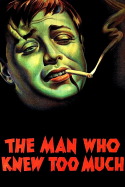
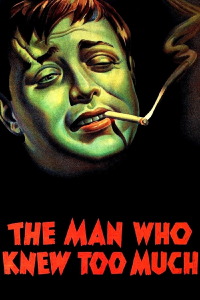
Review of The Man Who Knew Too Much (1934) by Edith N — 18 Apr 2011
Today's Version With Peter Lorre.
There are worse films to be your first one in a language you don't speak very well, and I bet Peter Lorre knew it. He basically conned Alfred Hitchcock, which I find pretty impressive, all things considered. He convinced the man that his English was good enough that he should be cast in the movie, and it wasn't. I mean, he pulls it off, and I'm not trying to claim that he doesn't. However, if you really listen to some of his lines, you can tell that he's learned them phonetically. He doesn't quite have the feel for how the language sounds which becomes so apparent in his later movies. He also plays a rather more debonair character than he would be typecast with later in his career, though of course still a villain. My understanding is that Peter Lorre was actually a pretty sweet guy, but it may be that he's funny-looking. It's hard to be a leading man if you're funny-looking.
Bob (Leslie Banks) and Jill (Edna Best) Lawrence are vacationing in Switzerland with their daughter, Betty (Nova Pilbeam). While there, they meet Abbott (Lorre), who charms the socks off Betty. They also get caught up somehow in the death of Louis Bernard (Pierre Fresnay), a French spy. Abbott and his co-conspirators kidnap Betty and send them back to England with instructions not to tell anyone at all about what they know if they ever want to see their daughter alive again. They somehow (I missed a lot of details) get sought out by people somewhere in the British government, who then seek out Abbott and the others. They are involved in a plan to assassinate an ambassador from some country or another during a concert at the Royal Albert Hall. Various government agents, Bob, and Betty are all held prisoner in some sort of religious temple, and Jill is at the Royal Albert Hall, but if she stops the assassination, she may lose her husband and daughter.
One of the people points out that, in July 1914, the Lawrences never would have heard of Archduke Franz Ferdinand, Sarajevo, or Gavrilo Princip, but a month later, the three came together in an event which changed the world. Similarly, though they'd never heard of this ambassador, his death could plunge the world back into war. (Though one suspects that they'd heard of the Royal Albert Hall.) It's a sobering thought, really, but that's often how history works. Franz Ferdinand wasn't even in the line of succession anymore--he married a commoner--but events are triggered by unusual things. Naturally, the conspirators can't be certain that an assassination would lead to such things. People get assassinated all the time. But Europe in 1934 was a pretty touchy place. After all, Peter Lorre was making English-language movies because he'd fled his homeland to get away from the Nazis. In five years, the world would be an even scarier place, and it wasn't unreasonable to assume that an assassination could have shortened that time.
This is before Hitchcock really hit his stride, I think, which may be why he remade the movie. (I will be watching the remake tomorrow.) He was already developing his main theme, though, which is the innocent caught up in events beyond their control. The Lawrences are no one important. They're well-off enough to be vacationing in Switzerland, and she's in some sort of competition at the beginning of the movie. (She's skeet shooting.) However, that may only be so that they're moving in the kind of circles which would get them into the story in the first place. They also, let's face it, have to have the kind of money where she can get a last-minute ticket to a concert at the Royal Albert Hall. One which is being broadcast on the radio. In general, though, they're out of their depth almost from the beginning. Heck, they're unimportant enough so that it passes almost without notice that they've returned from overseas without their daughter.
I don't know as much about early Hitchcock as I ought, I think. I've dabbled, and I do have a collection I picked up for five bucks last summer and haven't really gotten around to watching. (This might even be in it, but that's not why we're here now.) It's interesting to consider in comparison to where he would go by the end of things, though. I think his most fruitful years are those which encompass the remake. He was a very busy man in the '50s and '60s, and I think he probably liked it best. I am not, in general, all that into the [i]auteur[/i] theory, because filmmaking is far too complicated to be placed all on the head of a single individual, no matter how much of a control freak they are. But I do think you can frequently see the touch of certain individuals, that there are certain people who shaped enough of the films they made that they cannot be confused with the work of anyone else. Hitchcock was, when he made this, on his way toward being one of those people.
This review of The Man Who Knew Too Much (1934) was written by Edith N on 18 Apr 2011.
The Man Who Knew Too Much has generally received positive reviews.
Was this review helpful?