Review of The Man from Laramie (1955) by Jezzy A — 07 Nov 2005
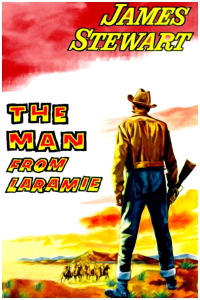
Between 1950 and 1955, director Anthony Mann ([i]The Fall of the Roman Empire[/i], [i][El Cid[/i]) and actor Jimmy Stewart ([i]Vertigo[/i], [i]Rear Window[/i]) collaborated on five, adult-oriented, psychological westerns, each featuring an obsessive, haunted lead character (soon to be Stewart?s specialty as the 1950s progressed). Beginning in 1950 with [i]Winchester ?73[/i] a revenge-themed western that follows the rifle of the title as it moves between several characters, continuing through [i]Bend in the River[/i], with Jimmy Stewart?s character-with-a-past leading a wagon train across a hostile wilderness and [i]The Naked Spur[/i], another revenge-themed western, this time with Jimmy Stewart as a determined, neurotic bounty hunter determined to bring his quarry in for a reward he hopes will transform his life, to Mann and Stewart?s final collaboration, [i]The Man From Laramie[/i], an ambitious, classical tragedy, with Jimmy Stewart?s character functioning as the catalyst for a series of complications and reversals that bear more than a passing resemblance to William Shakespeare's [i]King Lear[/i].
The owner of a modest freight service, Will Lockhart (James Stewart) arrives in Coronado, New Mexico (actually Santa Fe and Taos) with a wagon train full of pre-paid goods. Despite Lockhart?s good intentions, he?s quickly drawn into a struggle between different groups or individuals. Apparently misinformed that he can mine the local salt flats for cargo on his return journey, Lockhart encounters Dave Waggoman (Alex Nicol), the hotheaded, irresponsible, sadistic son of patriarch Alec Waggoman (Donald Crisp), the most powerful landowner/rancher in the territory. Dave, assuming that Lockhart and his men are thieves trespassing on his father?s property, reacts with casual violence, destroying Lockhart?s wagon train. Vic Hansbro (Arthur Kennedy, Waggoman?s foreman, temporarily saves Lockhart from Dave?s rage.
Lockhart retreats to a cold, hostile Coronado, with only Barbara Waggoman (Cathy O'Donnell), the owner of a dried goods store and Alec?s niece, and Kate Canady (Aline MacMahon), a landowner/rancher in her right, as potential allies. Lockhart, however, is interested in more than obtaining restitution for the loss of his property. Instead, he came to Coronado for a decidedly personal reason, one that involves rifles, the local Apaches, and the U.S. Cavalry. Vic, for his part, hopes to acquire a share of the ranch when Alec dies. Dave, weak, temperamental, and brutish, is Alec?s sole, undeserving heir, which Alec recognizes all too well. Lockhart?s presence sets in motion a series of conflicts that ripple out to include the Waggomans, Vic, and Kate. Although Alec, Dave, and Vic all perceive Lockhart as a threat to the fragile social order, it?s their own tortured relationships with one another that inevitably lead to violent confrontations between the men, none more brutal and sadistic than when Dave and Lockhart meet for the second time on the range.
What immediately stands out in any analysis of [i]The Man From Laramie[/i] are the unexpectedly rich characterizations and the layered revelations that gradually unmask the individual characters inner lives, motives, and backstories (unexpected in what appears to be a traditional western). If anything, Lockhart?s motivations, when revealed, are the most straightforward, making him less interesting than the characters of Alec and Vic. Alec is wealthy, powerful, but clearly in the twilight of a life full of regrets, especially in a son that never ceases to disappoint. Vic is equally complex, emerging as a sympathetic character corrupted by his own ambition, even when his actions are revealed as questionable, at best, or reprehensible, at worst. Dave may be a simple character, but even he?s given a scene that suggests a lifetime of disappointing his father and himself.
Credit, of course, begins with the screenplay by Philip Yordan and Frank Burt (based on a story by Thomas T. Flynn first published in the [i]Saturday Evening Post[/i]). Mann complements the screenplay with taut, dynamic direction of the dialogue, action scenes, and performances, but also in his eye for, at times, pictorially beautiful widescreen compositions in CinemaScope (the first western filmed in that format) unmatched by most other directors working within the genre (John Ford and the lesser known Budd Boetticher are the other two who immediately come to mind). Mann, however, wasn?t simply interested in pictorial beauty for its own sake, but in using visual compositions to suggest the inner, psychological states of his characters and their isolation within an impersonal, unforgiving natural environment.
This review of The Man from Laramie (1955) was written by Jezzy A on 07 Nov 2005.
The Man from Laramie has generally received positive reviews.
Was this review helpful?