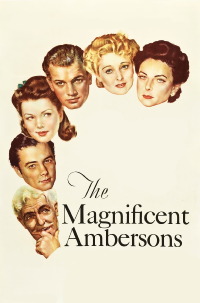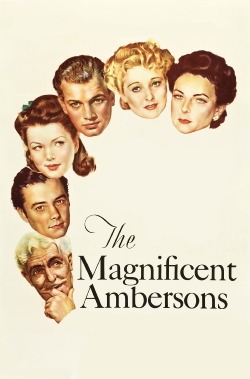
Review of The Magnificent Ambersons (1942) by Matthew D — 10 Dec 2018
A tragic romance set at the turn of the century.
Orson Welles wrote, directed, and narrated The Magnificent Ambersons (1942), only a year after his masterpiece Citizen Kane, as a phenomenally engaging drama about a failed romance, a spoiled child, and a changing landscape. Welles in crafting a thrilling, funny, and infuriating tale of love lost and rekindled. Welles was not allowed his final cut of Ambersons, but what we got is still one of the greatest films ever directed.
The long sweeping shots of the Ambersons' mansion, to the tender close up of the town folks' faces prove Welles' mastery of the camera. The beautiful use of black silhouettes against the dim lights of old houses is stunning. Likewise, the black and white lighting of faces in the dark is breathtaking. Welles makes great use of the old time setting to invent the automobile on screen, recreate old America, and find time to show the town's gossip. It's all as fun as seeing Welles pan up multiple flights of stairs as it is brilliant watching him panning away from Agnes Moorehead screaming in delirium. The unique perspective in how we see characters is unmistakably trademark Orson Welles' directorial style as an auteur.
Similarly, I love the use of Bernard Herrmann's score in the background to keep scenes lively or grand in feel. Again, what little remains of Herrmann's compositions in The Magnificent Ambersons is stunning and worth hearing. Welles knew how to incorporate Gothic sounding orchestral music with his intimate romance drama.
Aside from Welles' immaculate direction, the real draw to The Magnificent Ambersons is the fantastic acting from the wide cast. The leading actor, Joseph Cotten, gives an excellent and likable performance as the kindly romantic lead Mr. Eugene Morgan. He is so nice and patient, while Cotten plays him with a subtle sense of despair at his loved one's rejection. It's a fascinating performance from Cotten.
I have to mention the remarkable actress Agnes Moorehead in her portrayal of Fanny Amberson. I absolutely adored Agnes Moorehead in The Magnificent Ambersons. Her forlorn loneliness as the single Aunt Amberson is really touching as she longs for the unrequited affections of Eugene Morgan. I also liked her versatility as the desperate woman who feels empty to the raving madwoman driven to sadness. Her screaming monologue by the radiator is something to behold and my favorite scene in The Magnificent Ambersons. Moorehead practically steals the show with each moment she is on screen. I found her enchanting. No wonder Orson Welles once said Agnes Moorehead was his favorite actress.
Lastly, the other assorted supporting performances are really excellently cast. Dolores Costello as Isabel Amberson is so sad and upsetting that by the end, you truly felt sorry for her. Anne Baxter is a beam of sunshine and empathy in The Magnificent Ambersons that you cannot help but like Lucy Morgan. Ray Collins is very funny as Jack Amberson. Finally, Tim Holt is so revolting and domineering as George Amberson that his character often feels like the villain to the whole story. His antagonism and hatred for Eugene Morgan is so palpable and disgusting that I felt such a strong loathing for Holt himself. It is an incredibly powerful performance in his own regard.
Overall, The Magnificent Ambersons is highly underrated and deserves to be revisited by those that have overlooked it. Orson Welles continued his innovative direction from Citizen Kane into The Magnificent Ambersons. I hope this film is not forgotten.
This review of The Magnificent Ambersons (1942) was written by Matthew D on 10 Dec 2018.
The Magnificent Ambersons has generally received very positive reviews.
Was this review helpful?