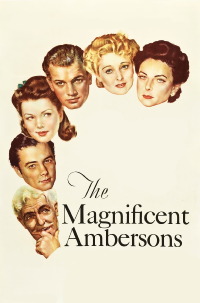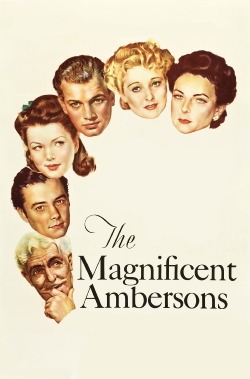
Review of The Magnificent Ambersons (1942) by Paul D — 10 Dec 2009
Citizen Kane, no matter what you may think of it personally, is undeniably one of the most important motion pictures ever made, and in 1942 Orson Welles faced the unenviable task of having to follow a masterpiece. Not to mention the fact that Citizen Kane was only his first movie, and he was merely 25 at the time. So, how did he do it? He turned his camera inward, making what I believe to be his most personal, and best, film.
The Ambersons are the kind of family that have been rich so long that nobody can remember how they got that way, and the youngest of the family, George (Tim Holt), is spoiled in a way only the very wealthy can afford. When George's father dies and an old flame of his mother's, a budding automotive magnate named Eugene Morgan (Joseph cotton), comes to town, George takes it upon himself to defend his family's archaic sense of honor, and in turn disregard his mother's happiness. Young George is fueled all the while by his bitter, spinster of an aunt, played by Agnes Moorhead in an award winning performance.
Though Welles doesn't appear in the picture as an actor, his voice is all over The Magnificent Ambersons, both literally as narrator and figuratively as the film's writer/director. Welles' speaking voice is the stuff of legend, and he uses it masterfully in the film's opening sequence. He speaks of the late 19th/early 20th century life with such fondness that we are immediately drawn into the picture. As a director, the visual style he and cinematographer Gregg Toland pioneered on Citizen Kane is just as strong here. Welles' use of light and shadow to set tone is widely imitated, but still largely unmatched.
It is well known that Ambersons was significantly altered, some would say butchered, after it's completion, from nearly 2 and a half hours down to 88 minutes. This naturally infuriated Welles, but I think it actually works to the film's benefit. The way that characters are spoke of before they are introduced to the audience, and sometimes disappear from the story without explanation is actually very realistic. It creates a ?fly on the wall? effect turning the audience in to guests of a family who don't care to acknowledge that we are even there.
What makes The Magnificent Ambersons Welles' best picture in my opinion is the personal connection he felt to the story. The film is based on a Pulitzer prize novel by Booth Tarkington, who had been a friend of the wealthy Welles family when Orson was young. Welles always believed that the story was based on his own family, and in particular, that he was the inspiration for the character of George. So, characters that may be looked at in a negative light by most people are treated with respect and compassion by Welles. This makes for an interesting and surprisingly moving study of wealth, and a beautiful motion picture.
This review of The Magnificent Ambersons (1942) was written by Paul D on 10 Dec 2009.
The Magnificent Ambersons has generally received very positive reviews.
Was this review helpful?