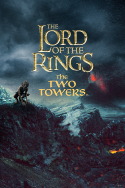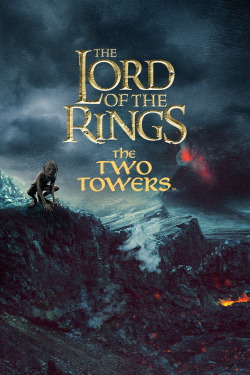
Review of The Lord of the Rings: The Two Towers (2002) by Thomas B — 30 Jan 2015
Peter Jackson left the entire world on a cliffhanger when he finished The Fellowship of the Ring. After having done such an impressive job with the first film and then having the balls to stay true to the source by finishing as he did, he was almost setting himself up to fail; giving himself a task even greater than the original undertaking: a sequel. Not just any sequel; a sequel to film being touted as one of the greatest fantasy films ever made and himself being declared a genius. This sort of hype is almost impossible to live up to. Almost. .
Taking up where its predecessor left off, The Two Towers follows Aragorn, Gimli and Legolas as they chase down a troop of Uruk-Hai, Frodo and Sam as they journey further towards Mordor and Merry and Pippin as they, well, get into lots of trouble. .
The story is much more divided in comparison to the first of the series with a fellowship of nine journeying together rather than three different groups and their various shenanigans. This is the first challenge to overcome for filmmaker Peter Jackson: how to tell all these stories in under four hours? Not only that, but how to allot time to the different storylines without 1) making it boring and 2) losing focus on the main story which just happens to be the more boring aspect of the source material: Frodo and Sam's trek towards Mordor. After all, how inventive can one director be with half the story taking up by two diminutive figures walking towards a place which they don't actually reach by the time the films finishes? .
It's almost as if Jackson hasn't noticed these issues as the second film is just as fulfilling and story-driven as the first without sacrificing any major plot points or basically getting rid of anything that would cause a fan outcry. Yes, technically the ents do show up to help at the battle of Helm's Deep and no we don't get to see Merry and Pippin in Treebeard's house or talking to Quickbeam but in the end, Peter Jackson has conquered these seemingly mammoth tasks with ease. This is a reflection on Jackson's instinct for pace, as the extended edition shows that these time-consuming though unnecessary scenes were in fact filmed, but were left on the editting floor. Jackson's fearlessness with the source material yet mindfullness of it as well means that the story is left completely intact; enough to appease any fan. Jackson has also made room for the lighter moments as well, revelling in the joy of discovery when Merry and Pippin first encounter Treebeard and having time for jokes between the double-act which just keeps getting better of Legolas and Gimli. Jackson doesn't forget about his characters either, keeping the film from feeling hollow by introducing the beautiful Miranda Otto as never-to-be love interest Eowyn and the abandoned-by-his-country Eomer as well as extending his existing characters in Merry and Pippin who only get more endearing, Frodo and Sam whose seemingly unflappable relationship is beginning to show some strain. And even though Gandalf's character goes under a major revamp he's still the same enigmatic mentor as before, albeit slightly more badass. It's this attention to detail which makes Peter Jackson's work so watchable, all the way through the crazy runtime. .
Shore's score is as strong as ever, this time bringing the beautiful theme of the world of men to the fore. Shore's understanding of motif and mood is pivotal here, even more so than Fellowship as the story isn't as driving as its predecessor. Because of this, Shore's score is able to ferry us through the slower moments and throughout the entire film. .
The performances here are just as textured as they were in the first film. Not only that, but the sequel factor means that actors are able to loosen up a little more, in particular in the case of Orlando Bloom's Legolas and John Rhys-Davies' Gimli. The two of them have more fun than it should be possible to have in an epic of this size and they pull it off without ever feeling camp or not taking it seriously enough. Ian McKellen's Gandalf is still the standout of the series but it's great to see the rest of the cast becoming more and more involved in their characters. Viggo Mortensen's Aragorn is one of the performances which shows a lot of progression. His presence has more gravitas in this one and his character is more layered than the original; more difficult to read. Elijah Wood has much less to do in this film, leaving him to keep mostly the same expression on his face for most of the film. While this may be true to story, it does occassionally make you wish that he had something else to do than walk around some rocks for a while. Sean Astin's Sam is similarly beleagured and while their parts of the film are integral to the story, you sometimes wish that we'd move back to the interesting parts a little sooner. Bernard Hill makes a great addition to the cast as Theoden as well as his onscreen daughter Eowyn played with fragile strength by Miranda Otto. Brad Dourif's Grima Wormtongue is fantastic; a slimy, manipulative groveller who snivells perfectly through every scene he's in. .
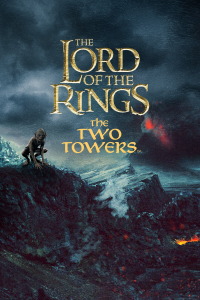
Another of Towers' achievements lies in another of its new characters: Gollum. Gollum is a completely CG creation, performed by Andy Serkis with groundbreaking technology, enabling Serkis to interact with the actual actors and thus makes the performances all the more real. This innovation makes for incredible viewing as one of the more unfilmmable sections of Tolkien's work is brought to life onscreen. Serkis' performance is largely discounted in terms of acting accolades but it's incredible to see. His work here set the benchmark for motion capture. .
But all these technical factors fade into the background at the Battle of Helm's Deep: a battle scene so epic that it drowns out everything that comes before it. Ten thousand Uruk-Hai facing off against Rohan's much depleted forces is so overwhelming that it makes it difficult to spot any kind of flaws in the rest of the film. Jackson seamlessly blend CG with fantastic costume and makeup to create an entirely believeable all out war which lives up to the scenes detailed in the book and revells in the little moments like Legolas riding a shield down some stairs or a rousing speech from King to King. Jackson's sense of pace throughout the battle is fantastic, moving from the Entmoot to Sam and Frodo without ever losing momentum. And the coup-de-grace of Gandalf's arrival is as breathtaking a moment as the series brings in any of its three films. .
While this may be the weaker cinematically of the three films, the fact that I'm still giving it five stars shows you just how high the bar is set for this series. The fact is that, despite lacking the grandeur of the third and the sense of wonder and scariness of the first, it's still a better film than 90% of the blockbusters Hollywood vomits up on regular basis. Truly incredible filmmaking. .
Defining Scene: .
The Battle at Helm's Deep. Of course.
This review of The Lord of the Rings: The Two Towers (2002) was written by Thomas B on 30 Jan 2015.
The Lord of the Rings: The Two Towers has generally received very positive reviews.
Was this review helpful?