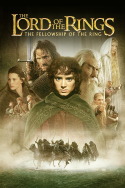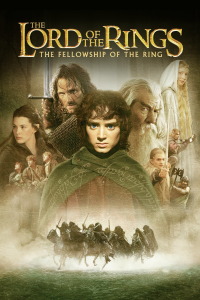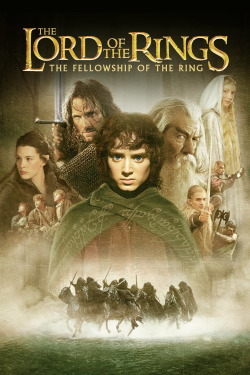
Review of The Lord of the Rings: The Fellowship of the Ring (2001) by Moviemastered — 22 Mar 2016
Partially adapted for the screen once before by Ralph Bakshi in an unsuccessful 1978 animated version, Tolkien’s 1,000-page yarn poses all manner of challenges for a screen transfer — imaginative, logistical and financial. With the final bill likely to come in somewhere near $400 million when production and marketing costs are all tallied, one has to credit New Line Cinema with a tremendous amount of guts for shooting the moon for all three pictures with a young New Zealand director with only one genuinely notable, and small-scaled, film (“Heavenly Creatures”) to his credit.
But Jackson must have convinced someone that he would do it right, a view thoroughly borne out by what’s up on the screen. Evocatively delineating the many aspects of Middle-Earth on tremendously diverse locations in New Zealand in resourceful collaboration with a massive crew, Jackson keeps a firm hand on the work’s central themes of good versus evil, rising to the occasion and group loyalty in the face of adversity, and always keeps things moving without getting bogged down in frills or effects for effects’ sake.
Pic’s main problem, however, is inherent in the odyssey-like structure of the tale; the “and then, and then, and then” nature of the narrative becomes necessarily repetitive and even a bit wearisome at times, and ultimately arbitrary in the sense that one battle more or less with the Orcs, Ringwraiths or Uruk-Hai wouldn’t have made much difference. Lack of dramatic arcs involving rising action, relaxation and interconnecting story strands unfortunately makes the film’s running time feel pretty much like the three hours it is.
The film also very well handles the matter of perspective and height differentiation between the Hobbits and Dwarfs, for example, who are meant to be less than four feet tall, and the human-scaled characters, something that must have been as difficult as many other more obvious effects. Andrew Lesnie’s lensing has its slightly murky moments but is predominantly muscular in putting forceful images on a large canvas.
While he has perhaps not written a classic epic adventure score in the manner of Korngold, Rozsa or Steiner, Howard Shore has composed two hours of music that is constantly supportive, creative and complementary to the action. As such, it represents an object lesson that handily points up how unnecessarily intrusive and insufferably distracting John Williams’ work is in “Harry Potter.”.
One place where “Harry” outflanks “Rings” is the in the starriness of its cast, but the film is nonetheless capably served. One hallmark of the players is their startlingly blue eyes, especially those of Wood, McKellen and Blanchett. Wood’s Frodo spends most of “Fellowship” coming to terms with his unwanted responsibility as Ringbearer, and is generally uncertain and frightened as a result, something that will no doubt change over the course of the two remaining installments. McKellen delivers Gandalf with great relish and gusto, giving the picture a shot in the arm whenever he’s around, which is often. Mortensen and Bean cut dynamic figures as Frodo’s expert swordsmen, Rhys-Davies is a barrel of fierce defiance, while horror vet Lee is silkilysuperb as the chief nemesis in a black tower. Blanchett and Tyler have relatively little to do, at least in this first episode, and the small attempts at humor, particularly with the tag-alongs Merry and Pippin, seem half-hearted and rote.
Still, New Line and company should be able to breathe a sigh of relief after the picture comes out, and there is little doubt that those who grab the “Rings” at the start will anxiously await Frodo’s trip into ever more perilous territory a year hence.
This review of The Lord of the Rings: The Fellowship of the Ring (2001) was written by Moviemastered on 22 Mar 2016.
The Lord of the Rings: The Fellowship of the Ring has generally received very positive reviews.
Was this review helpful?