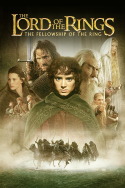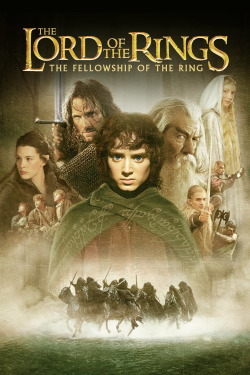
Review of The Lord of the Rings: The Fellowship of the Ring (2001) by Thomas B — 30 Jan 2015
When I was seven years old, my dad decided to begin reading a book to my sister and I. It was a big book and we didn't expect to be finishing it anytime soon, but my dad persevered and continued reading night after night, chapter after chapter. The creatures and characters which were conjured up in my mind as my dad read The Fellowship of the Ring, complete with voices and gestures, will remain with me forever. .
This is the challenge Peter Jackson was left with in creating the first in his Lord of the Rings trilogy: the collective imagination of literally millions of fans, each one filled with different intricacies and opinions concerning characters, settings, basically everything involved in production design and being a director in general. With such a burden weighing on Jackson's shoulders, no one would have blamed him if he simply curled into the foetal position and sobbed when he actually bagged the role of director. But I'm sure I speak for fans, critics and the entire world when I say that I'm so glad that he didn't. .
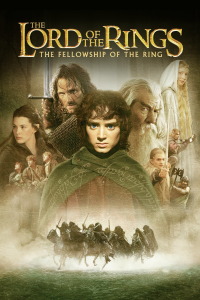
The first in the sweeping epic of the Lord of the Rings, The Fellowship of the Ring begins with the origin of the one ring; an object created by the dark lord Sauron in order to take over Middle Earth. After a battle sequence or two, we join up with our hero of the piece; Frodo Baggins, a Hobbit from the Shire. After finding out that his Uncle Bilbo's magic ring is in fact the ring in question, Frodo is forced to undertake a journey to Mordor in order to destroy the ring once and for all. A fellowship of nine warriors is formed in order to help Frodo on his journey and the quest begins. .
Even the synopsis above comes laden with backstory and explanation. What is a Hobbit? What is a Sauron? What is a Frodo? All these questions can mean that the film can become bogged down with explaining what the exact properties of Hobbit's feet are that they are able to never wear shoes or how exactly the Ringwraiths are able to survive at all. It is a credit to the script that none of this is explained, nor does it feel necessary to be explained. Even for a newcomer to Middle Earth, the escapist factor of the world onscreen is enough to dismiss any disbelief or need to find out how exactly shadow and flame combine to be a Balrog. Not only this, but the script also does a fantastic job of cutting out everything unnecessary in order to keep the storytelling lean. It also manages, while trimming the extra weight (in the form of things like Tom Bombadil), to keep the feeling of wonder that the books are so renknowned for. Many book adaptations can end up being driven by the story alone, allowing no time for the more emotional moments between characters and forgetting entirely to establish connections between them. Not so here, as every member of the fellowship is allowed their moment on the screen, from Boromir to Gimli, and all of them have their own distinct personality. .
This personality distinction can also be attributed to the perfectly cast ensemble. Every single character has their perfect corresponding actor to play their onscreen counterpart. J.R.R Tolkien, the books' author, actually endorsed Christopher Lee to be Gandalf (the two were good friends up until Tolkien's death), but despite this glowing reference, Ian McKellen was cast instead, Christopher Lee playing the part of Saruman. Looking at the finished product it's impossible to imagine the roles being reversed as the two are so perfect for their respective parts. The actors themselves do brilliantly. Viggo Mortensen is almost Eastwood-like in his understated effiency as Aragorn, John Rhys-Davies and Orlando Bloom make up one of the great double-acts of the pieces, the other being the hilarious Dominic Monaghan and Billy Boyd as Merry and Pippin. In this we even get to see a little more range from Elijah Wood which is not as evident in the sequels, mainly due to his character's role later on. The standouts, despite the entire ensemble performing fantastically, are Sean Bean as Boromir who displays more talent than National Treasure would give him credit for and Ian McKellen as Gandalf. His performance is the rock that the film can stand on and he seems as though he's not so much visiting Middle Earth as he's been living there his whole life. The gravitas he holds and the empathy he evokes is simply astounding and it's not until repeat viewings that this can really be seen. .
After having made limited successes like Heavenly Creatures and The Frighteners, Peter Jackson stepped up to the plate in a major way in directing the Fellowship of the Ring. As mentioned before, the strain could easily have proved too much but from the very first scene it's obvious that Jackson is more than adept at handling a sweeping epic such as this. As he deftly move through the opening battle sequences and into the beauty and serenity of Hobbiton, Jackson's camera is rarely still, sweeping through the incredible locations and swirling around his characters in a beautifully choreographed dance. Every single shot counts for something and the bare minimum is obviously never enough in Jackson's mind. This is the more beautifully photographed of the three, despite the grandeur and spectacle of the Return of the King. Rohan storming the armies of Mordor is all very well but it's scenes like the Wraiths attacking the four all but helpless Hobbits on Weathertop which leave the most lasting impressions. Jackson's versatility is also on full display here as he moves through the autumn shades of Rivendell to the cold stone of Moria to the eerie blue-green of Lothlorien, every setting is perfectly captured by Jackson's lens. And does he know how to bring the fight scenes. Mr. Bay could take a few pointers in terms of how to shoot a battle scene, whether in the dark of Balin's tomb or the leafy surrounds of Parth Galen, every moment counts and every movement is felt, rather than the mindless slugging out of giant robots. .
The score of Shore also deserves a lot of the credit for fully immersing the audience in the onscreen world. Howard Shore's unmistakable tune is applied liberally throughout the film but it works perfectly every time. The themes and motifs which he includes according to character or even species is astounding. The nostalgia of Hobbiton is beautifully underscored with one of the more subdued peices of the soundtrack but the thundering main theme is as powerful and overwhelming as you would hope it would be and then some. It's no surprise that one of the four Oscars the first film won was for Shore's score (teehee). .
It's the complete immersion in the world of Middle Earth which makes this film so incredible. Despite the film's runtime being close to 3 hours long, even longer in the extended version, it never feels taxing to sit and soak up the breathtaking surrounds. Where some films can feel like a chore at two hours, it's almost impossible to keep from loading the next film instantly after finishing the first one thanks to the incredible power to entrance the film holds. The combination of flawless production design from props to locations along with the beautifully crafted story and faultless direction makes this film one of the greatest of all time. .
Defining Scene: .
The attack on Weathertop. Despite being comprised of far fewer parties than many other battles in the series, the terrifying Ringwraiths more than make up for it.
This review of The Lord of the Rings: The Fellowship of the Ring (2001) was written by Thomas B on 30 Jan 2015.
The Lord of the Rings: The Fellowship of the Ring has generally received very positive reviews.
Was this review helpful?