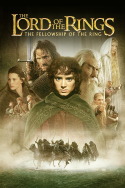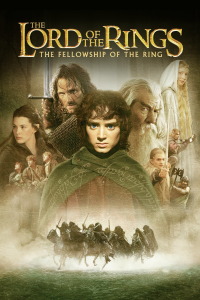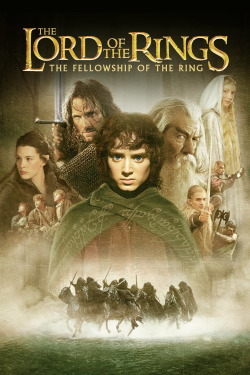
Review of The Lord of the Rings: The Fellowship of the Ring (2001) by Cinemasins — 09 May 2015
In the pantheon of fantasy writers, no diety is treated with greater reverence than J.R.R. Tolkien, who is regarded by most readers as the Father of Modern Fantasy. During the past three decades, the fantasy area in bookstores has expanded from a minor subsection of science fiction to a major category in its own right. A couple dozen titles have been replaced by hundreds. Fantasy has gone from being a cult genre to entering the mainstream. This would not have happened without the popularity and influence of Tolkien's The Hobbit and The Lord of the Rings. Nearly every published fantasy author acknowledges having read and been inspired by Tolkien's canon, and, while The Lord of the Rings may not be the longest or most complex fantasy series to date, it remains the standard against which all similar works are measured. It is the epic fantasy series.
When Tolkien began writing The Hobbit in the 1930s, he was unaware that he was essentially defining a genre. Tolkien was not the first author to write what would eventually be labeled as "fantasy", but his synthesis of elements - mythology, stories of larger-than-life heroism, the supernatural, and fairy tales - was unique. Nothing on the scale or scope of The Hobbit and The Lord of the Rings had previously been seen - not even the legends of King Arthur, Merlin, and Camelot were as well developed or executed.
To say that fantasy movies have not been a big draw at the box office is to understate the matter. A lot of this has had to do with the poor quality of the product. Consider the evidence: titles like Willow, Dragonheart, and Dungeons and Dragons. Finally, 2001 has seen the belated emergence of fantasy as a legitimate cinematic genre. Harry Potter and the Sorcerer's Stone was one of the year's most anticipated releases and, by the end of December, it will be one of the top money-makers of the past 12 months. Now, along comes The Lord of the Rings, as anticipated for 30-50 year olds and Harry Potter was for their children.
As entertaining as Harry Potter may be, it cannot hold a candle to The Lord of the Rings: The Fellowship of the Ring. With this production, Jackson has used The Lord of the Rings to re-invent fantasy for the cinema in the same way that the novel provided the blueprint for the written word. This astounding movie accomplishes what no other fantasy film has been able to do: transport viewers to an entirely different reality, immerse them in it, and maroon them there for nearly three hours. The Lord of the Rings: The Fellowship of the Ring brings Middle Earth to glorious life. From the first moment of the first reel, I was there.
Lord of the Rings devotees will be delighted to learn that the motion picture adaptation is as faithful as one could imagine possible (and, consequently, is nearly three hours in length). Jackson and his co-screenwriters (Fran Walsh & Philippa Boyens) do an excellent job condensing more than five hundred pages of text into a script that never feels choppy, uneven, or rushed. The Fellowship of the Ring moves fluidly and, in the process, exhilarates. Certain scenes have been cut or condensed in the name of pacing, and the role of one character (Arwen) has been expanded to enhance a romantic angle, something that was largely absent from Tolkien's work.
In crafting his vision of Middle Earth, Jackson has employed all of the tricks available to him: miniatures, deceptive camera angles, location shooting, impressive set design, and matte paintings. He has also made use of computer graphics, but not to the extent that another director might have. Thus, The Lord of the Rings has a less artificial appearance than might have been the case if Jackson had relied too heavily on CGI technology. Andrew Lesnie's camerawork has the grand scope expected in an epic motion picture, and Howard Shore's score, which is at times heroic and at times thoughtful, compliments the visuals without ever calling attention to itself.
The strength of Jackson's vision as depicted in The Fellowship of the Ring gives movie-goers cause to hope that we may be in the midst of a cinematic achievement. If The Two Towers and The Return of the King live up to the standard set by this film, The Lord of the Rings will become a milestone not only for its genre, but for motion pictures in general. But, regardless of what the future brings, the single movie we now have before us stands out as one of the most rousing examples of entertainment to reach multiplexes in a long time. At last, someone has figured out how to do an epic fantasy justice on the big screen.
This review of The Lord of the Rings: The Fellowship of the Ring (2001) was written by Cinemasins on 09 May 2015.
The Lord of the Rings: The Fellowship of the Ring has generally received very positive reviews.
Was this review helpful?