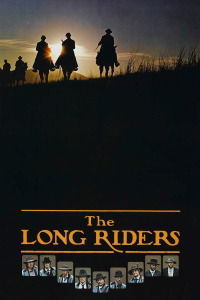
Review of The Long Riders (1980) by R.c. K — 19 Jan 2008
On a small Missouri farm.
Back when the west was young.
Two boys learned to rope and ride.
And be handy with a gun.
War broke out between the states.
And they joined up with Quantrill.
And it was over in Clay Count.
That Frank and Jesse finally learned to kill...
How could I, Warren Zevon fanatic that I am, resist beginning a review of a film about the James-Younger gang with a quote from his immortal song "Frank and Jesse James"? Obviously, however I could have done so, I didn't, so let's move on.
I know what drew me to this film was my fascination with the idea of the dynamic between real-life brothers portraying brothers onscreen. Really, I'd have been interested to see this mess of folks regardless of their playing brothers. It's inherently fascinating. What brothers do I speak of? The Keach brothers, James and Stacy, playing the James brothers, Jesse and Frank respectively; the Carradine brothers playing the Youngers, David (Cole), Keith (Jim), Robert (Bob); the Quaids playing the Millers--Dennis (Ed) and Randy (Clell); and the Guests as the Fords--Nicolas (Robert/Bob) and Christopher (Charlie). Yes, not only one set, but a full-fledged four. The Keach brothers also had a hand in the scripting, though four pairs of hands (assuming, of course, everyone has all of theirs) were in total, so how much is unknown.
However, despite all of these names (I'm big on David Carradine, Stacy Keach, Christopher Guest in comedic roles and like Robert, Dennis and Randy well enough--but had never seen Keith, James or Nicolas before to my knowledge) no one really held out as a star or jumped out as a focus. And with this, suddenly, I finally got Walter Hill, who directed this. I've seen 48 Hrs (my first experience) and The Warriors (both versions) and Last Man Standing and of course, my recent love, Streets of Fire. 48 Hrs always seemed odd to me--I was expecting an Eddie Murphy vehicle along the lines of Beverly Hills Cop. It's not. Hard Times was, I think, my first exposure to Charles Bronson. The Warriors did something funny as well. I wasn't sure what, but that time I liked it a lot. Last Man Standing I had even more trouble with. Watching this film I finally, finally understood. The Warriors works and Streets of Fire works for the same reason I had trouble with the two films that had big names in the major roles--Hill treats everyone the same. There AREN'T stars or standouts or big flashy anything. This isn't to say Hill doesn't delve deep into style. His films are all terribly stylish--sometimes to near excess (or beyond).
No one assumes control of this movie as an actor. We've got strong lead actors all over the place, we've got very charismatic actors, too. But there's not even fighting for control, there's not a sense of "Oh, he's the lead, wait, he is, no, it's him.." Interestingly, the less familiar in all cases seems to end up in control in each family--James Keach (outside of this, I didn't even know there WAS one...) and David Carradine (my favourite Carradine, so no opposition here) and Randy Quaid (the two of them are probably the most famous of all and nearest to equal, but Dennis has gotten more leading roles, or at least it feels like it) and even Nicolas Guest (again, no idea he existed). But even with that in mind, that they all seem to be the "leads" in their families, it's still not controlling lead roles. There's this feeling of the entire film being shared by the entire gang, if not everyone in the entire movie. I was previously interpretting that as an error, as if Hill had somehow forgotten to put actors in, even though they were all there. Now I get it, and I'm in awe of what kind of skill it must take to give a film over to everyone--though it may, in the end, give Hill the greatest role of all, I suppose. Still, to be able to remove the focus that is seen in almost any other film, managing to do something that is only subtly and yet so radically different...it makes me want to watch all of his movies again with this in mind.
Oh, right, the movie. This is the James-Younger gang, moving from its peak on down to its dissolution and the assasination of Jesse James. It moves along in the same way, plotwise, that Hill approaches characters and actors, it seems. No scenes are pivotal, despite the greater importance of some events, like their eventual attempt on a Minnesota bank outside their homestate. Somehow it all becomes shared ground, blending into one seamless experience in its entirety and managing to completely avoid deadening the entire thing in the process. I know I'm probably getting a tad hyperbolic here, but I was absolutely enraptured by the whole thing and ended up drawn into every single character instead of just one, never feeling that Robert Carradine was even suggesting his most famous, or at least most identifiable, role (as the lead in Revenge of the Nerds) nor that Stacy was exuding his usual villainous menace, or that Dennis was the usual strong lead, or that David was that aloof and wise sort. Expectations all around were almost turned on their ears; now Stacy is a humble and quiet follower of his charismatic and fairly enigmatic brother, Dennis the screw-up slob, Randy the more dominant and wild--it was absolutely magnetic to see all these performances working not against each other but in unison.
Ry Cooder works for the first time with Hill and builds a fabulous score of noodling slide guitar over accents played by fiddles and other strings, managing to get both the lonesome, neverending, exhausting ride of bankrobbers unable to truly settle and the sad aspects of the loss they all experience at one point or another. I almost want to compare it to the work he did on Streets of Fire, but it's not appropriate--both are perfect marriages of the visual style to the auditory, and both are completely different styles to marry in the first place. Sweeping and pulling scene changes feel age-appropriate by virtue of their own aged use, despite the fact that realistically no scene change can be relevant, temporally, to a time before film.
What is immediately apparent, though, is the influence of Sam Peckinpah. This is a violent film, and Hill has no qualms about showing it. Because of how he makes us interact with the characters, it's never pleasant, even as he uses viciously painful looking squibs and balletic slow motion, just in the fashion that Peckinpah did. It accentuates it, but makes it instead of "pretty" or "cool" horrifying and unpleasant. It's interesting for a man known for action films to be able to do this--it's strange how he is so stylistic, yet somehow doesn't feel like he's sacrificing reality for it, but neither is he embracing reality. This balance adds further to this strange muted accentuation he builds into everything, pushing it all to the forefront, just as he pulls it all back and evens it out, giving a solidly unified feel to the entirety that one doesn't see in any other director that readily comes to mind.
Final note: yes, our good friend (and apparently Hill's) James Remar (also known as The Warriors' Ajax or 48 Hrs. Ganz (amongst a host of other roles) appears as one Sam Starr, half Indian wife of the whore Cole Younger is infatuated with. Of course, Peter Jason also appears--who is used constantly by Hill (48 Hrs.' racist bartender, a cop in Streets of Fire, etc) and also John Carpenter (I managed to identify him because I distinctly remember him from his role in my former favourite movie ever, In the Mouth of Madness) and here appears as a member of the Pinkerton National Detective Agency tracking down the James-Younger gang.
This review of The Long Riders (1980) was written by R.c. K on 19 Jan 2008.
The Long Riders has generally received positive reviews.
Was this review helpful?