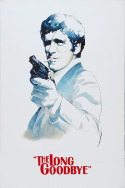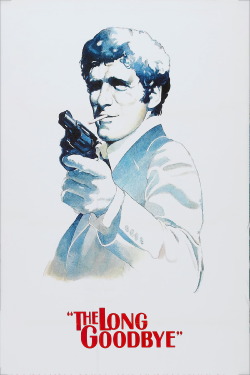
Review of The Long Goodbye (1973) by Pierluigi P — 25 Jun 2010
When he awakens at the beginning of the movie, private eye Philip Marlowe is a 1953 character in a 1973 domain. He wears a dark suit, white shirt and skinny tie, yet sees flower power and nude yoga each time he steps out of his apartment. He chain-smokes, and no one else seems to take even a drag. He is allegiant to Terry Lennox and calls him his friend, but all we see is a scene of them playing conversational poker. Marlowe carries a $5,000 bill for most of the movie, but doesn't commit to the risks he takes with a big pay-off in mind.
Bogie, Mitchum, Montgomery and Powell were concise and watchful. They show us in their stylish ways contempt for phonies and resentment for trivialities. Gould's Marlowe is virtually unflappable and wryly cynical. He's not that terribly dissimilar from the other Marlowes we're used to, but the film seems to almost parody Chandler's icon by having him deliver a wandering discourse that plays as a dazed narration to himself. Gould's Marlowe has a cat, and in the endearing pre-credit opening sequence he tries to persuade the cat he is providing its preferred cat food, but the cat is no rube, so he goes out in the wee hours of the morning to buy the right can. There is no narrative reason for this sequence, except that it establishes Marlowe as a guy who, no matter how dry, has a heart, and that his cat is his one true friend.
The story can be explained in a spare sentence or a roundabout monologue. At any rate, how everyone connects to each other doesn't interest Altman nearly as much as the texture and atmosphere of the film. Probing the ever-shifting line between fantasy and reality, he wants to show a private eye from the noir era floundering through a plot he is maybe too old-fashioned to wrap his mind around. The movie's aesthetic approach accents his bewilderment. Altman and his cinematographer, Vilmos Zsigmond, "flashed" the color film with delicately gauged extra light, to give it a bleached, pastel look, as if Marlowe's domain evades rich colors and acute delineation. Most of the shots are filmed through cloudy foregrounds: Panes of glass, trees and shrubbery, building nuances, all skewing our view.
The trademark Altman overlapping dialogue makes it seem like Marlowe doesn't get wise to everything around him. Far from objecting to the darkness in his world as he did in older Chandler adaptations, Marlowe periodically recaps the fantastic logline, "It's all right with me." The line was ad-libbed by Gould, and he and Altman chose to make it a cynical motto. In a way there is another, in character with Altman's penchant for the self-reflexive use of sound and music: The title theme, which is almost the only music in the film. It plays constantly with various performers, even a Mexican mariachi band, with the sheet score pinned to some guy's shirt. I guess Altman found it funny in that detached, cynical way that Gould's Marlowe finds so many things amusing. The film is full of unexpected humor, which is often funnier than when it's expected. I laughed the most when Marlowe hand-walks a gangster's blockhead henchman through the basics of tailing him.
Casting is pivotal to film noir since the actors in the genre's essential works tend to show up already en route to their destinies. Altman's actors are as surprising as they are destined. Sterling Hayden, a humiliated lion, growls and bluffs in futility at his pathetic situation. Mark Rydell, a director, sounds as if to siphon Martin Scorsese's speech patterns in a performance that utilizes laborious politeness as a masquerade for a barbarism only the dumbest of thugs would follow; this notion is used to hilarious effect. And Gould is a Marlowe lunged into a play where everybody else knows their parts. He rambles carping and baffled, and then abruptly gets precisely what he must do.
This screamingly iconoclastic condemnation of a movie should not be anybody's first film noir, nor their first Robert Altman movie. Its entire impact comes from the way it messes with the genre and the way Altman's admirable signature attempt to subvert some of American history's most forthright myths frustrates the basis of all private eye movies, which is that the hero can walk through murky alleys, see beyond doubt, and tell right from wrong. The man of dignity from the 1950s is lost in the punch-drunk self-seeking of the 1970s.
This review of The Long Goodbye (1973) was written by Pierluigi P on 25 Jun 2010.
The Long Goodbye has generally received very positive reviews.
Was this review helpful?