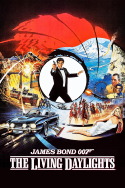
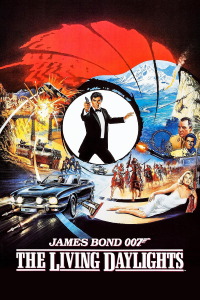
Review of The Living Daylights (1987) by Ola G — 19 Dec 2014
James Bond-Agent 007 (Timothy Dalton)- is assigned to aid the defection of a KGB officer, General Georgi Koskov (Jeroen Krabbé), covering his escape from a concert hall in Bratislava, Czechoslovakia during the orchestra's intermission. During the mission, Bond notices that the KGB sniper assigned to prevent Koskov's escape is a female cellist from the orchestra. Disobeying his orders to kill the sniper, he instead shoots the rifle from her hands, then uses the Trans-Siberian Pipeline to smuggle Koskov across the border into Austria and then on to Britain. In his post-defection debriefing, Koskov informs MI6 that the KGB's old policy of Smiert Spionom, meaning Death to Spies, has been revived by General Leonid Pushkin (John Rhys-Davies), the new head of the KGB. Koskov is later abducted from the safe-house and assumed to have been taken back to Moscow. Bond is directed to track down Pushkin in Tangier and kill him in order to forestall further killings of agents and escalation of tensions between the Soviet Union and the West. Although Bond's prior knowledge of Pushkin initially leads him to doubt Koskov's claims, he agrees to carry out the mission when he learns that the assassin who killed 004 left a note bearing the same message, "Smiert Spionom." Bond returns to Bratislava to track down the cellist, Kara Milovy (Maryam d'Abo). He determines that Koskov's entire defection was staged, and that Milovy is actually Koskov's girlfriend. Bond convinces Milovy that he is a friend of Koskov's and persuades her to accompany him to Vienna, supposedly to be reunited with him. Meanwhile, Pushkin meets with arms dealer Brad Whitaker (Joe Don Baker) in Tangier, informing him that the KGB is cancelling an arms deal previously arranged between Koskov and Whitaker. During his brief tryst with Milovy in Vienna, Bond meets his MI6 ally, Saunders, who discovers a history of financial dealings between Koskov and Whitaker. As he leaves their meeting, Saunders is killed by Necros (Andreas Wisniewski), Koskov and Whitaker's henchman, who again leaves the message "Smiert Spionom." Bond is forced to hunt down both Koskov and Whitaker to stop their evil plans...
Timothy Dalton was originally unavailable to play Bond, and Pierce Brosnan was then chosen to play 007 in 1986 and was given the script to The Living Daylights (1987). Although he was contracted to Remington Steele (1982) for seven seasons, NBC decided to cancel the show at the end of the fourth season, which meant that Brosnan was free to play James Bond in The Living Daylights the following year. However, shortly after the end of the fourth season, NBC had second thoughts about canceling Remington Steele and subsequently approached the Bond producers directly, in an attempt to strike a deal that would allow Brosnan to play both James Bond and Remington Steele the following year. NBC also offered to completely reschedule the shooting of Remington Steele to ensure that there were no scheduling conflicts. But eventually, Albert R. Broccoli famously told NBC that "James Bond will not be Remington Steele and Remington Steele will not be James Bond." Accordingly, Brosnan would only play Bond if the show remained canceled. NBC had a 60 day deadline to revoke their decision to cancel Remington Steele series and at 6.30pm on the 60th day of the deadline, Brosnan learned that NBC decided to make a fifth season. The Bond producers subsequently prevented Brosnan from becoming the next James Bond. Subsequently, the role went to Timothy Dalton, who was now finally available. NBC went on to make only six episodes of the fifth season of Remington Steele before finally canceling the show for good. Timothy Dalton was originally considered already for the role of James Bond in the late 1960s, after Sean Connery left the role following You Only Live Twice (1967). Dalton was screen tested by Albert R. Broccoli for On Her Majesty's Secret Service (1969) but he turned down the part as he thought he was too young. He was also considered for Diamonds Are Forever (1971) but turned it down again, still feeling he was too young. He was considered again for the role in For Your Eyes Only (1981) when for a time it was unclear whether Roger Moore would return. However, Dalton declined at that time, as there was no script (or even first draft). Dalton was offered the role again in 1983 for Octopussy (1983), and yet again in 1985 for A View to a Kill (1985), but had to decline the role both times due to previous commitments. IGN lauded the film for bringing back realism and espionage to the film series, and showing James Bond's dark side. Many, including John J. Puccio and Chuck O'Leary, praised Timothy Dalton's performance and his performing most of the stunts himself. The Washington Post even said Dalton developed "the best Bond ever." Roger Ebert of the Chicago Sun-Times criticised the lack of humour in the protagonist. The funny part with reading all this surrounding "The Living Daylights" is that I can´t really understand the process of hunting down Timothy Dalton to play Bond for so many years, the movie itself and the very positive critique of the movie. I reckon I do need to reflect on the fact that this took place in 1986-1987 and I did see it at the movies when it came out then, and a new Bond movie was a big big thing in the 80s. Not maybe the same today, even if the current part of the Bond franchise is very successful. Re-seeing "The Living Daylights" ends up on the less good movies shelf for me. Timothy Dalton seems unfocused, not really fitting the Bond costume, slightly poor in his acting in some scenes and the humour bit doesn´t work at all compared to how Moore tackled the funny parts in his Bond movies. The movie is shot ok in some scenes, bad green screens and stage environments in others. You can clearly see the use of stuntmen instead of the real actors in several scenes (nothing new in terms of Bond though). The general vibe and feeling is a poor mans Bond in my point of view. The action is ok in some scenes, pretty shitty in other scenes. The bad guys don´t really come off as all that bad. Reviewers claim that this is "dark", I don´t agree at all to that. As far as I remember, "Licence To Kill" was a hell of a lot more darker than this. I personally think this is amongst the worst Bond movies made. The best part in this mess? A-ha´s title song and the stunning Maryam d'Abo.
This review of The Living Daylights (1987) was written by Ola G on 19 Dec 2014.
The Living Daylights has generally received positive reviews.
Was this review helpful?