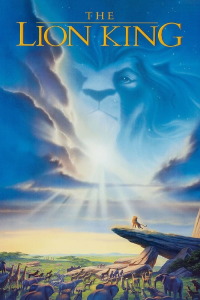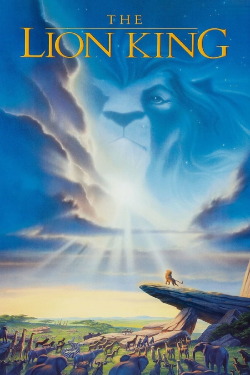
Review of The Lion King (1994) by John W — 21 Oct 2014
Like many kids of my generation and those surrounding it, "THE LION KING" was one of my favorite films growing up and to this day still remains up there. Because if anything, I have only been able to get even more respect for it as I've developed a more analytical and critical personality with regards to film and storytelling in general. Something I have noticed with some other Disney films as well. Because in something a colorful cartoon with lions, for instance, there actually is a well developed story. It is one that admittedly many people will not shy away from noting owes a bit to both William Shakespeare's "HAMLET" and the anime series "KIMBA: THE WHITE LION", some to the detriment of the film. And while the influence of those on this are near undeniable I do think certain comparisons are blown out of proportion beyond superficial elements and that this film manages in my opinion to both easily and strongly carve out its own identity in spite of that as an exceedingly well told coming-of-age story about both growing up into an adult and accepting the responsibility that comes with it. Now for all two of you who have not seen the movie yet, keep in mind that this is going to be spoiler-heavy. So take that into consideration before deciding to read on.
Something I have been noticing more and more with Disney films as I have been growing older is how many cases there are of the villain being a twisted shadow of sorts to the hero. And Scar fits that category perfectly. And in that regard, is pretty well the pure antithesis to the idea of the "coming-of-age" arc as a whole. Very much being a "shadow" of sorts to Simba, with his key flaws largely being exaggerated versions of Simba's own, and in many ways is what Simba could have very well grown into. And in order to touch on why that all works, as it's the crux of the film, I think the best way to go about it is to discuss the beats of the story with regards to the actions of those two characters, particularly in how they compare and contrast in their decisions.
Both characters start out full of themselves, both act irresponsibly, and both desperately want to become king. Simba gets it into his head that he is pretty well untouchable and can do whatever he wants because he is next in line to the throne. Illustrated in places where Simba impetuously wakes his parents because he is eager to get to have that tour of the kingdom he was promised, which is not inherently a bad thing mind you since he is aching to spend time with his father but is just going about it a bit rudely, and later on when he against all warning from his father goes out to the elephant graveyard just as a means to show how brave he is, and even winds up taking a friend along in spite of the potential danger as well. And when they get there, even when confronted by the hyenas Shenzi, Banzai, and Ed naively asserts that they cannot hurt them because he is king of the Pride Lands. But he comes to quickly learn that the world isn't so simple, and he and Nala are almost killed and would have been if it had not been for the intervention of Mufasa. That event and Mufasa's talk with him afterward helping to provide him with some real perspective, and is his first step to adulthood. I have heard some complaints in more recent times from people who find Simba to be an unlikable protagonist for such reasons. I don't think that is the case, as they do portray him as clearly caring about his family and friends, even if he is a tad rude and makes irresponsible decisions with them. But the point is that he grows, and by the end of the film he does, and so I think it all plays. Simba was kind of supposed to be overly entitled at the beginning, and as I've said before that is the point. Now naturally everyone is free to perceive the film and character as they want, film is art after all, but I just thought it was worth noting.
On the flip side Scar who is jealous of all the recognition his brother gets decides to try and secure the throne for himself even though he does not seem to either care about or understand the weight of the responsibility that comes with it. It is also notable that both he and Simba are not above bullying/making-fun of his "servants" as displayed in the way Simba treats Zazu when he is just trying to do his job in watching over Simba, or how Scar often belittles the Hyenas a lot of the time and even similarly was shown disrespecting Zazu at the beginning of the film as well.
The big thing that got me to notice all of the thematic paralleling between the two characters on later viewings is when I noticed how complimentary the songs "I Just Can't Wait to Be King" and "Be Prepared" are to each other. Because when you get right down to it, at their core Sima and Scar are essentially singing about the same thing in their respective big musical numbers. Both are singing, with a group of their "subjects" joining in, about how excited they are about becoming king and asserting how great and wonderful they are and will be after they receive the recognition they are deserved. Both songs even end with their respective characters ascending on some really outrageous spire of sorts, one of animals stacking themselves on top of each other and the other a rock spire being sent up due to volcanic activity, as if to represent their own soaring egos.
A complaint I have heard from quite a few others at this point, though the first place I had heard it was from the famous online critic Doug Walker, is that they feel that Scar ceases to be interesting if not outright goes outside of his established character in the scenes where we see him as king of the Pride Lands. However, I would keep all of this in mind when judging his character because I think it works in favor of the film's main themes. The story, as said before, is a coming-of-age story about accepting responsibility. And that is what Simba's arc is all about. And thus I don't think it is a coincidence that after a long stretch of time as king, Scar to be annoyed when he is confronted with all of the legitimate responsibility that comes with the job, seeming to shirk things off to others like the Lionesses, and even acts like a petulant child in how he thinks he is entitled to have everything his way as shown when Sarabi confronts him and tries to tell him that they have to move on from the Pride Lands. Him getting defensive and trying to pin the state of things on the Lionesses rather than to accept responsibility for the degradation of the Pride Lands being his fault. Asserting "You're just not looking hard enough." Not so differently from how Simba acts at the start of the film. Though he is both intelligent and manipulative to be sure, he does not seem to have the emotional capacity to really deal with the major problems he must deal with as king and thus it is fitting that after he's been dealing with it for so long that he'd regress and become annoyed as much as he had. Though again, that is not to degrade his capabilities as a villain completely. When in his element, he is more than capable. As displayed when Simba returns and he quickly manages to regain control of the situation and almost take out Simba by playing with his head through his guilt over Mufasa's death.
And while he is not in direct control of anything like Scar is in the middle act of the film. Simba is also wallowing in irresponsibility in how he stays away from the Pride Lands living an easy life out in paradise where there are no rules and he has no responsibility to anyone or anything. Afraid to go back, and having to own up to the "accidental" death of his father and enjoying his life "With no worries". This changes when Nala shows up and tells him about all that had transpired, including how Scar's reign has been leading to the rotting of their land. Events that he had indirectly allowed to transpire because he had before refused to own up for what happened before. Though he feels bad about it, he refuses Nala's plea to return. And it is only after further rumination on his part and talking with both the sage Rafiki and the spirit of his father that he musters up the ability to put that wrong behind him, and return to accept responsibility in order to set things right.
That is essentially the moment where Simba finally decides to "grow up". He decides to face a hard situation because he has to and decides not to shirk it off. In contrast to Scar, who appears to have never managed to truly do the same. Even during the finale we are given signs of Simba's ability to grow, and Scar's flaw of remaining stagnant. Simba manages to return still thinking that Mufasa's blood was on his hands (or, well...paws rather. Seeing as we're talking about lions here. LOL) Mufasa himself interestingly enough did not take the opportunity to tell him the truth as if he knew this would be an important test to measure the character and mettle of his son, confronts Scar and eventually manages to retake the Pride Lands from him. In this time he learns that Scar had actually been the one to organize the death of his father, and becomes enraged and is filled with the desire to kill him. When he has the chance however Simba, knowing that the battle was pretty well won and that he'd have no need to, relents in spite of his desire. Asserting to Scar that, "I'm not like you" and gives him the ultimatum to leave and never return. Though he'd live in shame because of what happened, he would still get to live. The final sign showing how far Simba has gone. All of which is unlike Scar, who was willing to kill relatives in order to try and fulfill his own shady desires. Putting his honor/responsibility above that more malicious desire. Scar on the other hand during the finale, in true child-like fashion, refuses to take responsibility for what had happened for fear of being punished for it. Instead trying to pin most of the blame for everything on the hyenas, going so far as to claim it was, "All their idea". And in turn whilst Simba's ability to accept responsibility manages to allow him to reach his ultimate victory, that moment of Scar trying to shirk it off in turn is what ultimately leads to his doom. The hyenas having overheard what he said, get back at him at the very end when they decide to devour him. (In what I still think is the most chilling death scene in a Disney movie) In the end Simba then manages to step up to becoming king, and take upon the responsibility of his position. And as we see in the flash forward to later in his reign, we see the Pride Lands recovering. Simba now having grown not only into being a king, but a responsible adult as well. With the final image being the presentation of his newborn child. Simba finally ready to take up that sort of mantle of responsibility. I thought it would be interesting to outline all these beats, given the few times I've ever seen them really discussed.
I will also briefly touch on the other elements, but seeing as I have seen them discussed more than the intricacies of the story I don't know how much I have to say beyond how I find elements like the songs, score, and animation to be as wonderful as everyone else has said. It all still holds up to today, and most of the songs are top tier entries into whatever song category they happen to fall into. At least in my opinion. I'll also quickly add that I think the voice cast is top-notch as well. James Earl Jones exudes wisdom and grace in his performance as Mufasa, which is a very interesting contrast to how he comes off as far more malevolent in his most famous role as Darth Vader. Timon and Pumbaa are both very funny, and make a great pair of sidekicks. So it's no wonder that they've become as popular as they have in my opinion. If I were putting my critic hat on again perhaps it could even be argued that the theme of responsibility also comes through with them, where at the end of the day they make the decision to abandon their easy trouble free life to help Simba because of how much they have come to care about him. Learning that there were things more important than living comfortably. But who know, maybe I'm going too far with that one. I'll let you decide. LOL And the rest including the likes of Nala and Zazu come across perfectly as well. The former as a strong and principled person whom you can buy Simba would fall in love with and be inspired by, and the latter as the uptight comic relief.
If I were to try and think of potential criticisms for the film, the closest I could think of would be how one could argue that there is not so much of an explanation for why Scar's reign leads to the Pride Lands becoming a desolate wasteland whilst Simba's manages to repair it. We get the idea that over-hunting and Scar's poor ruling is involved with it given Nala's story, but given that they are all lions it is left a little hazy as to how so much damage was caused by that. Though who knows, maybe there is something I have missing. Though especially in a Disney film, it's really easy to let the magic of the experience overtake you in the face of such things even if it is a problem. And I don't think it's anything like a big deal, but it's still worth noting. If for nothing else than the sake of "fairness" so to speak in that you need to at least consider such things. Again, not necessarily an actual fault as much as it is just something one may have to accept as a part of the "Suspension of Disbelief" experience people have with certain films. After all, one could easily point out that Scar throwing the ethereal but ominipresent "Circle of Life" out of wack in how he ran things was the cause that Simba came to repair by restoring order by taking and accepting his place as both a king and a leader. Or perhaps I'm overcompensating, I'm not sure at this point. LOL.
Whatever the case it is a film that has definitely stayed with me, and no matter how old I get has remained one of my very favorite movies. And as said before, if anything I've only come to love it more as I have managed to start appreciating it on even more levels. And given the staying power it has had in the twenty years since its release, I think it will continue to last as a childhood classic. And naturally, I find that to be deservingly so.
This review of The Lion King (1994) was written by John W on 21 Oct 2014.
The Lion King has generally received very positive reviews.
Was this review helpful?