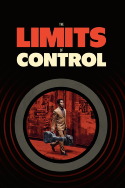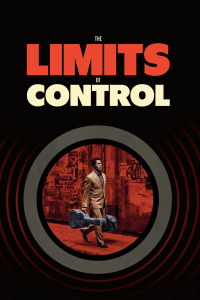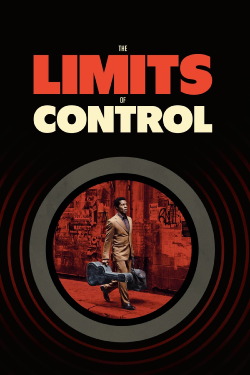
Review of The Limits of Control (2009) by Jason R — 24 May 2009
As hallucinogenic as it is stilted, the sheer volume of banal (yet gorgeously photographed) repetition and the absence of all trope becomes a reservoir for every inexplicable moment that DOES happen and our imaginations are left to struggle with piecing together with not just what's happening but more importantly WHY the movie exists as it does. In fact it practically implores us. There's a moment near the beginning of the film where a platinum blond in a flashy cowgirl outfit strolls up in slow motion (with tripped out Boris groove making her seem that much more out of place) so the main character who is sitting at a Madrid cafe. We have already watched him do it twice with no noticeable result. After creating an artificial fear of poisoned espresso she asks Lone Man if he is interested in movies. She says she is interested in movies where people just sit and talk. Of course that is perhaps the only trope Jarmusch uses consistently in his work, but it's not actually something that happens in the Limits of Control, which is made only of scenes with a Monologist and a Listener. As if playing with the notion of a scene "paying off" , later in the film he sees a movie poster with the same blond cowgirl, turns the corner and immediately sees her being carted off by threatening black-suit/sunglasses characters. And while this causes more (artificial) intrigue and suspense, it, as with most of the vignettes they never really ad up. While it's POSSIBLE this event somehow correlates to Lone Man's "mission", there's no real evidence anywhere that this is actually true for the film. This sort of hollow trick that is normally the sign of a cheap thriller becomes imbued with so much possibility just by being flashy and obvious, and is representative of how the film gets us to make something out of nothing, or at least out of very little.
After two hours of exhaustive minimalism punctuated by increasingly strange monologues by inexplicable cartoons we're treated to a showdown with "The American", hidden away in in a bunker-like office somewhere in the Spanish countryside. Here we have the only actual conversation in the whole film, although more accurately it is a reversal of roles - the Lone Man becomes "active" and says everything he has been told, meanwhile the American is only defined by his negation of the ideals the Lone Man (and we, the audience) has been more or less conditioned to internalize. In his last breaths the American spews venom at bohemians who are completely divorced from reality with their hallucinogenic drugs. He touches on every subject the other characters in the movie monologued about during our trip, which now seem more like talking points. His world view seems to include everything in a nice little package of evil, but he is pure antithesis and seems to be completely aware - and rightfully terrified - of it. In this sense he's probably the only honest character in the film, because though we know absolutely nothing about him, we know that the movie has created the sense of malevolence we are supposed to assume is coming FROM him. The Lone Man doesn't know anything because he doesn't speak the language, so he has not been able to consider very much at all. The whole thing happens in less than 5 minutes, he is garroted and we travel in silence through the film's denouement.
While the way I'm describing Limits makes it sound like a Lynchian movie-about-making movies ripoff, the entire time I was watching it I felt that spiritually the closest relative to Limits is actually Kubrick's Eyes Wide Shut. Both share a strong fixation on the mundane that offsets the weirdnesses and malevolence and asks us to consider what, if anything, the film has to do with the real world.
This review of The Limits of Control (2009) was written by Jason R on 24 May 2009.
The Limits of Control has generally received mixed reviews.
Was this review helpful?