Review of The Lighthouse (2019) by Bertaut1 — 16 Feb 2020
A superbly made film about madness, isolation, alcohol, a cheesed-off one-eyed seagull, and farts.
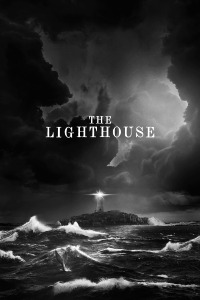
A manic fever dream fusing Greek mythology, Jungian psychology, and German Expressionism with Herman Melville and H.P. Lovecraft, The Lighthouse is the second film from writer/director Robert Eggers, who made The VVitch: A New England Folktale (2015). Co-written by Max Eggers, the film is very loosely based on the "Smalls Lighthouse Tragedy" (1801). A bizarre experience in just about every way, from the glorious visual and aural design to the grandiose acting to the jet black humour to the ambiguity, the film fits into a horror subgenre that focuses on cerebral, difficult-to-define, and always slightly off-camera terror (see films such as The VVitch, The Blair Witch Project, The Babadook, and The Wind). And I loved every crazy minute of it. In the late 1890s, Ephraim Winslow (Robert Pattinson) and Thomas Wake (Willem Dafoe) arrive on an outcropping off the coast of New England to begin their four-week rotation manning the lighthouse. The more experienced Wake assigns Winslow menial tasks, whilst he himself attends to the lens. Although Winslow has some unnerving dreams, the four weeks pass without incident. However, on the night before their relief is due, the wind suddenly changes, and the island is hit by a violent storm, stranding the duo indefinitely.
The importance of Damian Volpe's incredible sound design is indicated immediately, as before we see anything, we hear the wind blowing and a foghorn rumbling in the distance. That horn is omnipresent throughout the film, and to say it gets under your skin is an understatement. It's unsettling and disturbing, and it makes it impossible to ever acclimate yourself to this strange milieu. There's only one sequence in which we don't hear it; the pivotal opening scene of the third act, and the silence is oppressive.
The sound design is matched by the stunning monochrome visuals. Working with cinematographer Jarin Blaschke, Eggers shot The Lighthouse in 1.19:1, a transitional format that was only used briefly during the shift from silent cinema to sound. And that's exactly why Eggers and Blaschke chose it. This is a folktale, a fable from a by-gone age, so what better way to present that fable than by replicating the way the film would have looked had it been made during the early years of sound filmmaking, creating the sense that this is a disturbing artefact, an antique vestige from a different era.
One also has to praise Craig Lathrop's production design. The lighthouse used in the film wasn't an existing structure, but was custom-built to scale on Cape Forchu, an outcropping off the coast of Nova Scotia. Lathrop has imbued every inch of the building, both inside and out, with an existentialist dread – from the industrial hell of the gears in the basement to the almost Eden like peace of the lantern room high above.
Eggers also does something interesting with the narrative itself. Winslow and Wake are focalisers – the world is filtered through their perspective, but they don't narrate. Indeed, although we shift from one character to the other, Eggers never leaves their perspective, nor does he present any kind of omniscient narration. Important here is the use of "fallible focalisation"; the story is one of madness, and it's abundantly clear that neither man is a reliable witness. As things begin to fall apart, this sense becomes ever more prevalent, as we begin to question much of what we're seeing. It's a wonderful use of a defamiliarising technique which works to keep the audience constantly on edge and constantly second-guessing everything they see insofar as we know that some, none, or all of it could be the figment of a failing mind.
The film's storyline is slight enough as to suggest several themes without really going too heavily into any of them. For example, one could certainly read Winslow and Wake's relationship as homoerotic, whilst the societal construct of masculinity, particularly as manifested in competitiveness, is never far from the surface. Another reading would be that the film is an allegory for class struggle – the lantern room high above is the upper class, the bowels of the lighthouse is the working class. Alcoholism is also omnipresent, with the duo progressively drinking more and more each night, until they run out of rum, and so try to mix turpentine and honey, so dependent have they become on the numbing effects of drink.
The Lighthouse definitely isn't for everyone, and is challenging and rewarding in equal measure. There's a lot that has gone into making this film what it is, both in terms of crafting the folkloric story and in the more mechanical sense of putting the finished film together. An aesthetic marvel, it's thick with mood and atmosphere, and proves that The VVitch was no fluke.
This review of The Lighthouse (2019) was written by Bertaut1 on 16 Feb 2020.
The Lighthouse has generally received very positive reviews.
Was this review helpful?