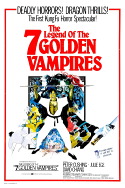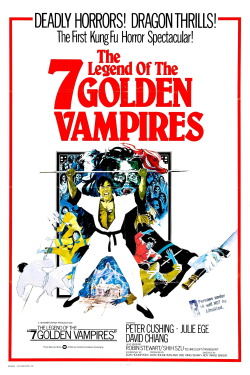
Review of The Legend of the 7 Golden Vampires (1974) by Mel V — 06 Jan 2005
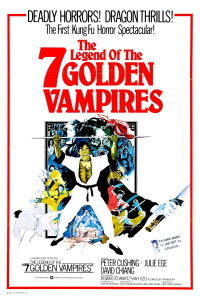
In 1973, with box office returns decreasing rapidly with each new horror film release, Hammer Studios co-financed a vampire/martial arts film with the legendary Shaw Brothers, a Hong Kong based production company that specialized in low-end martial arts films. Their collaboration, [I]The Legend of the Seven Golden Vampires[/I] (released in the United States as [I]The Seven Brothers Meet Dracula[/I]) featured Peter Cushing as Professor Van Helsing, the ostensible protagonist of the film. Here, Van Helsing has journeyed to the Far East, China, circa 1904 to explore the spread of vampirism. At a university lecture, the Chinese professors and students scoff at his claims to have encountered real vampires (they dismiss his claims as the imaginative musings of an uncivilized, backwards culture). Van Helsing is less than ably assisted by his son, Leyland Van Helsing (Robin Stewart), a rake who impossibly (and risibly) escapes several attempts on his life. Former Bond girl, Julie Ege completes the western cast, a bored wealthy widow, Vanessa Buren who offers her financial support for Van Helsing?s quest to find and defeat the vampires of the film?s title.
Given the hybrid nature of the film, and Cushing?s advanced age, most of the physical action is handled by Asian martial arts star David Chiang. Chiang plays Hsi Ching, the leader of a band of seven brothers (plus one sister, Mai Kwei [Szu Shih], equally adept at martial arts) who seek to rid their native village of seven golden vampires and their nefarious leader Kah (Shen Chan). Kah, in the opening prologue, ventures into Eastern Europe, to seek out the help and advice of the Lord of Darkness, Dracula (John Forbes-Robertson) himself. Despite the obvious language, Kah and Dracula come to an understanding. Upon his return to China, Kah resurrects the seven golden vampires, so-called because they wear masks made of gold to cover their hideous faces. The vampires also wear a golden belt buckle (shaped to resemble a bat) that, when removed, causes the vampire to ?leak? clouds of smoke, and eventually collapse in a fiery, ash-filled ruin.
The schematic plot moves from a large Chinese city, Chung King, where the two groups eventually join forces, to a stretch of deserted highway where Van Helsing, the seven brothers, and their sister, must defeat a group of brigands. From there, the plot moves to a nighttime, campfire scene that allows for the first stirrings of romance between two inter-racial couples, His Ching and Vanessa Buren, and Van Helsing?s son and Ching?s sister. Outside of this perfunctory scene, however, there?s little time for romance, as Van Helsing and his group must battle the vampires inside a cave, and later, in [I]Seven Samurai[/I] fashion, in and around the village infected with the vampires.
The martial arts action is, even for the time period, crude and badly choreographed, the special effects are equally crude and mostly laughable, the characters one-dimensional, and the plot turns comical and, more often than not, nonsensical. Still, there are a few pleasures to be derived from [I]The Legend of the Seven Golden Vampires[/I]: chief among them, Peter Cushing?s always convincing turn as Van Helsing, regardless of the ludicrousness of the situation or the banality of the dialogue. The variation on vampires is also of some interest. Vampirism here is treated as culturally relative: with different means of defense against the vampires (i.e., Buddha statues instead of Christian crucifixes, the golden medallions that prove to be the vampires weak point). Here, victims of the vampires aren?t themselves turned into vampires, but into an army of the living dead (the audience is treated to multiple shots of the army being summoned by Kah, rising from their graves in zombie-fashion). The living dead also hop (and seem to carry bells with them, easily announcing their presence to the villagers and the film?s heroes), presumably in keeping with the relevant Chinese mythology. For westerners, however, the hopping dead add yet another level of unintentional humor to a film that offers minimal scares and choppy action scenes.
For obviously commercial reasons, [I]The Legend of the Seven Golden Vampires[/I] was heavily (and ineptly) edited for American audiences and released as [I]The Seven Brothers Meet Dracula[/I]. Surprisingly, this truncated version is by far the more entertaining version (in the ?so bad it?s good? sense). The extended opening credits feature slow motion edits of the seven golden vampires attacking a village, scenes which are repeated chronologically once the film itself begins, and a third time via flashback. The repetition of these scenes served a two-fold purpose, to increase the film?s martial arts content, and to highlight the brief moments of gratuitous nudity. These scenes also push back Van Helsing?s introduction into the film (well past the twenty-minute mark). Once introduced, Van Helsing?s scenes, at the lecture hall, and in scenes that fill in the backstory, are either trimmed or eliminated outright, presumably in an attempt to focus on the action scenes featuring David Chiang and his brothers (an odd choice, as becomes clear in the third act). Still, for Hammer completists, or those simply curious about what a martial arts/vampire film, circa 1973, looks and sounds like, [I]The Legend of the Seven Golden Vampires[/I] must be seen to be appreciated.
This review of The Legend of the 7 Golden Vampires (1974) was written by Mel V on 06 Jan 2005.
The Legend of the 7 Golden Vampires has generally received mixed reviews.
Was this review helpful?