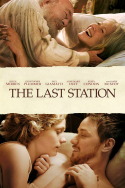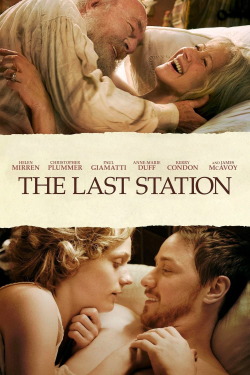
Review of The Last Station (2009) by Elizabeth M — 07 Apr 2011
The Decay of Love.
It's a funny commonality of nonconformist movements that they end up requiring conformity of belief and behaviour. In order to separate themselves from Them, they have little rituals and requirements. It's also interesting how often they have to do with sex. The primary choices are Free Love and total abstinence. (It's funny how the abstinence movements die out, isn't it?) You have to observe the proper rituals in order to really be part of the movement. If you don't, you're a total conformist. Naturally, they never see the irony of it. One of the characters in this movie makes a persuasive argument that the heart of the Tolstoyan movement is about freedom, and therefore, she should have sex if she wants to. I don't know much about the movement, but it's my understanding that a lot of his followers refer to his wife as having "seduced" him because she didn't force him to follow his own principles by kicking him out of her bed. The movement was more important than the man they were supposedly basing it around, which generally also becomes the case in the end.
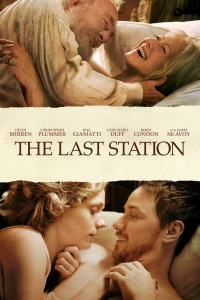
Valentin Blugakov (James McAvoy) is a member of the movement. He has been sent to Yasnaya Polyana, the Tolstoy estate, to be a secretary to the great Leo Tolstoy (Christopher Plummer). Vladimir Chertkov (Paul Giamatti) selects Valentin because he is a good and faithful member of the movement, one who can be trusted to do what he ought. Which includes spying on the relationship between Tolstoy and his countess, Sophia (Dame Helen Mirren). They had been married for forty-eight years and had thirteen children together, five of whom died. Sophia is naturally concerned about the remaining eight. Chertkov is working on Tolstoy to change his will, leaving his copyrights to "the people" and the executorship of his estate to Chertkov. Sophia sees him, apparently accurately, of working to drive a wedge between her and her husband. Of course, it is also true that she rejects pretty much his entire movement, distrusting the lot of them and thinking them hypocrites. Unfortunately, this just works to drive them even further apart.
I do have a great deal of sympathy for Sofia, which not everyone does, it seems. She did bear the man thirteen children; he refused to countenance birth control. And then he essentially wanted to disinherit her and their children. The fact that still loving him made them try to keep her away must have been agonizing for her. Their daughter, Sasha (Anne-Marie Duff), sided with her father's followers over her mother; late in the film, Sophia says that five of her children died, and why couldn't Sasha be one of them? She is completely irrational by the end of the film in a lot of ways. On the other hand, you can see the process which drives her to it. She was sixteen years younger than he, but that didn't mean she was a young woman. After all that, she's been cast off? The despair of the film is that these people actively worked to keep her from her husband's side as he was dying, even though he was calling for her. No, she couldn't have known, but she felt nearly fifty years gave her the right to be there in his last moments. Certainly above a man she thought of as a moocher.
I'm thinking James McAvoy does best in films where he plays an observer. I admit I'm basing this on limited viewing, but it does mean that I'm rather dreading his upcoming appearance as Professor X. In the end, Valentin must decide where his loyalties lie. Or perhaps more accurately, which version of Tolstoy he would respect in those last moments. Tolstoy's doctor, Duan Makovický (John Sessions), refers to Tolstoy as a prophet. Sophia scoffs at him and insists that Tolstoy is just a man, and nobody's helping anybody by pretending otherwise. Valentin has spoken to Tolstoy the Man as well as Tolstoy the Prophet, and he must decide for himself which one Tolstoy himself preferred. He has spent the film watching, and in the end, as in [i]Last King of Scotland[/i], he can no longer watch. It is the time for action. He must in the end side with someone, and he never expected to have to make such a monumental decision. He's just a secretary, after all, and nobody expects secretaries to change the world.
Watching this movie makes me even less happy about Sandra Bullock's Oscar than I was going in. I haven't seen [i]The Blind Side[/i] on the grounds of not actually wanting to, and I haven't seen [i]Precious[/i] on the grounds of not wanting to actively push myself into a depressive episode. However, I've seen the remaining three films, and the only one I didn't think did a fine job was Meryl Streep. Dame Helen has been nominated four times, three--including her win--for playing real people. (Two of whom were British monarchs, even.) Yes, her performance here is pretty over the top in places, but she conveys several different intense emotions. No, it wasn't the kind of movie where I felt myself surfacing from it after it ended, but it was really quite good. I will flatly say that, entertaining as Christoph Waltz was, he wasn't as good in [i]Inglorious Basterds[/i] as Christopher Plummer was in this. Christopher Plummer played a character; Christoph Waltz played a caricature.
This review of The Last Station (2009) was written by Elizabeth M on 07 Apr 2011.
The Last Station has generally received positive reviews.
Was this review helpful?