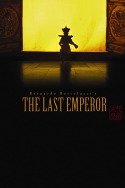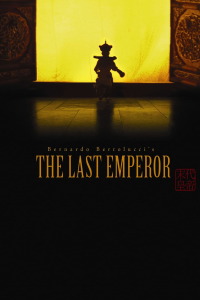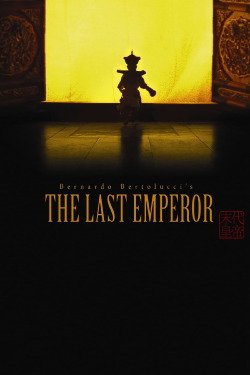
Review of The Last Emperor (1987) by Cameron J — 07 Jul 2012
It's an English-language film about the last Emperor of China that's directed by an Italian, produced by a Brit and features a cast of people from various regions of Asia, as well the Irish Peter O'Toole as a Scot with an accent that's more English than Scottish. Okay, now, I'm not even gonna try to figure out how that much multiculturalism works, because I'm still having trouble wrapping my brain around just how short this film is for Bernardo Bertolucci. I mean, it's only a little over 160 minutes, and on top of that, its extended director's cut isn't but a little over three-and-a-half hours, so that means that there's only almost an hour of added material; that's it? So yeah, in case you haven't figured it out, Bernardo Bertolucci is known for making some long films, or, at the very least, obscenely longer extended cuts, and I use the word, "obscene", because that's something else that Bertolucci is pretty well known for (Lord knows what he put in the original cut of "Last Tango in Paris" to get it from a little over two hours to a little over four hours). Okay, perhaps not even most of Bertolucci's films are extremely-oh, I'm sorry, I mean, "obscenely" long, it's just that after you do something like "1900", people are gonna remember you as "that guy who makes really long movies", and thank goodness for that, because if you're film is five-hours-and-a-quarter-long, then buddy, it better be memorable. Okay fine, I haven't seen one of the 316 minutes of "1900" or, well, somehow, a minute of any Bernardo Bertolucci film up until this one, and that's a shame, because if his other films are as good as this one, then I've been missing out. Still, it's not like I've been missing out tremendously if his other films are like this one, because although this a really good film, it goes held back by quite a few factors.
I tell you what, he may be Italian, but Bernardo Bertolucci sure seems to know a thing or two about that good old fashion Chinese Cinema melodrama, because this film will hit a couple of overwhelming moments in drama and other aspects, making for some seriously unserious-feeling unsubtlty. To make matters worse, Bertolucci understands that kind of cheesiness a little bit too well, to where he really pronounces it to an extreme extent that, on the rarest of occasions, cuts the drama from the melodrama and just leaves behind a bit of corniness that throws you out of the film for a moment. Still, as much as those moments throw you way off, occasions in which the melodrama is that severe are extremely scarce, while any occasion of melodrama in general is far and few between, and what you really need to worry about is how that statement of "far and few between" can also be applied to the points in which something happens in the film, or at least the points where something not dull happens. The film gets to be meditatively quiet, with a dry overemphasis on pure nothingness (We don't even get the common courtesy of something that's actually symbolic), and while those occasions are only here and there, when something actually happens, quite often, the dryness remains, yet moments like that remain different from the moments of pure nothingness for the transitions between storytelling methods to feel somewhat inorganic. Of course, that might just be because the slow spots - of which, there are quite a few - disengage you so much that you don't even pay attention the tonal transitions, though exposition, on the other hand, certainly goes missed, not because you lose focus in the film, but because the film simply doesn't have a whole lot of fleshing out within its very complex story and characters, thus landing yet another blow to the subtlty of the film and leaving you to want a little bit more from the story. Boy, the consensus sure isn't kidding when it says that the film is imperfect, as it is a meditative epic with just not enough subtlty to meditate upon, and the final product comes out with quite a bit to be desired. However, it's not like you'll be walking away dissatisfied, because for every false move in this film, there is a real hitter of one that leaves it a rewarding epic from a visceral standpoint, and certainly from a stylistic level.
Vittorio Storaro's cinematography is not terribly upstanding, yet there is a degree of attractive emphasis on deep colors, with the most eye-catching thing about Storaro's photography might very well being its very clever play with scope, as there is a kind of epic vastness, married with intimacy, that is both engagingly nifty and even rather reflective of the film's fairly prominent theme of isolation from a grand and complex world, thus leaving the cinematography to make the film feel more effective as a character study, as well as an epic. Hey, I don't know about you guys, but I'm just happy that there's enough broadness to the photography to give us a nice view at the remarkable production designs, which are detailed, believable and dazzling, further catching your eye and breathing further life into the story. The story is a worthy and fascinating one that is really livened up by such intricate and production value, yet the person who doesn't so much liven up the story, as much as he really brings it to life in the first place is director Bernardo Bertolucci. Sure, Bertolucci's direction really does a number on this film as it struggles to fulfill some pretty high potential, yet it gets up to good momentum by what Bertolucci does so very right, as he manages to really capture the depth and emotions of Emperor Puyi's story and Puyi himself, perhaps not in the most subtle or fleshed out fashion, but still with enough inspiration to where he really cuts to the core of this story and creates some genuine high spots that are more than enough to win you over and make this film a rewarding one. Bertolucci really absorbs plenty of dramatic depth and epic sweep, and it really carries this film, which isn't to say that Bertolucci couldn't have given this film as much energy as it has without the help our leads. Sure, there are plenty of memorable performances, from Peter O'Toole as Puyi's charismatic and concerned tutor, to Vivian Wu (Or as she's credited, Wu Jun Mei) as Puyi's very much secondary-feeling secondary wife, yet it is, well, everyone behind Puyi who really keep things going, whether it be Wu Tao as the roughly maturing Puyi or John Lone as the strong, but still very humanly struggling adult Puyi. All portrayers of the late final Emperor of China are faithful to the role, almost to the point of transformation, yet no matter whose turn it is to lead, expect a compelling performance that stands among the many things that ultimately make this film a more often than not engrossing one.
In the end, the final product goes tainted by a few overwhelming, if not a little bit cheesy melodrama, as well as consistent slowness - which will sometimes decent into dry, bloated meditation on pure nothingness - and even quite a bit of unsubtlty, thus making for a film that's not quite as complex as it should be, but still with plenty of depth, as well as epic sweep, thanks to the inspired direction of Bernardo Bertolucci, whose work goes complimented by Vittorio Storaro's grand cinematography and fine production designs, as well as particularly upstanding performances by just about every portrayer of our central focus Emperor Puyi, thus leaving "The Last Emperor" to stand as a slow and steady, but generally compelling and ultimately rewarding study on, well, the last Emperor of China.
3/5 - Good.
This review of The Last Emperor (1987) was written by Cameron J on 07 Jul 2012.
The Last Emperor has generally received very positive reviews.
Was this review helpful?