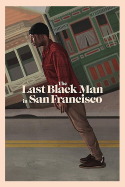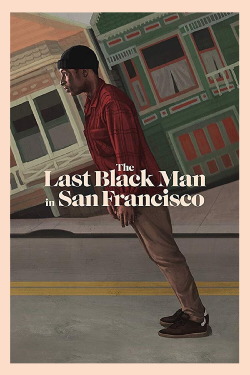
Review of The Last Black Man in San Francisco (2019) by Hnestlyonthesly — 07 Oct 2019
Last Man in San Francisco is a story about the myth of ownership and a film that touches on gentrification and masculinity through comically earnest and odd characters, surrealist commutes, and black humor. The film is weighed down by its bias toward the literary–it’s a script for scriptwriters, that savors its own cleverness, and stumbles on its own commentary about storytelling. I don’t need very much more of a reason than knowing A24 is the production house, but I’m happy to have someone making films about the city I see when I visit rather than the sanitized, impersonal vision that other romcoms try to present.
My favorite scenes are 1) the opening five minutes, 2) the surrealist elements of Jimmie and Mont’s commute, and 3) Mont’s quirky directorial confrontation with the neighborhood gang outside his grandfather’s house which at once shows how eccentric he is while also tearing away the fourth wall in very straight performance of the joke. Wife said when she saw that scene, it was the first time she considered that Mont might be just as weird as his friend Jimmie, that the two of them matched one another in their eccentricity.
Friend saw this with a colleague a couple days after us and said it never really felt like it got off the ground and gained momentum. I don’t know if I totally agree, but let’s circle back to this when we talk about the final act.
Jimmie Fails is a newcomer to the silver screen–plays himself, wrote the story. Jonathan Majors, who plays Mont, hails from two films I’ve seen before the weird cowboy film with Christian Bale that turned its objective lens on the violence of the Old West and White Boy Rick. Not necessarily films you might think of as “ensemble pieces,” and yet he defies typecasting, rebrands himself completely in every role. Don Glover plays the role of ailing grandfather subtly: never asks his grandson to stay outright, always comes in from an oblique angle, asks to help brainstorm the script, offers to let Jimmie stay without reservation, lets him sit on the couch in a poignant contrast with one of the early scenes in the film.
The end of the film leads up to a feelsy meta-play that Wife had little patience for, but the resulting action is a powerful representation of loss on both a personal and urban level. Mont is unexpectedly bereft of his companion when a happy ending seemed within his grasp. Jimmie’s exchange with the two white women on the train grousing gauchely about their sour grapes in San Francisco, “You can’t hate it unless you love it,” rubbed Friend the wrong way. “I wish we had seen some evidence that Jimmie loved the city outside of simply the house of his childhood,” which I think is an interesting point. We don’t see a lot of situations in which Jimmie and Mont enjoy the city, because they have already been exiled to the suburbs. The more I thought about that, the more it started to irk me too.
The true end of the film, though, accomplishes some things that I think mark it as a film that is good because it is different–in the way that it does not give the audience what it expects of it or of the genre. The final scenes, of Jimmie back at Mont’s house, but newly integrated into the family, of Mont alone and adrift, are the fulfillment of that damning pronouncement, if you can’t live there, it’s SF’s loss not yours.
This review of The Last Black Man in San Francisco (2019) was written by Hnestlyonthesly on 07 Oct 2019.
The Last Black Man in San Francisco has generally received positive reviews.
Was this review helpful?