Review of The Ladykillers (2004) by Edith N — 01 Jun 2010
An Examination of the Southern Species of Dotty Old Bat.
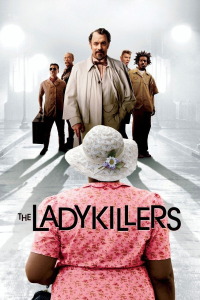
Let's compare to the list from yesterday, shall we? We must remember, first, that this is the Southern Black Lady species, so "small and frail" gets replaced with stout. This is a woman who enjoys her food. (And, not to be crude about it, there was probably a certain amount of deliberate breeding for size in her ancestry, though how common that was I cannot say.) However, she does have classic Little Old Lady clothing, like her Middle Class English Lady cousin. Hat with flowers, even. She is widowed and childless. This woman is so innocent that she sends money to Bob Jones University, apparently unaware that they espouse just the sort of racial views she considers reprehensible. She goes to her church; she is active in it. She can fill a house with a crowd of similar women, also in pastels and flowered hats. When pushed, she slaps Marlon Wayans the way quite a lot of people wish they could.
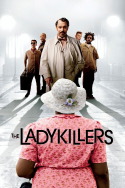
Here, she is Marva Munson (Irma P. Hall), who we first see complaining to the sheriff (George Wallace) about the "hippity-hop." As happened in the original, she takes in a boarder, one Professor G. H. Dorr, PhD. (Tom Hanks), an expansive white man in one of those white suits which cry Southern Gentleman to people envisioning such luminaries as Mark Twain, Colonel Sanders, and the Devil in [i]Constantine[/i], though his is more cream. He is that Coen staple, the overspoken man whose dialogue flies over the head of everyone around him. It almost seems as though Marva lets him rent a room just to get him to stop talking. And he brings in friends to practice Renaissance music in her basement, which I guess makes her feel all cultured. But as we know, having seen the original yesterday, they are not musicians. In this case, they have a plan to tunnel out of Marva's basement and into a casino down by the river. And, as yesterday, things do not go according to plan.
And, as with yesterday, I'm not clear on how these people got together in the first place. I'm guessing the Professor found all of them. It's clear, for example, that Garth Pancake (J. K. Simmons) would never have had the slightest interest in finding Gawain MacSam (Wayans). The General (Tzi Ma) seems to have been dug up (ha!) from a refugee camp where he was hiding from his Communist comrades, who would like to send him to "reeducation" or else just shoot him. And Lump Hudson (Ryan Hurst), well, really just seems superfluous. If they needed him to lift the money, they were trying to lift too much money to be carried away reasonably. Oh, Mr. Pancake had his own assistant in Mountain Girl (Diane Delano), but that's actually the only relationship explained in any detail, despite the fact that it's the least important explanation. We see a little bit about each of the men prior to the main events of the movie, but what brought them together isn't considered all that important.
The Coens have a fascination with the South of their imaginings. Of the movies of theirs I've seen, two of them are set in and around their native Minnesota, and the third is in a '30s, sepia-toned Mississippi. I have as little doubt that their Minnesota is accurate, for a given definition of "accurate," as that their South is based on what we all believe it to be, those of us not from there. We believe, deep in our hearts, that the South is to this day populated with high-speaking men in white suits and ridiculous facial hair and Dotty Old Bats of both the White and Black species, wearing their flowered hats and working at their churches. We believe in the sleepy sheriff with cobwebs growing between the cell door key and the wall, though that he's black isn't our first image of him. (There's an amusing campaign poster on the wall asking constituents to re-elect him because he's too old to work.) Even though the modern South impinges on the story in the face of the modern casino, the rest of the imagery is frozen in time.
Alas, this is a lesser Coen. I haven't seen much of Ealing Studios, so I don't know where yesterday's movie fits in their ranking, but it does draw uneven comparisons. Professor Dobb seems as much a ripoff of their own Ulysses Everett McGill as Sir Alec's Professor Marcus. The criminals here, and I include Mountain Girl, are more broadly drawn, less (except Lump and Gawain) the kind of people who actually exist. The setting is as plausible to me; they're both distant enough from my experiences that I'm perfectly willing to just believe in them. Both species of Dotty Old Bat are ones I'm culturally programmed to accept. The crimes are equally believable. This one, while entertaining enough, somehow feels lacking in its execution. It feels as though the Coens could do more with it. It may just be that they're not stars at the remake, which fills me with foreboding given their next project, an unnecessary remake of a John Wayne film.
This review of The Ladykillers (2004) was written by Edith N on 01 Jun 2010.
The Ladykillers has generally received mixed reviews.
Was this review helpful?