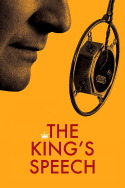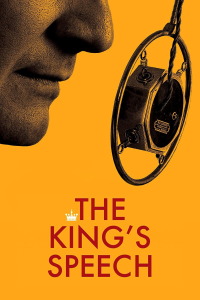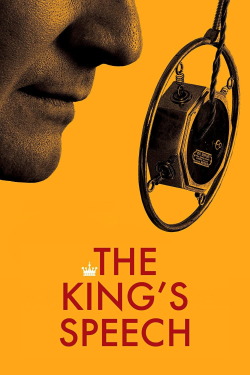
Review of The King's Speech (2010) by Jerry R — 08 Aug 2012
"Uneasy lies the head that wears a crown.".
- King Henry II, Part II, Act 3, Scene 1.
I don't think that any monarch in modern times felt that more than England's King George VI. In 1936, when England ruled most of the planet and the throne was occupied by uneasy circumstances - King George V was growing senile and the heir to the throne, his son David (later King Edward VIII and then the Duke of York), was showing signs that he wasn't fit to rule - it became inevitable that the crown would eventually rest on the uneasy head of younger brother Albert, who might have been fit to rule were it not for a series of debilitating insecurities and a nasty stuttering problem.
The King's Speech is a wonderful story of how the ceiling of circumstance came crashing down on Albert's uneasy head and how he was forced to overcome a speech impediment at a time when the entire British Empire's ears were now open to His Majesty thanks to the advent of radio. Previous monarchs were charged only with making public appearances, now they must master the art of speech making as it will enter every home and hovel throughout the world.
The film begins in 1925, and Prince Albert (Colin Firth) is only two steps away from being the ruler of his country. Albert's wife Elizabeth (Helena Bonham-Carter) understands more than anyone that circumstances will ascend him to the throne - His father isn't getting any younger and his brother David (Guy Pierce) is cavorting with an American divorcee, Wallis Simpson (Eve Best), that he stubbornly intends to marry. That eventually forces him to abdicate the throne and make room for Albert. Further complications arise on the world stage with the news that negotiations with Hitler aren't going so well and the country might find itself in a second world war. That means that the throne of England might require someone who can be an effective leader. With David, then Albert in line for the job, England is in serious trouble.
After a series of quacks attempt to cure Albert's speech impediment with silly exercises, like filling his mouth with marbles, his wife Elizabeth decides to take matters into her own hands. Without consulting Albert, she hires a speech therapist, a native Australian named Lionel Logue (Geoffrey Rush). Logue is a genial family man, a failed actor who is getting along in years and can't find work on the stage. He takes the job without realizing that his client is Prince Albert. Even still, when his identity is revealed, he doesn't see fit to kowtow to his famous client. Lionel takes, what seems to Albert, a series of gross measures of disrespect. He asks him to meet him in his own home, not Buckingham Palace. He asks to be on a first name basis - calling His Majesty "Bertie", the nickname given him by his family. He asks a series of personal questions in an effort to get to the root of the stuttering problem. He also makes it clear that he isn't impressed by the royal family. Prince Albert, to him, isn't a magnanimous figure, but simply another man, a patient who has come to him with a problem.
What Lionel becomes, in effect, is not just a speech therapist but a kind of pseudo-psychiatrist to a man who is fraught with deep personal insecurities, brought on by an upbringing that forced him into an emotional closet. Albert's job is to lead his country but even if he can't find the confidence to do that, Lionel can at least give him the confidence to sound like a man who knows what he is doing.
That relationship lies at the very center of this story and it is what makes The King's Speech so effective. Prince Albert is, at first, outraged by his instructors impropriety but after realizing that this man many be his only hope, they develop a bond formed by Albert's desperation and Lionel's no-nonsense approach. Colin Firth and Geoffrey Rush are splendid together, creating a friendship that feel real, not just two actors working together. Firth - one of my favorite actors - has the more difficult role, having to spend most of the movie speaking in fractured sentences. He plays Albert as a man with an obvious anger management issue brought on by years of pressure and teasing (we see the first from his father and the second from his brother), but also a man who is petrified beyond words to have to speak to in public. The opening scene, in which he has to speak at the 1925 Empire Exhibition at Wembley Stadium, is painful as Albert stands before the microphone and can say virtually nothing.
Geoffrey Rush has the larger role, he plays has the task of taking a potentially cliched role - the inspirational teacher - and making it into a good deal more. He won't give up on his student, not because of what is going on on the world stage but just because he knows that Albert needs his help. He is a good man who breaks through all the pomp and circumstance of His Majesty's title so that he can get to the root of the problem.
Both Firth and Rush are just fine but I think the key role in the film belongs to Helena Bonham-Carter. She plays Elizabeth (who was mother to the reigning Queen Elizabeth and known to my generation as The Queen Mum) as a sympathetic wife who can see the problems that will come if he husband doesn't get help. That becomes apparent at the Wembley stadium speech as she sits in the audience with sympathetic eyes. You can see that she is already thinking. I think she understands more than anyone what will happen to the kingdom if her husband doesn't get help. What is interesting is that, while she occupies the key role here, shes spends most of the movie in the background, just to Albert's left. In effect, she is his inspiration, loving him through his faults and insecurities. She has a moment of confession late in the film that is just about perfect.
What I love most about The King's Speech is that while it is a retelling of a chapter of history, it doesn't feel like an epic. Director Tom Hooper also made the wonderful TV mini-series "John Adams" and there, as here, got inside the people not as historical monuments but as people facing monumental tasks. We understand what is at stake but it never feels hurried. Hooper is less interested in major historical milestones than in the people who have to face them.
This review of The King's Speech (2010) was written by Jerry R on 08 Aug 2012.
The King's Speech has generally received very positive reviews.
Was this review helpful?