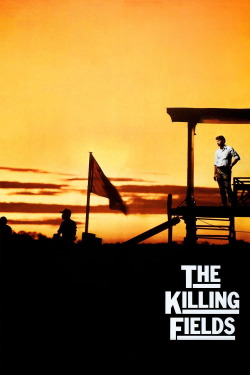
Review of The Killing Fields (1984) by Afzal S — 17 Sep 2007
David Puttnam, who produced The Killing Fields, has long argued for more films to be about something, reflecting the larger world we live in. The Killing Fields is a product of a polemical cinema, based on real people and events, for the promotion of a cause célèbre, in this case the dubious morality of the United State's involvement in modern Cambodia and the country's subsequent descent into a totalitarian nightmare.
In early 1970's Cambodia, American journalist Sydney Schanberg reports on US mass bombing on the Vietnamese border, carried out in order to destroy Vietcong bases located there. He sees the destabilisation of the country, and witnesses, as a consequence in his view, the Khmer Rouge's rise to power. This theme, the abandonment of the United State's Third World involvement once its interests in an area have diminished, is personified and presented allegorically in Schanberg's real life friendship with a local journalist and translator, Dith Pran. At first Schanberg treats Dith Pran like an employee, rather than as a friend or partner, chiding him when he cannot 'find the story'.
Schanberg and some colleagues stay on once the Khmer Rouge takes over, though it is clear this is as much for their own self-serving career needs as it is for truth and justice. In any case, it becomes clear that these naive journalists have no idea of the danger they are in, and what follows is a journey of survival, guilt and redemption.
Schanberg and his fellow western journalists, having 'found the story' and nearly been killed in the process, are eventually granted safe passage out of the country, and Schanberg abandons Dith Pran in the hands of the Khmer Rouge. The film thus shifts from a war film on the ground, splitting towards a twin narrative. The first shows Schanberg's return to the US to awards and comfort. He has become the famous war reporter he wanted to be, which fuelled his interest in Cambodia in the first place. But he now finds emptiness and misery in his guilt-ridden state, as he makes futile attempts to help his friend Dith Prin, who only stayed in Cambodia to help Schanberg and put himself on the line for Schanberg when the Khmer Rouge initially captured them. On an allegorical level, the United States, having involved themselves in South East Asia to protect its national interests, has abandoned the region to the fate of the conflicts it helped create.
The second, concurrent narrative shows Pran's nightmare journey towards deprivation and dehumanisation in the Khmer Rouge's rural death camps, where he has to be anonymous as urbanised, educated people are put to death. Here he witnesses the terrifying destruction of social and family life, and restructuring of society on totalitarian lines, before he escapes.
It is unusual for a western film to focus on a native 'supporting actor'. They are usually confined to being sidekicks to the active American 'hero', who has to sort out the situation for the natives. However, The Killing Fields contrasts Schanberg's purgatory in New York, trying to keep the authorities aware of Dith Pran and helping his refugee family, and Dith Pran's own unbelievable, but real, journey of survival. But the film is keen to point out that, far from Dith Pran being destroyed by his experience, he fights for his humanity, making a connection with the disenchanted Khmer Rouge leader who recaptures him. When the leader dies due to infighting, caused by an invasion by the Khmer Rouge's Vietnamese former allies, Dith Pran takes the man's son with him when he escapes, only for the boy to die in a landmine attack. It is interesting to see Dith Pran giving the boy a Buddhist funeral, showing he has not forgotten the humanistic traditions of his country, which the Khmer Rouge have tried to wipe out. The dignity of the small funeral in the forest contrasts with the horror of the mass graves, the killing fields he has stumbled upon throughout the country. It is also an allegory on the fate of children under the Khmer Rouge, reflecting the brutal 'education' of children, which turns them into vicious little units, separated from their families and with no humanity, only loyal to the state.
Dith Pran eventually makes his way to safety. Schanberg has gone from ambitious war reporter to broken man, and is revived by news of Dith Pran's escape. Dith Pran has changed by extraordinary circumstances from an aspiring journalist to being some thing much greater, a man ennobled by undefeated courage and an unshakable faith in humanity. In the final scene, Dith Pran, helping a landmine victim, sees Schanberg arrive at the aid camp he has found refuge in. There is a tense moment as the two face each other from a distance, which collapses as Dith Pran runs to hug Schanberg. Schanberg asks for redemption in abandoning Dith Pran, to which he replies there is no need, and that he is only happy to see him again. In the same way, the film is allegorically asking for the United States to redeem itself by re-engaging with the region, but this time with peace and humility.
The cast is uniformly excellent, particularly Sam Waterson as Schanberg and non-actor, Dr Haing S. Ngor as Dith Pran. Roland Joffe's direction is superb, filming Robinson's skillful, resonant first screenplay with an ambitious realism and sensitivity, whilst retaining an eye for the natural beauty of Cambodia. The shifts in location from rural, third world Cambodia to urban, first world New York are handled seamlessly. Particularly interesting is his concentration, during certain scenes, on the reaction of the common person caught up in the events that surround them.
Overall, a tour de force in polemical cinema.
This review of The Killing Fields (1984) was written by Afzal S on 17 Sep 2007.
The Killing Fields has generally received very positive reviews.
Was this review helpful?