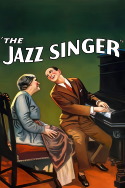
Review of The Jazz Singer (1927) by Geoff C — 12 Aug 2009
The film was not as bad as I thought it would be. I expected a terribly racist film, which it wasn't. I only rented it because it was the first non-experimental sound film, and I was curious to see what it was like.
Oddly enough the film begins with about 5-10 minutes of orchestral score that has the titles "The Jazz Singer - Overture" They didn't really have film previews in those days, and the filmmakers obviously didn't want the film goers to walk into a silent theatre, when the sound angle would have obviously been hyped.*.
The Warner Brothers logo they have on screen looks very primitive, and was obviously hand drawn.
The film was really 75% silent, but I can imagine how much electricity would have been going through the theater when Al Jolson spoke for the first time, saying the immortal words "You aint heard nothing yet." I also imagine it would have been quite strange yet wonderful to hear the music, without the presence of a piano/organ. The simple things we take for granted in film today were so magical back then.
The film was fairly touching, though very melodramatic as one would expect from a 75% silent dramatic film.
It is about a son in New York who loves ragtime, but his Jewish Cantor father (Who is the fifth generation in his family to be a cantor, and wants his son to follow in his footsteps) disapproves of him of wasting the voice god gave him, and promises to "give him a whipping" and the kid promises in return that if he gets spanked he will "Run away and never come back." Both things occur. The kid grows up to be Al Jolson, (surprise) and is discovered by a pretty young woman named Mary Dale who is apparently big on Broadway. She gives him his big start as a performer. He goes on tour, and he is a hit. As he is about to leave for his next big destination, his friend runs up to him and tears up his train ticket, and he tell him that he has a gig on Broadway.
His reaction is (in titles, not dialogue).
"Broadway!".
"New York!".
"MOTHER".
I found the films plot to be surprisingly Oedipal. He never does have sex with his mom, but damn. I almost felt a little sick watching parts of it. Al Jolson's Character seemed too attached to his mother. When he sees her for the first time in 20 years, they share an embrace that reminded me of one between Rhett Butler and Scarlett O'Hara in "Gone With The Wind".
After that sickly encounter, Jolson begins to play piano, and sing "Blue Skies" to his mother. *1 His father comes in while he is playing/singing and is outraged. "You have brought your JAZZ music into my house?" And they argue back and forth for a while. He then the father says "I taught you to sing the songs of Israel" to which Jolson says.
"You taught me that music is the voice of God. It is as honorable to sing in the theatre as the synagoge".
He leaves to perform the show.
His father grows very ill as he is about to go on. This happens before The day of atonement, an important jewish holiday. He gets word as he is about to go on stage, which provides him with a huge moral conflict.
Should he go on stage, and fulfill his lifelong dream, or should he go sing in his father's place for the day of atonement.
When one person indicates to him that he should stick to the theater, Jolson's character belts out the corniest line in the whole movie:
"But the songs of Israel are tearing at my heart!".
He ends up going to the day of Atonement, and presiding as Cantor for one day in his fathers place, and one performance is cancelled as a result of it. His father forgives him ,and the film ends with Jolson singing "Mammy".
I suppose I should address the use of Black face in the film, since I did indicate that I did not believe the film was racist. Yes, there is a scene where Jolson puts on Blackface, and goes on stage looking more like a monkey than an African American, but we must remember the times, and try to put it into that context as best as we can. Back then, few people thought about the racial divisions in the country. Most didn't even notice the divisions, and assumed that everybody had their "place" in this world. The black face was intended to simulate the look of an African American, but it was not done out of malice. The film has no racist messages, and it has no intent to cause any harm. The black face used in this context was thoughtless, intensive, but not malicious. Is was a racist scene, born out of ignorance, but the film contained no intentional racist messages.
Over all, this film was corny, and campy and cheesy and whatever other expletive you want to use. It got a little boring twoards the end. But over all I liked it.
*1 - This is the scene that was shown in the movie "The Aviator".
This review of The Jazz Singer (1927) was written by Geoff C on 12 Aug 2009.
The Jazz Singer has generally received mixed reviews.
Was this review helpful?