Review of The Jazz Singer (1927) by Lyzette G — 08 Mar 2011
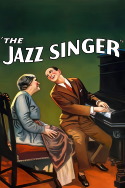
If there is one thing that 1927's The Jazz Singer is synonymous for, it would have to be be its technical impact on the world of movies. This film is well-known for being the first to feature scenes of synchronized sound and dialogue. Although not entirely a sound film, it was a definite factor in the decline of previous generations' silent films, and the ushering in of a completely new breakthrough: the "talkie" generation.
However, despite its impact, the plot of this movie is one to be forgotten. It centers around Jakie Rabinowitz, son of two devout Jewish parents, who, despite their intentions for him, runs away to become (you guessed it!) a jazz singer. This story may have been original in its time, but these days it's overdone; thus, the audience can bore quite easily from this movie.
The most superb thing about this film, however, would be its musical numbers. Al Jolson, an American stage performer, plays the main character Jakie (who later adopts the stage name Jack Robin). This movie intended on bringing sound pictures to mainstream audiences in a clever and unique way - through its music scenes. And that it did! The very minute one see Jolson perform "Dirty Hands, Dirty Face" with such gusto, they know they are in for a treat. Not only does Jolson have a great voice and perform with such magnetism, but the nostalgic sounds of the jazz music is so great in itself. Afterwards, we hear Jolson's first spoken words: "Wait a minute! You ain't heard nothin' yet!". Classic!
Unfortunately, not much of the same could be said for the acting pieces. In the few scenes of acting Jolson has, he does so quite awkwardly. It may be that he is used to performing on stage, but there are even certain points where he definitely overacts, to the point where it even becomes ridiculous. Many of the acting scenes in general are just really boring, and the viewers find themselves looking forward to more of the jazz numbers.
Going back towards the musical bits, I'd like to touch upon one scene in particular, possibly the most iconic moment of the movie. At the very end of the film, we see Jolson on stage, in blackface, performing a song entitled "Mammy". Before this movie, Jolson was well-known for performing on stage in blackface; as a result, he was praised by the black community for paying homage to them. He is even regarded as being one of the first individuals to introduce "black" music (jazz and blues) to white communities. These days, however, such an act is seen as politically incorrect, and much negative criticism has recently been fired upon this film. I believe that, no matter how controversial it may seem nowadays, we must take the time to appreciate its impact. Sure it may be regarded as offensive, but without Al Jolson, we would not have had Duke Ellington, Louis Armstrong, or Cab Calloway (one of my personal favorite jazz artists).
So, to conclude, I believe that the entertainment value of this film is very high, as Al Jolson is such a great performer. However, it has not much else to offer besides feeding one's historical curiosity. Nonetheless, it's a great classic film that is a must-see for any cinephile.
This review of The Jazz Singer (1927) was written by Lyzette G on 08 Mar 2011.
The Jazz Singer has generally received mixed reviews.
Was this review helpful?