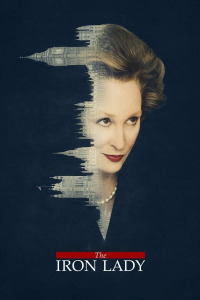
Review of The Iron Lady (2011) by Jerry R — 15 Apr 2013
I suppose that the difficulty in playing Margaret Thatcher is the same as playing Richard Nixon. Both had such well-known, distinct and distinguishable personality traits, and both had been parodied so often, that getting to the meat of the personality without mocking is a daunting task. The first thing to report about The Iron Lady, the new biopic about the life and times of Margaret Thatcher, is effect of the performance of Meryl Streep in the title role. Does she avoid parody? Does she convincingly occupy the person of England's 49th Prime Minister in a manner that convinces us that we are watching the real thing? Not surprisingly, the answer a resounding 'yes'. Streep turns in a brilliant performance, not an impression, but an embodiment. She not only allows us to get inside the mind of one of the most powerful and controversial women of her time, but allows us to feel for her no matter what political side we're on.
Only Meryl Streep could have played her so well. In all of her characters, from Sophie Zawistowski to Lindy Chamberlain to Julia Child to Sister Aloysius, Streep takes great pains to completely lose herself in the character she is playing. Here, she is playing a woman whose every movement is familiar to us. Therefore our scrutiny would seem reasonable, if she can win us over in the impression, then she can sell us the complete performance.
It doesn't take much time to get comfortable with her. We see Streep in the opening scenes as the elder Lady Thatcher, well into her 80s, as she goes about her simple domestic affairs despite the fact that she really doesn't seem to have many. She awakens, has her tea, and talks to her husband Denis (Jim Broadbent). Little bother occurs to her that Denis has been dead for years. Her home is prepared as if he still lived there. She carries on conversations with him, sleeps on one side of the bed, and not infrequently takes trips down memory lane. It is known that Thatcher, now at 86, is suffering health problems, particularly a faltering memory - this is documented in the film - and what Streep does with this is extraordinary. There are moments when she simply stops and looks around her, trying to gather her bearings. When she speaks, the voice is distinctly Margaret, but it is graveled and tired. There's a gait in her walk that tells us that she is struggling with a body that is growing weak and tired. Streep occupies the person of Margaret Thatcher as if she's been there all along.
The scenes in the present-day are a framework for the central core of the film that looks back on her life, from her earliest days as a girl in growing up in Grantam, England (played by Alexandra Roach) where her father teaches her not to run with groups. She seems spaced away from everyone else. Somewhat anti-social, we can see that she has a firm mind, and an eye on the future, yet her expression tells us that she is scared to death of what lies ahead. She meets young Denis (played by Harry Lloyd), and we can see that they are opposites, but never-the-less seem made for one another. She is practical and has her eye on the ball, while he is open-hearted and a bit of a free-spirit. They seem made for one another.
In a few scenes we see Margaret's rise to fame, first running for office in 1951, attracting media attention for her youth and her gender. She's bold, with a good mind and the heart of a lion. She carries, all through her political life, the fierce determination and loyalty to king and country that came from her generation - a generation that learned to spell duty with a capital "D". This is the generation that suffered The Blitz and went on to conquer Hitler and Mussolini. Margaret carries that spirit into her politics and we sense her resolve as she stands up for what she believes in.
All the while, as she suffers the ups and downs of her political career, Denis is right there at her side. The most successful aspect of The Iron Lady are the scenes of Thatcher's domestic life. I expected the issues of her term as Prime Minister but I was surprised by how touching the film is as a portrait of a woman who has lost her husband, friend and confidant, and won't allow herself to let him go. That's the real meat of the story. We get scenes that pass over the familiar struggles of her political life - the IRA, The Union disputes, The Brighton bombing, the Faulklin Islands - but it is her personal story that really grabs our attention.
The scenes depicting Thatcher's political life are overly-familiar and feel somewhat spongue-cleaned. The film is leaned firmly on her side and hardly give us an indication of how and why she became such a controversial figure in British politics. If you don't know much about Margaret Thatcher going into the movie, this won't be a history lesson on who she was as a politician. We see her grandstanding, speaking out against public assistance, but there's something one-sided about the way in which it is portrayed. It is as if she is not allowed to be seen with any negativity. The chronology of events of her political life seem to hit the highpoints, but they are never really given any dramatic weight. Those scenes often feel hurried.
What is clear is that the movie wants to have the same kind of affection for Margaret Thatcher that Stephen Frears' The Queen had for Queen Elizabeth II. The difference is that, that film dealt with a specific period in The Queen's life and didn't try to encompass her entire career. I think that may have been a better approach for The Iron Lady. Perhaps if the film had simply dealt with Margaret Thatcher in the present, it might have been a much more effective film. The scenes depicting the elder Thatcher have much more gravity and weight. We can see the aging of a woman we know all too well. Those scenes have a certain dramatic power and, of course, Meryl Streep's wonderful performance (I am recommending it on that basis), but as for the public image, I think the film needed a little more work.
This review of The Iron Lady (2011) was written by Jerry R on 15 Apr 2013.
The Iron Lady has generally received mixed reviews.
Was this review helpful?