Review of The Ice Storm (1997) by Edith N — 21 Jul 2009
Stillness.
I do not, it should be noted, really remember the '70s. It is not, for obvious reasons, possible for me to remember the time when this movie is set. Much of the background of this movie is distant to me, the product of some arcane past. We just had the fortieth anniversary of the Apollo landing the other day, and somehow, that's more real to me. Now, that may be in part because the knowledge of Apollo is so ingrained in me, so much a part of my being, that I don't remember when I first learned about it. Key parties, not so much. I do understand a lot of the dissatisfaction with life that a lot of these characters experience, though their motivations are distant to me. For one thing, they come from that odd time when divorce was acceptable but still somehow shocking, when it was considered better to stay in a miserable marriage for the sake of the kids than to split up and make everyone feel better. (I have always included the kids in "everyone.") I don't think most of these couples really want a divorce, but I don't think most of them even consider the concept.
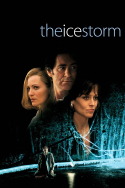
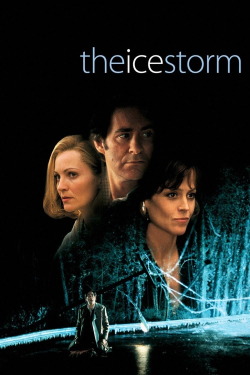
It is 1973 in Connecticut. We are looking at two families, the Hoods and the Carvers. Ben Hood (Kevin Kline) is having an affair with Janie Carver (Sigourney Weaver). Elena Hood (Joan Allen) and Jim Carver (Jamey Sheridan) are faithful but discontented. Wendy Hood (Christina Ricci) is drawn to both Mikey (Elijah Wood) and Sandy (Adam Hann-Byrd) Carver, though each for different reasons. Paul Hood (Tobey Maguire) is away at college, where he is fascinated by Libbets Casey (Katie Holmes), a thing he never should have told his roommate, Francis Davenport (David Krumholtz), who apparently makes his move on any girl Paul is interested in. And then, on Thanksgiving weekend, The Carvers throw a party. Paul goes into the city to see Libbets and Francis at her parents' great Manhattan apartment. Wendy spends the evening with Sandy, and Mikey goes out into the night. There's an ice storm, as the title indicates--it rains, but the temperature drops so fast that the whole of their town is covered in sheets and spikes of ice.
Much can be made of Mikey's retreat into the ice. He has a hard time connecting with the world; I think he is no little afraid of it. He gives a speech to his class about how smell is a product of molecules entering your nose, that when you smell things, you are taking whatever-it-is into your body. This is obviously not something that appeals to him, though I think this is in part because he thinks most about the gross stuff. I've always thought there was a great metaphor in taking in roses or the ocean. He, however, thinks of poo. So he leaves the confusion of the inside, of Wendy, of parents and brother and [i]molecules[/i], and he goes out into the ice, the ice that damps the molecules, that makes everything still. Distant. There is no smell. There is no contact. There is only him. He doesn't even really touch anything. All he touches is ice, and that hardly counts, right?
Then, there's the movie's treatment of sex. (Apparently, it's so close to the book that the author wept during the end credits, so we're looking at the book as well.) Janey, for example, is only interested in sex as far as Ben goes. She doesn't want to hear him talk. She wants him to come in, screw her (it's an appropriately distant term), and go away again. No words. No affection. A cheap affair. Wendy doesn't seem to understand what she wants, which is something I suspect most modern teenagers can't understand. There is the World's Most Awkward Conversation between Ben and Paul as they're returning from the station--no teenager wants to get a lecture from a parent about how masturbating in the shower wastes water and electricity. As for Elena, I think she doesn't know what she wants, but she knows she isn't getting it. For everyone, there is a sense of dissatisfaction that I don't think originates in the sex but is expressed by it. I think Elena is unhappy with Ben, but the only way she can express it is by sexual yearning for other people. Frankly, the most normal person in the two families is Paul, who knows what he wants and just can't get it.
I find Ang Lee's career enchanting and strange. When people think of him, I suspect, they think of [i]Crouching Tiger, Hidden Dragon[/i]--if they know who he is at all. However, his Oscar is from [i]Brokeback Mountain[/i], in theory about as distant a movie as you can get from it at all, and this one is off at another angle from both of those. On the other hand, there are clear parallels of theme between this and [i]Brokeback[/i]. Both are about repression, after all. In fact, based on IMDB, I'd have to say that it's what he works in. In theory, there's very little similarity between the family in [i]Eat Drink Man Woman[/i] and the Dashwoods of [i]Sense and Sensibility[/i]. Adding Bruce Banner into the mix makes it even weirder. But in all cases, there is sublimation of emotion. Anyone in any Jane Austen novel, after all, is trapped by proprieties just as much as Bruce Banner is trapped in the need for people not to make him angry. This is a beautiful film. However, I think it may well work best as a continuation of Ang Lee's portrait of what happens to emotions under ice.
This review of The Ice Storm (1997) was written by Edith N on 21 Jul 2009.
The Ice Storm has generally received very positive reviews.
Was this review helpful?