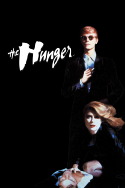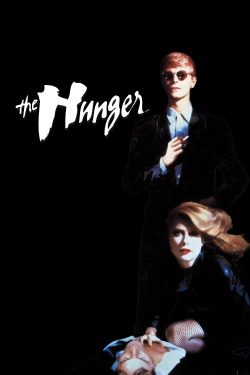
Review of The Hunger (1983) by Edith N — 04 Jan 2010
Bela Lugosi Is Dead; Catherine Deneuve Is Not.
You know, there was a time, not so long ago, when vampires had class. I blame Kiefer Sutherland for the change. As I think we've established, I love [i]Lost Boys[/i]. It's not a good movie, but it's a movie I have always enjoyed. On the other hand, it is the first of the new breed of vampire movies, and we're all just going to have to come to terms with that. Let's face it, you can picture it just as clearly as I can. Star and Michael finish getting turned into vampires, and they sit around writing mopey poetry all the time. And they cut themselves, but it doesn't do anything, because, you know, vampires. For heaven's sake, one of the vampires in that movie is played by Alex Winter. Can you picture Bill playing the cello in a beautiful room with gently-blowing curtains? No, and neither can I. Even Kiefer, no matter what he's done since, doesn't belong among all that art and in that little garden. Oh, they try to put the sparkly ones in that setting, but I'm not falling for it. They're still the Lost Boys sleeping in a hotel that's falling into the sea, and they all need Coreys to come in and slaughter them. That's all I'm saying. But can you see any Corey being able to kill Catherine Deneuve? Because I don't think they'd be able to tear their eyes away from her cleavage, even if they were strong of character enough to approach her at all. We aren't even going to talk about Ted in [i]"Bram Stoker's" Dracula[/i].
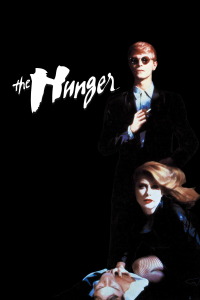
Miriam (Deneuve) and John (David Bowie) Blaylock go to a "disco," where they encounter "disco band" Bauhaus, more on whom anon. They pick up a couple of strangers (John Stephen Hill and Ann Magnuson, who would herself go on to play a Catherine). The strangers do not get what they expect. What they get is brutally murdered so Miriam and John can drink their blood. Because, you see, vampires. Only John is somehow different from Miriam, who created him, and he knows it. He knows his--call it "predecessor" did not have a happy end, and he knows he's undergoing it. He is beginning to age very quickly now, and so he seeks out the famous Doctor Sarah Roberts (Susan Sarandon, playing with sexuality some more), who is trying to find a way to stop aging. Only it's too late for him--but there is no release, it seems. No matter what, he can never die. He can only age and age and age until he's a wrinkled, dried mummy, whom Miriam will then keep in a box in the attic, something she's been doing for a very long time now. Only she doesn't want to be alone, and no ordinary mortal can really be part of her life, because their lives are so short. But Sarah seems like someone who will do.
So Bauhaus. Indeed, so 1983. I have no memory of the band from that year; I wouldn't really become aware of them until high school. (It is also true that I was awfully distracted in 1983, even had I had some source of popular music.) However, were I to think long and hard about a more appropriate song to open our movie with, I would not be able to find it. They aren't disco, and while I think the title is mean to imply "band who played at the disco" and not "band who plays disco," I'm sure they were still annoyed. I imagine their fans have been for twenty-five years. However, I think they were used to great effect, no matter what you call them. There are three distinct places of existence in this movie. There is the part of the movie where there is plenty of anonymous sex--in a few more years, vampirism would be just one more AIDS metaphor--and the Quaaludes Alice (Beth Ehlers) has stolen from her stepmother, the woman afraid of growing older. (This is the world inhabited by 1st and 2nd Phone Booth Youth, also known as Cousin Ira from [i]Mad About You[/i] and Willem Dafoe.) There is the modern, up-to-date 1980s of Sarah and her boyfriend and colleague, Tom Haver (Cliff De Young). Then, there is the step outside time and place into that beautiful building. In that building, there is no Bauhaus--there is Ravel. Even he is exceptionally modern compared to a lot of the rest of the house.
There is, as I said earlier, some interesting sexuality to this film, which is made all the more thoughtful by the choice of cast. David Bowie is, was, and ever shall be David Bowie, with all that implies. His co-stars here are no strangers to the exploration of sexuality, either. We've talked here about [i]Belle du Jour[/i], Catherine Deneuve's turn as an afternoon prostitute obsessed with sadomasochism. We have not talked about [i]The Rocky Horror Picture Show[/i], but do we have to in order for people to remember Susan Sarandon running around in her underwear? She famously refused the original plan of having her character get totally hammered before the sex scene, explaining that no one would have to get drunk in order to have sex with Catherine Deneuve. (This is one of the reasons I scoff at people who call her a closeted lesbian. Do they really think she'd stay closeted?) She also essentially set it up herself. David Bowie's a little more separated from the actual sex, but he is perfectly comfortable with the idea that the companion Miriam had before him was a woman, and the only reason he would be worried about the companion after's being a woman would be the idea that there would be a companion after.
This is an exceptionally stylish movie. The opening sequence, the one at the "disco," is shot in a style I think of as Early '80s Ultra-Modern. There is much cutting back and forth between Peter Murphy and, you know, the killing. There's freeze frame. And so forth. Later, in the more intimate moments, there is soft light and swathes of diaphanous fabric. This contrasts with faux science in the hospital where Sarah and Tom work, doing something I didn't really catch apparently involving making monkeys stop aging or age faster or something. Possibly both. David Bowie's age makeup is pretty amazing, too. The problem, I thought, was that the story got kind of buried in the style. We never really got a clear image of the changes Sarah was undergoing and how she was dealing with them, because what we got was her lying in the dark, twitching, with more of that drapery blowing across her. (Does Catherine Deneuve just keep a fan in the corner of every room?) None of Sarah's colleagues are every really defined, even Tom, whose place in her life is really kind of important. All the movie really seems to care about is being beautiful.
This review of The Hunger (1983) was written by Edith N on 04 Jan 2010.
The Hunger has generally received positive reviews.
Was this review helpful?