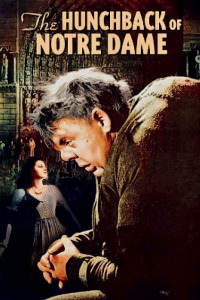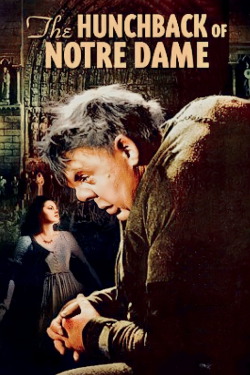
Review of The Hunchback of Notre Dame (1939) by James H — 15 Jun 2009
Why Do They Keep Filming It?
This is literally the last film of the great 1939. It came out on 31 December, at the end of what is generally considered the best year in the history of film. It is a lesser-known version of the story; it isn't the Lon Chaney silent, and it isn't the Disney animated. And, of course, they change the story, because they always change the story. So far as I understand, speaking as someone who was unable to get through the book, no one ever actually ends the movie the way they end the book. My understanding, further, is that a fair number of changes are made to the characters. In short, people want to have the good bits, but they don't really want to get into the depth of the story.
For one thing, let us look at the fascinating Gypsy, Esmeralda. She is played, as all good Gypsies should be, but the extraordinarily Irish Maureen O'Hara. She slips into Paris despite the fact that Gypsies are banned without special permits. She ends up as part of the . . . well, it frankly has a bit in common with Ankh-Morpork's Beggars' Guild, kind of crossed with the lower echelons of the Thieves' Guild as well. Since she is so exotic, she catches the eye of half of Paris, including the dark, mysterious Frollo (Sir Cedric Hardwicke), upstanding French soldier Phoebus (Alan Marshal), and feckless poet Clopin (Thomas Mitchell). Not to mention the titular Hunchback, Quasimodo (here Charles Laughton). Frollo is not at all pleased with his own attraction to the girl, and the plot spirals downward from there.
Or anyway, it would if they followed the book. But, again, no one does. There are several stories along those lines. In part, this is because we feel we ought to celebrate the Great Works. This is Literature, and we all like pretending that we know it. I myself blame all the Literature I haven't read on Ms. Drury, my English teacher from my junior and senior year of high school--she died, and the whole year was thrown into chaos. If it's Literature, and I haven't read it, it's because I was supposed to, senior year. It's not actually as good an excuse as I like to pretend it is, because there's been a while since then where I could have caught up, but at least I have an interest in trying to fix that. (I bought [i]The Canterbury Tales[/i] the other day.) What's more, I acknowledge my ignorance, a thing others tend to blame on the current standards of education. How many times have [i]you[/i] heard the excuse that no one knows the difference?
I'm farther down the lines for the Disney than I was for this one, because the line for Disney is [i]always[/i] long. So we'll be getting to that in a while. The library doesn't even seem to have the Chaney, so I'm going to Netflix it, and I'm in no tearing hurry for it. And, again, I've never gotten through the book. However, I will say that the makeup is striking, and the various performances are, while not on par with much of the greatest of 1939, are certainly worthy. It's another production where you can see the money. Sure, the facade of Notre Dame's a little fake, but it clearly took a lot of work getting it to the level that it is. It's not as though the French would be terribly jazzed about allowing an on-site production, especially given the world situation at the time.
In a way, for all it's a flawed adaptation, this did have a message that the world needed at the time. The Gypsy was innocent. The government was not necessarily right. The will of the people was important, but people can easily turn into a mob. In the end, in this version, Right prevails. Scapegoats are freed. Yes, the movie did also help perpetuate the believe that people thought the Earth was flat at the time, which of course had nothing to do with the real debates of cosmology, but I don't really expect better. The film also shows both the power and the danger of the press, which is all shades of interesting. King Louis XI (Harry Davenport) is fascinated by the whole thing, and one gets the impression that he'll stand up for it against whoever tries to fight it down. Which is not a bad thing, all things considered.
This review of The Hunchback of Notre Dame (1939) was written by James H on 15 Jun 2009.
The Hunchback of Notre Dame has generally received very positive reviews.
Was this review helpful?