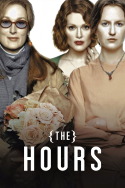
Review of The Hours (2002) by Layne W — 21 Mar 2009
Every now and then, I'll revisit "The Hours," and learn something new about my life. I've seen it countless times, usually when I need to, sometimes when I want to, and most recently, because I didn't have any other choice--my uncle just passed away with AIDS, and for some reason, "The Hours" was weighing heavy on my heart.
I watched it, and found comfort. What is it about great movies that heal the spirit? "The Hours" is one of the most powerful, beautiful films I've seen, and it's a personal favorite of mine.
Every element of the movie is perfectly in place, flawlessly synchronized, gorgeously in balance, on point, in tune--David Hare's immense, fascinating script; Philip Glass' earnest, intense score; the feverishly stellar cast; and finally, the man who combines all these elements into a richly layered, multi-faceted, and emotionally galvanizing motion picture, Stephen Daldry.
As a complete and whole work, "The Hours" is high art, a film that has the depth and potency of great literature (and it should, since it's based on Michael Cunningham's book of the same name, a Pulitzer-prize winner).
More effectively than any film I've seen, "The Hours" deals with themes of life and death, and happiness and sadness, and all human emotions in such a way that we can pick out a character, watch them, and discover ourselves.
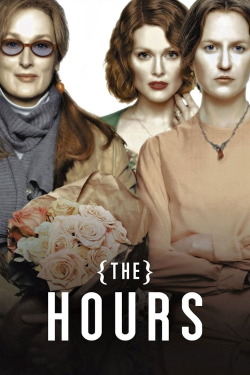
And what a cast: Meryl Streep, Julianne Moore, Nicole Kidman, Ed Harris, Stephen Dillane, Miranda Richardson, Allison Janney, Toni Collette, and John C. Reilly, among others. The supporting cast is sublime, with Ms.
Collette's fascinating five-minute stunner one of the best examples out there of an actress making the most out of her limited screentime. Still, it's all about the trifecta: Streep, Moore, and Kidman.
To say one performance is better than the other would be an error in judgment. All three women are working in unison; this isn't a movie about separate triumphs or stand-out achievements. One of the movie's most intriguing assets is its mixed chronology and the fluidity with which we see Kidman's Virginia Woolf in 1920s Richmond alongside Moore's Laura Brown in 1950s Los Angeles and Streep's Clarissa Vaughan in modern day New York City.
All three women have something to do with the novel "Mrs. Dalloway," from Woolf who's writing it to Brown who's reading it to Vaughan who's living it, in a way. The man she visits, Richard (Ed Harris), an esteemed poet who is dying of AIDS and may have been her lover at one time, calls her "Mrs.
Dalloway." All three women have similar sexual dispositions, since we get hints that Woolf and Brown may be closet lesbians and Vaughan is living openly with her female partner Sally (Allison Janney).
All three women must deal with death, although how and in what ways, I won't reveal. The film is astounding for aspiring actors because of individual "moments," as acting teachers like to call them, in which something seemingly irrelevant will jump off the screen.
It's the way Moore shrugs off her question, "Does Ray have a birthday?" with an insecure, wounded smile; it's the way Kidman realizes the fate of Mrs. Dalloway as she's walking down the street ("She's going to die.
"); it's the way Streep cracks a smile to say, "When I'm with (Richard), yes, I am living." Streep, in particular, does a monumental job of showing a woman reeling under the surface and with her attention always directed behind her into the past.
When she recounts to Louis Waters (Jeff Daniels) the morning in Wellfleet when Richard put his hand on her shoulder and said, "Good morning, Mrs. Dalloway," and when she tells Louis he's courageous for going back to Wellfleet because it meant facing the fact that "we have lost those feelings forever," Streep puts the microscope on a soul that has been damaged by the realization that life didn't go the way she'd hoped.
Moore's speech at the end, in which she doesn't so much plead for forgiveness for her actions but explains her motivations, is bleak and heartbreaking, but so altering for Clarissa that it helps inspire the hopeful look we see on her face as she turns out the lights for the night and perhaps on that chapter in her life.
The scene that may have won Kidman the Oscar is at the train station as she pleads with Leonard to take her back to London, but it's the deep sincerity of her final voiceover that haunts me every time I hear it: "To look life in the face, always to look life in the face, and to know it for what it is--at last, to know it; to love it for what it is, and then to put it away.
" In those few words, she has described the human experience. This is one of my favorite movies.
This review of The Hours (2002) was written by Layne W on 21 Mar 2009.
The Hours has generally received very positive reviews.
Was this review helpful?