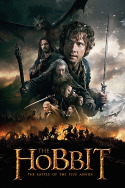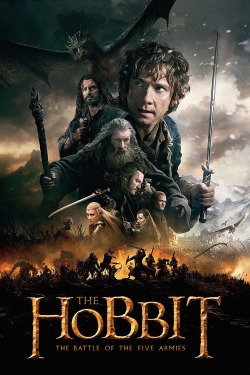
Review of The Hobbit: The Battle of the Five Armies (2014) by Harry W — 20 Jan 2016
With The Hobbit trilogy beginning with a start that was decent at best and followed by a poor middle entry, it was safe to assume that The Hobbit: The Battle of the Five Armies was set into mediocre roots from the start.
The entire Hobbit series has felt like an excessive stretch from start to finish. Despite their production values, the storytelling has been less-than-stellar since there is nothing innovative it can offer in terms of story while always being compared to the groundbreaking Lord of the Rings trilogy (2001-2003). The Hobbit: An Unexpected Journey (2012) had some visual flair but was so slow and short on any feeling of adventure while The Hobbit: Desolation of Smaug (2013) was an example of a film with no story that stretched itself on for far too long before ending halfway through its climax, leaving viewers with cinematic blue-balls. The entire first two films are essentially a lead-up to an action-fuelled climax promised all the more by a title which promises a supposed battle of five armies.
Since the last film ended halfway through its climax, The Hobbit: The Battle of the Five Armies begins by taking off right there and kicking off straight into the action. By this point in the trilogy, Peter Jackson no longer finds it appropriate to even pretend like there is a story worth telling in The Hobbit: The Battle of the Five Armies, and any time he does proves to simply echo the same material already established by superior films. The one major story improvement that The Hobbit: The Battle of the Five Armies makes over its predecessor is being far shorter with only 144 minutes simply because it gives viewers less time to consider how little story there is, increasing the pace of the film.
The script itself maintains the same language of the Middle Earth universe and gives the characters some effective drama even if it lacks much individualistic depth along the way, but this still fails to compensate for the plot-less narrative which is actually nothing more than a front for action. As per generic contract when constructing a trilogy, the final film must go out with a bang. In the case of an epic spectacle along the lines of The Hobbit, The Hobbit: The Battle of the Five Armies does little more than spend its time attempting to create entertaining imagery. In all honestly, the results of this plight are mixed in quality.
Succumbing to the same flaws as its predecessor, The Hobbit: The Battle of the Five Armies is far too computer generated for its own good. While the Lord of the Rings films were shot on location in New Zealand, The Hobbit: The Battle of the Five Armies is essentially a game of Where's Wally where the viewer must determine which selected scenes were not shot on a green-screen set. It is a rare occasion in which they will find it, but one must remain hopeful that somewhere amid 144 minutes is an actual location. What I learned from watching The Hobbit: The Battle of the Five Armies is that the entire trilogy has been less of a universe expansion for the great Lord of the Rings trilogy but rather Peter Jackson's own version of the Star Wars prequel trilogy (1999-2005). While I enjoyed those films, the more I grew up I was able to realize precisely what the flaws in them were. Since The Hobbit: The Battle of the Five Armies comes at an age where I am most critical of cinema, the flaws are easy to spot. Literally serving as a prequel to the Lord of the Rings trilogy, The Hobbit: The Battle of the Five Armies confirms once and for all that there are too many comparisons between its three films and the Star Wars prequels to pass up.
Like the original Star Wars trilogy (1977-1983), the Lord of the Rings trilogy were shot on location and used practical universe building with the addition of groundbreaking visual effects. With The Hobbit trilogy, it follows the Star Wars prequels and uses little more than an extensive collection of green screens to provide its backdrop. There are scenes where characters are doing things as simple as walking over cliff edges while the camera maintains the illusion of a tracking shot, yet the backdrop is artificial and everything looks way too polished. The style of shot takes me back to the cult-classic Highlander (1986) where tracking shots were one of the most iconic visual traits of the film. When the cinematography panned across cliff edges and behind characters, the sights were beautiful. I never thought I'd see the day when the production values of a low-budget production like Highlander were better than anything along the lines of a $250 million blockbuster. You proved me wrong, Peter Jackson. It's more sensible that The Hobbit: The Battle of the Five Armies of all films would make the most use of green screen since it is centred around its titular battle, but it still cannot help but feel overdone. The biggest problem with all this is not just that it is a sign of Peter Jackson's excess of reliance on visual effects over storytelling, but it makes it difficult to believe much of the film since it is always obvious whenever the characters are against a computer generated backdrop. In some sequences you can see that even the costumes of the characters have to be animated since there was no room in the $250 million budget to purchase tangible material and procure something a human.
Being may actually wear. And on top of it all, Peter Jackson once again wastes the time of viewers pretending that adding the 3D gimmick to his film will be of any value. It may distract viewers from the obvious backgrounds by bringing them closer to imagery in the foreground, but it really just ends up shoving the CGI of the film in the face of viewers a lot more. In comparison to the Star Wars prequels, while there is no Jar Jar Binx or Hayden Christensen to drag any of The Hobbit films down, there is no story to actually hold it up which leaves it dangling somewhere in the middle.
As the title clarifies, The Hobbit: The Battle of the Five Armies is all about the battle and must be discussed as such. Succumbing to an endless barrage of visual effects, The Hobbit: The Battle of the Five Armies is little more than an animated film. However, its action sequences are a step up from its predecessor since there is less to distract it this time around. Quite a few of the action scenes end up being a blur since there are too many characters engaged in combat for the viewer to know who to focus on, while at other times the intended focal point is blocked from sight by the countless supporting figures. However, there remains a lot of impressive choreography that the actors perform, even if the cinematography may not consistently give it consistent focus. The cinematography is more focused on grasping the large scale of things, and it does manage to assist in ensuring there is an epic feeling at the heart of The Hobbit: The Battle of the Five Armies. There is certainly a scope of magnificent imagery packed into the film thanks to its production design and costumes. And though the visual effects cannot help but leaving The Hobbit: The Battle of the Five Armies feeling like an animated film more often than not, it is very detailed in certain areas. The first sign of this comes when viewers are once again given the sight of Smaug who has impressive dedication to design. And as the action continues to roll out, viewers are given the best of it all. When the film actually focuses on the more one-on-one combat that occurs during its epic battle, it becomes far more entertaining because there is a clearer focus for the scenes. The characters are more engaging in these moments and their dedication to the battle is clearer. On top of it all, there are a lot of these fights to see in which we witness the versatile skills of each character in putting up a fight. In essence, The Hobbit: The Battle of the Five Armies is heavy on visual effects but uses them to create some impressive action sequences which are ripe with versatility in style and strongly timed editing and sound effects.
On top of it all, the musical score for The Hobbit: The Battle of the Five Armies carries the same style from the Lord of the Rings films with enough innovation to create some new themes. They always grasp the tense mood of the film, the scope of the spectacle and even quite down during the more sentimental moments of the film so the drama can develop naturally.
And though there are an abundance of characters in The Hobbit: The Battle of the Five Armies with only a modicum of any resulting impression being made, the cast keep the life of Middle Earth alive on an emotional level.
Martin Freeman once again leads The Hobbit: The Battle of the Five Armies very well. Though he is hardly given all that much screen time or a chance to get in on the action all that often, Martin Freeman keeps his charms active in the lead role. He remains a likable presence with a friendly nature and keen taste for adventure, but he comes with a new direction to take on the material this time. There are some really emotional moments in The Hobbit: The Battle of the Five Armies where Martin Freeman has to bring Bilbo Baggins to terms with the tragedy around him. He manages to do this instinctively, proving his natural skill in embracing the most intricate dramatic moments of the film. Though there is not much drama for him to work with, Martin Freeman delivers his absolute best during his small period of screen time and remains a powerful lead actor.
And as in the preceding film, Orlando Bloom is a most welcome presence. He is mostly in the film for the sake of paying fan service and spends the majority of his time animated by visual effects, but it is still clearer that Orlando Bloom makes a strong effort. With a true passion for the role of Legolas, Orlando Bloom fuels his role with tense energy so that he puts an effective effort into all the action and delivers his lines with the same serious nature. He sinks so deeply into the part that he lights up the screen with his natural charms any time he shows up, and the skills of Legolas as an action hero remain a highlight for the experience.
Richard Armitage also brings a lot to his role. With a fighting spirit that burns very much throughout The Hobbit: The Battle of the Five Armies, Richard Armitage keeps the intense mood of the film alive. Without having to say all that much, Richard Armitage brings the tension with him through his mere facial expressions before transferring them into all his movements throughout the action scenes. He puts up a strong fight and doesn't hold back with any of his determination, ensuring that he plays an engaging part in the spectacle of battles. Richard Armitage takes a good stand amid the cast.
Luke Evans also delivers a notable effort, and the returning charms of both Ian McKellen and Christopher Lee are always welcome.
So The Hobbit: The Battle of the Five Armies offers no end in sight to a long barrage of CGI and a shortage of storytelling, but its spectacle of action and talented cast make it an improvement over its predecessor and a half-decent closure to the trilogy.
This review of The Hobbit: The Battle of the Five Armies (2014) was written by Harry W on 20 Jan 2016.
The Hobbit: The Battle of the Five Armies has generally received positive reviews.
Was this review helpful?