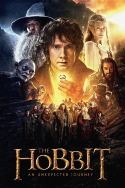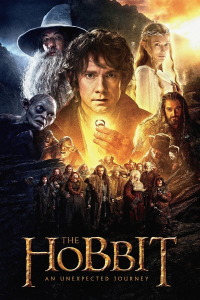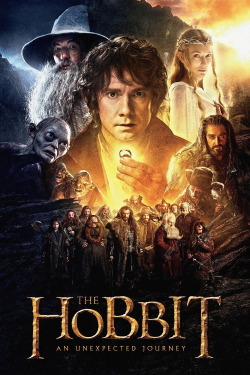
Review of The Hobbit: An Unexpected Journey (2012) by Celt1991 — 11 Dec 2013
Let me begin by saying that I had high hopes for this film.
With that out of the way, let's get to the meat of the thing:
"The Hobbit: An Unexpected Journey" certainly starts off on the right track; a hobbit, knowing nothing of theLet me begin by saying that I had high hopes for this film.
With that out of the way, let's get to the meat of the thing:
"The Hobbit: An Unexpected Journey" certainly starts off on the right track; a hobbit, knowing nothing of the world at large, is chosen by a wandering wizard as the prime candidate for a great adventure.
While this beginning is quite faithful to the book, that is where the similarities end.
I can truthfully say that just moments after the introduction, my facial expression changed from one of joy to one of disappointment and scorn.
While it is true that Bilbo Baggins was a somewhat 'reluctant' burglar, the dwarves and wizard did not simply cast him off as if he were not needed. They knew the importance of having a burglar to steal inside the Lonely Mountain, and Gandalf had very high hopes for Bilbo. In the Jackson adaption, we are shown that, while the company would prefer to have Bilbo be a part of their quest, they could do fine without him.
After Bilbo chases the dwarves down and convinces them that he wants to accompany them, Jackson strays further off the beaten path; he actually ruins two chapters at once.
Instead of sending Bilbo to scout the troll camp and possibly hone his burgling skills, he is sent to retrieve the company's ponies, which the trolls have captured. Now, this is a very important deviation from the book, as it changes the motivation of the goblins' capture of the dwarves and hobbit.
After the episode with the trolls and a quick stay at Rivendell, the dwarves begin their way through the Misty Mountains. After nearly being killed in a fight between Stone Giants, they make camp in a small cave. Instead of attempting to steal the dwarves' ponies, the goblins steal the dwarves.
This is where the worst deviation from the book occurs; instead of capturing the dwarves as they struggled to free their ponies, the goblins capture the dwarves because an ancient Orc named Azog has put out a bounty on them.
Now, according to both "The Hobbit" and the appendices of the "Lord of the Rings", Azog was killed by Dain Ironfoot years before the events of "The Hobbit" took place. Now, this may not seem like a serious problem, as Azog was a minor character, but in bringing him back as the main antagonist Jackson has derailed the entire film series. Instead of the quest being "reclaim the treasure of Lonely Mountain", the quest is now "defeat an ancient Orc and reclaim the Lonely Mountain itself". Jackson, in an attempt to stretch the story, has destroyed the original premise of the dwarves' journey. In making Azog a main antagonist, he takes the focus away from Smaug the Great, a much more deadly adversary, and changes the dwarves from artisans to warriors.
The feel of the book is gone. Instead of crafting sequences around the events of the book, Jackson creates a jigsaw puzzle, half book/half script.
While many may argue that this is a plot device to build Bilbo's character, that can be disputed.
In the original book, Bilbo Baggins gradually changed into a stronger person. In the films, he is portrayed as always being of a strong will, and just never having the chance to show it. By going this route, much of Bilbo's ongoing growth is lost, and his character suffers for it.
Jackson obviously did not trust this film to register with audiences familiar with the source material, and, with that in mind, changed the story to suit those only familiar with his previous films. By inserting Galadriel, Frodo, Radagast, and the 'cute' Sméagol, he gains the support of Trilogy fans, but at what cost?
Answer: Faithfulness to the original book.
While the scene with Galadriel could be seen as an adaptation of events from the LOTR appendices, the 'cute' Sméagol cannot. Gollum/Sméagol is meant to be seen as a frightening, wretched creature; the book again and again explains that Bilbo feared for his life during the riddle competition. Why then did Jackson include the 'tame' Sméagol from the LOTR Trilogy? Because he knew it would register with fans of those films.
In conclusion, I see this adaptation of "The Hobbit" as a way for Peter Jackson and New Line to profit from the LOTR Trilogy all over again. By grafting certain parts of the Trilogy onto "The Hobbit", New Line and Jackson are ensured that at least some of those fans will fork out money to watch three more films. I see this film not as an artistic exercise but as a cash cow. That is all.
This review of The Hobbit: An Unexpected Journey (2012) was written by Celt1991 on 11 Dec 2013.
The Hobbit: An Unexpected Journey has generally received positive reviews.
Was this review helpful?