Review of The Heiress (1949) by Everett J — 09 Jun 2008
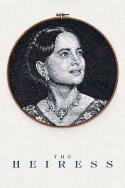
The Heiress.
Directed by William Wyler.
Written by Augustus and Ruth Getz.
Based on the play by Augustus and Ruth Getz.
Starring Montgomery Clift, Olivia de Havilland, Ralph Richarson, Vanessa Brown.
Ah, the brutality inherent in the myriad processes that inform human love. The fight for dignity in the face of so much emotional distress can kill anyone who falls prey to its cruel machinations. In this film, two people approach each other with distinctly different intentions that are slowly revealed to each character as the film approaches a great and terrible mystery. The film proves to be a tense, gloriously photographed study of socially proscribed etiquette that is both well-orchestrated ans stifling for those who exist firmly outside its strict formulations.
Catherine Sloper (de Havilland) has always done what her father, Dr. Austin Sloper (Richardson) has told her to do. She?s the perfect meek, docile daughter who can never bring herself to speak in polite company. In truth she?s capable of expressing herself but the pressures of society tend to tie her tongue so nothing of interest comes out. Her father recognizes this trait and despises her for it. He truly hates her for her lack of grace, manners, compatibility, etc. because he is convinced his dead wife was rich in such characteristics. Catherine is at another drab party where she is desperately trying (and failing) to make an impression, she meets the elegant and suave Morris Townsend (Clift). There is immediate tension between these two that is palpable as they dance. Quickly they are seeing more of each other and this leads to a proposal of marriage which Dr. Sloper rejects on the grounds that Morris is only after Catherine?s inheritance which will kick in when the doctor dies.
The conflict between staunch authority and thoughtless bliss is exploited throughout this picture. Dr. Sloper represents a rigid, solid constancy and he believes that hard word is a virtue. He loathes Morris because he has no job and no prospects and cannot allow his only daughter to marry a man who will waste her money. This is the old order of law and order. The film takes place in the 1850's America and possesses a genuine spirit of gaiety and regulation. In this society everyone knows their place and there are strict penalties for anyone who even makes an attempt to deviate from the norm. Morris is a deviant who must be put in his place. He has no right to pretend he belongs to high society because he is, in Dr. Sloper?s eyes, so incapable of putting his best effort forward come what may.
The contrast between the rational mind and the emotional realm of the imagination and the complexities of love give this film a poignancy that allows it to ask necessary questions. What is more important?financial viability or devotion? What are the necessary practicalities of life? Is it possible to truly love somebody who is incapable or unwilling to make their own way in the world if you are the one continuously footing the bill? Society in this period, much like now, did not reward ne?er-do-wells or essentially lazy individuals whose only intention is to live off of the good graces of others.
Morris is presented in just this light. He loafs about in a state of entitlement, surviving entirely on his charm and easy manners, never having to exert himself to earn his bread in any way. He has a calming effect on Catherine who is a jumbled confusion of nerves who is prone to great pangs of emotional distress at any time, anywhere. She exchanges her dedication to her father to Morris at great peril. She worships him and is pulled in by his ease and his ability to speak well whether he had anything interesting to say or not. There is a gentle element of true emotional between these two as they go about the arduous task of getting to know one another in a climate that is hostile to their interaction. They struggle at every turn and there are numerous awkward silences as Catherine clumsily tries to find the words that express her feelings to Morris. Mostly she just studies him and nearly swoons now and again which firmly articulate her approach to Morris and her reliance upon him for her emotional bearings.
This story is filled with dramatic emotional moments where the action is halted and an entirely new and strange arc is introduced. It follows a traditional narrative structure but there are several points where the narrative is dislodged and sent skidding. One of these instances comes when Morris is turned down by Dr. Sloper and forced to recede back into the darkness. From that point, any talk or pursuance of marriage is a deliberate violation of the code and a breach against the proper order of things. It?s the first act of rebellion. Any attempt to circumvent the rational, economical, material reality of modern life is considered as severely as an attack attempting to disprove the existence of god. Dr. Sloper carries himself as if he were a god, at least in his own house. His word is the only one that matters on any issue of grave importance and moreover he believes stringently in his ability to keep the stars aligned and the sun in the sky in his own, peculiar universe.
The relationship between Catherine and Morris can be read as a definitive break from the old order where emotions are frowned upon and certainly not considered as proper barometers for the edicts of proper, necessary society. Yet it also points to the near impossibility under most circumstances to effectively make a total breach of controlled, practical means of existence. Money and status are held up as ideal goals for anyone who dares to make something substantial of himself. Women are merely supposed to take husbands with the best prospects in these areas and forget about the trivialities of love which are a product and not a precedent of the marriage question. Catherine makes the mistake of falling in love with a young man who is unable to provide wealth or security and in this case the roles would be reversed as she would be the one with the money and quite understandably, the power. Such a power shift is unthinkable in this codified society and subsequently Dr. Sloper rejects Morris as a perspective son-in-law.
The performances in this film are quite effective throughout. Montgomery Clift exudes charm and a general aloofness and manages to create a character of a sustained mystery throughout. Clift maintains a brooding intensity that lures Catherine, who is entrapped in his web, kicking her feet in a desperate attempt to break free. The mysterious qualities of Morris?s character are both frightening and exciting for Catherine as Morris is practically the first man who has ever come along to treat her as the center of his universe. Clift conveys an uncertainty with Morris that informs every gesture he makes.
Olivia de Havilland demonstrates a protracted sadness throughout the film. She gives her character a decisive melancholia that is only broken by her relationship with Morris. Otherwise, Catherine is gloomy, dejected, confused and exceedingly lonely. She wiles away her time with embroidery and has shown an aversion to the social scene. De Havilland is graceful in her character?s awkwardness. She conveys an unease that nevertheless gives her character a strange kind of grace. There is a coldness to Catherine which works itself out in the film?s glorious conclusion which I consider one of the most emotionally satisfying endings I?ve found in film.
Ralph Richardson plays Dr. Sloper as the embodiment of the self-made man. He?s well-respected, projects an air of absolute authority, and manages to conceal anything remotely approaching an emotional life. He?s closed off and entirely divorced from the emotional reality his daughter exists in. Richardson ably convey Dr. Sloper?s arrogance as well as the futility of his position. All his money and prestige prove no match for the ravages of age and disease.
Overall, this film shows how order and the illusion of permanence tend to disavow the confusion and chaos that are revealed in those who give into to the tyranny of their emotions. The correct and only way of dealing with emotions, according to the characterization of Dr. Sloper, is to never allow the emotions to rule the intellect. To do so is to risk losing one?s footing which in Dr. Sloper?s case was built in accordance to the edicts of his primary will. Marriage is only of practical concern and must only be entered into if all measures are in place that will insure financial solvency well into the future. This viewpoint isn?t entirely disputed as the film reaches its startling conclusion. In many ways the ending cements the position of Dr. Sloper but merely as an exercise of reestablishing the correct order that is unduly threatened.
Ultimately this is a film about power and how circumstances often force one to wield it. Olivia de Havilland conveys her character?s drab, sunken-in appearance in the film but once she gains her inheritance, her entire countenance changes and she obtains an elegance and posture that is painfully beguiling. She?s already demonstrating her newly acquired power and it appears most readily in the spark of vehemence that lies in the depths of her eyes.
This review of The Heiress (1949) was written by Everett J on 09 Jun 2008.
The Heiress has generally received very positive reviews.
Was this review helpful?